June 27, 2010

Sun Ra Sunday

FLIGHT

What I thought I am
I am not
What was and is
Is not
What dreams were mine
I am not
What was and is
Is not
The laughter, the tears
The fleeting years
Are not
Gone like a sigh
Or a bird swift
In sudden flight.

-- Sun Ra

June 26, 2010

Playlist Week of 6-26-10

* Venice Baroque Orchestra (Marcon/Carmignola): Concerto Veneziano (Archiv Prod. CD)
* Venice Baroque Orchestra (Marcon/Carmignola): Concerto Italiano (Archiv Prod. CD)
* A. Scarlatti: Il Gardino di Rose (Accademia Bizantina/Dantone) (Decca SACD)
* Vivaldi: Cello Sonatas (ter Linden/Mortensen) (Brilliant Classics 2 CD)
* J.S. Bach: The Works for Lute (Kirchhoff) (Sony Classical 2CD)
* J.S. Bach: Violin Sonatas (Manze/Egarr/ter Linden) (Harmonia Mundi 2CD)
* John Patton: Accent on the Blues (Blue Note CD)
* Bobby Hutcherson: The Kicker (Blue Note CD)
* Bobby Hutcherson: Dialogue (Blue Note CD)
* Sun Ra: Slug’s Saloon 6-07-72 (AUD 2CDR)
* Sun Ra: Slug’s Saloon 8-19-72 (AUD 3CDR)
* Sun Ra: Lanquidity (Saturn/Evidence CD)
* Herbie Hancock/Wayne Shorter Quartet: Theatre du Chatelat, Paris 7-04-04 (FM 2CDR)
* Anthony Braxton 12+1tet: 9 Compositions (Iridium) 2006 (d.4) (Firehouse 12 9CD+DVD)
* Olu Dara: Neighborhoods (Atlantic CD)
* Aretha Franklin: I Never Loved a Man the Way I Loved You (Atlantic/MFSL CD)
* Led Zeppelin: Mothership (Atlantic 2CD)
* Chicago: Chicago Transit Authority (Rhino 2LP)
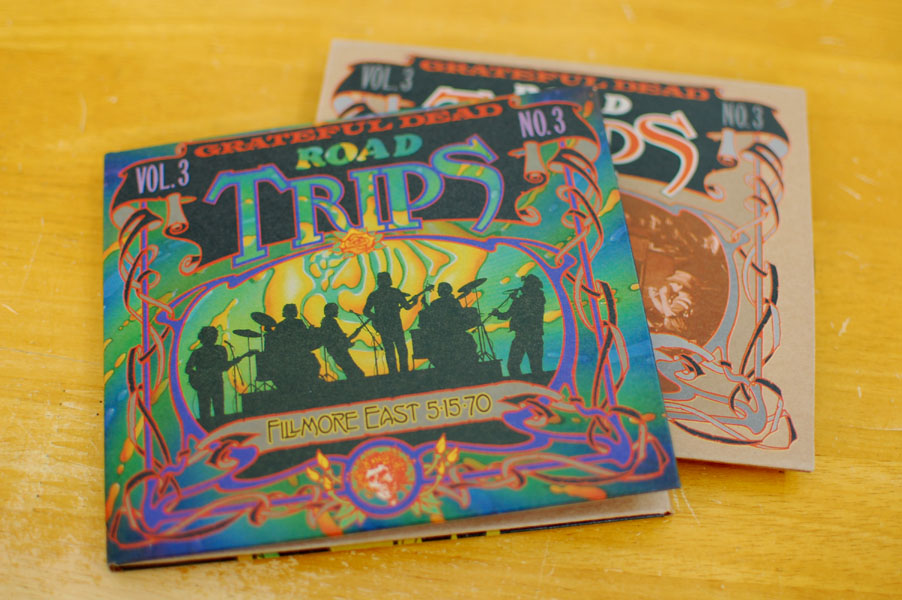
* Grateful Dead: Road Trips, Vol.3, No.3: Fillmore East 5-15-70 (GD/Rhino 3+1CD)
* Grateful Dead: Madison Square Garden, New York, NY 9-08-91 (SBD 3CDR)
* Grateful Dead: Madison Square Garden, New York, NY 9-09-91 (SBD 3CDR)
* Grateful Dead: Madison Square Garden, New York, NY 9-10-91 (SBD 3CDR)
* New Riders of the Purple Sage: Fillmore East, New York, NY 5-15-70 (SBD 2CDR)
* The Band: Rock of Ages (Capitol/MFSL SACD)
* Van Morrison: Wavelength (Polydor CD)
* Can: Soon Over Babaluma (Spoon SACD)
* Talking Heads: 77 (Sire/Warner Bros. DVD-A)
* Robert Pollard: We All Got Out of the Army (GBV, Inc. LP)
* Robert Pollard: Moses on a Snail (GBV, Inc. LP)
* Radiohead: Amnesiac (Capitol CD)
* Radiohead: “Pyramid Song” (Capitol CDEP)
* Radiohead: “Knives Out” (Capitol CDEP)
* Animal Collective: Campfire Songs (Paw-Tracks CD)
* Animal Collective: Here Comes the Indian (Paw-Tracks CD)
* Animal Collective: Sung Tongs (Fat Cat CD)

Commentary:

The new Road Trips is the first three-discer in the series (actually, four discs including the limited “bonus disc” -- more on that later). It contains most of the Grateful Dead’s epic performance at the Fillmore East on May 15, 1970, a classic show that has circulated widely in trading circles for forever. One has to ask: is it worth it? In my estimation: for a measly twenty-five bucks, yes. The sound quality is much improved, being sourced from the original vault masters and while purists may squawk about the editing decisions and the use of dynamic range compression, it is a smooth, coherent presentation of this music.

And what music! Jerry Garcia and Robert Hunter were writing whole batches of wonderful new songs that drew on their shared interest in old-time string band styles; Grateful Dead concerts were starting to sound more overtly country than outré psychedelic. By the spring of 1970, they were opening their concerts with intimate acoustic sets wherein these new songs were introduced (“Uncle John’s Band”; “Black Peter”; “Friend of the Devil”); obscure covers were given impromptu airings (“Long Black Limousine”; “The Ballad of Casey Jones”; “Silver Threads and Golden Needles”); and ending with a white gospel standard (“Cold Jordan” or “A Voice from On High”). Their touring companions, New Riders of the Purple Sage, would then play a set featuring Garcia on tangy pedal steel (!) and the Grateful Dead would conclude the evening with two more electric sets peppered with more of these tantalizing Garcia/Hunter tunes which sound like they were already a hundred years old (“Cumberland Blues”; “Dire Wolf”).

The pair were an uncannily copasetic songwriting team and the subsequent outpouring of songs came to define Garcia’s musical persona. But here Garcia is still trying to find his singing voice, affecting at times a faux-southern accent or at other times reverting to the acidized howl of the primal period. It would take another year or so for Garcia to grow into these songs. Even so, this set is a delight from beginning to end. The casual banter between the band and audience is charming and Pigpen is in fine form throughout, but especially on the concluding thirty-minute rave-up, “Turn On Your Lovelight,” hectoring the audience to “take your hands out of your pockets and do something!” while the band rages away modally behind him. Good stuff. Despite the good-timey vibe, if you listen closely you can hear the ghosts of Kent State hovering over the proceedings in the startlingly volatile outbursts of “off the pigs” and other counter-cultural rhetoric emanating from the stage from time to time. It was the ugly end of a utopian era -- and the beginning of a modern, professionalized Grateful Dead. In later years they would say almost nothing to the audience for fear of undue influence on their rabidly devoted (and possibly chemically altered) fans.

The annoyingly ultra-limited edition “bonus disc” is, of course, essential, containing six more songs from the May 15 concert, including gorgeous renditions of then-new Garcia/Hunter songs, “Candyman” and “Attics of My Life” as well as an electrifying forty-plus minutes from the previous night’s show in St. Louis. These things go out of print quickly, so if you’re interested in having the whole enchilada, you better act now. Even if the bonus discs are all gone, Road Trips Vol.3, No.3 is definitely top shelf Grateful Dead. Only available at dead.net.

It's Summertime!


Butterfly 2010-06-26a, originally uploaded by Rodger Coleman.

It's hot as heck, crazy thunderstorms arise out of nowhere, and the bugs are in abundance. That's not all bad; among the insects are magical fireflies at twilight and these iridescent indigo butterflies. This one didn't like me waving the camera at him, but this shot came out OK. Such amazing creatures, flying flowers, as evanescent as summertime.

June 20, 2010

Sun Ra Sunday

Sun Ra & His Arkestra: Slug’s Saloon, New York, NY 6-07-72 (AUD 2CDR)

When Sun Ra & his Arkestra returned to the east coast in May of 1972, they were welcomed back to Slug’s Saloon, the legendary Lower East Side nightclub where the Arkestra regularly held court from 1966 until their departure to California in 1970. But things were not the same: On February 19, trumpet star Lee Morgan was shot to death at the club by his enraged girlfriend further scaring audiences away from what was already well known as a rough neighborhood. By the summer, the club was on its last legs and would shut its doors for good shortly thereafter (see Szwed pp.218-220). So the Arkestra’s residencies at Slug’s during the summer of 1972 were both festive homecoming and sad farewell to an unusually supportive New York City venue. Fortunately for us, most of a complete set from their appearance on June 7 was recorded from the audience and circulates amongst devoted collectors. The mono tape recording sounds pretty decent for the period although it suffers from all the usual sorts of problems: generational loss, assorted glitches and drop-outs, general muddiness and, sometimes, outright distortion. If you’re willing to tolerate such anomalies, then it is well worth seeking out this spectacular performance.

While the core musicians remained faithful to Sun Ra’s vision, The Arkestra’s extended membership was, as usual, in flux. Once again left without a bassist, Alzo Wright steps in with some barely audible cello while Akh Tal Ebah replaces mainstay Kwami Hadi on trumpet, giving him an opportunity to step out from the shadow of Hadi’s showy virtuosity. For all that, the band sounds well-rehearsed and they tackle a bunch of new Ra compositions and re-arrangements with gusto. After an opening improvisation for arco cello and oboe followed by a long percussion work out, another unknown number in the “Discipline” series arises, this one fulminating with regal pomp. Moments later, another unknown title gets its first (and perhaps only) hearing: an agitated ostinato in 7/4 held together by Danny Ray Thompson’s relentless riffing on baritone sax. “They’ll Come Back” gets a dramatic vocal performance from June Tyson and ends with a brief but exquisite moment of “Strange Strings”-style orientalism. Ebah’s smeared tonality contrasts nicely with the churning skronk on “Calling Planet Earth” and, after a short statement of “Theme of the Stargazers,” “Discipline 11” is given a gospel-ish reading via spirited drumming from Lex Humphries with Ra’s aggressive organ solo pushing the band to ecstatic heights of electro-free-jazz intensity. Wow. This is a superb version of this rarely heard composition.

Another under-performed piece, “Somewhere Else,” gets an interesting (if somewhat tentative) reading here, with John Gilmore staking out the harmonic areas a cappella before the Arkestra enters with the oddly swinging, interlocking riffage. Ra takes one of his patented barbequed organ solos before Ebah attempts his own high-register acrobatic act, showing he was Hadi’s equal in terms of brilliant ideas, if not in their flawless execution. Personally, I love Ebah’s warm, mellow tone and find his blurry articulation endearingly expressive. A quick run through “Enlightenment” is followed by a typically grooving “Love in Outer Space” with Sonny rapturously vamping away on the organ throughout. Yet another unknown “Discipline” number follows, this one in the swinging big-band mold with multiple riffs colliding over swelling chords. Sadly, the tape is marred by numerous drop-outs, obscuring the composition’s subtle intricacies. As the drums devolve into more tribal sorts of rhythms, Gilmore takes a truly incendiary solo on tenor sax that gradually but insistently pushes the band towards its ultimate destination: “The Shadow World!” As the sound quality of the tape begins to improve, Sun Ra lays down the enervating chord sequence at a blindingly fast tempo. Astonishingly, the Arkestra erupts with a note-perfect rendition of this fantastically complicated composition. This inspires a tense, “mad-scientist-style” organ solo, Sun Ra spraying cluster-bombs of notes about the room with wild abandon, much to the crowd’s obvious delight. Not to be outdone, Gilmore returns with another blistering solo before the band returns with a tight reprise. Outstanding! Shifting gears, Sonny plays a pretty organ interlude over a set of melancholically descending chords which serves as an introduction to another unknown “Discipline” number. This one sets a pair of repeating, minimalist horn figures to balance atop the polyrhythmic rhythm section while Ebah blows a long-breathed, minor-key melody on top. Interesting. Danny Davis (or is it Marshall Allen?) takes flight on alto sax before a relatively brief drum solo which introduces a rare performance of “Angels and Demons at Play” in its recent bare-bones rearrangement. Unfortunately, the band still sounds unsure of itself and, after failing to coalesce, Sonny cues up “Watusi” which eschews the head for another tumultuous tenor solo from Gilmore before the extended percussion jam -- although Ebah can be heard wailing away in the background throughout. The tape cuts off shortly thereafter.

The Arkestra appeared once more at Slug’s a month later and again surreptitiously recorded from the audience (we'll take a listen to that one next time). Both of these gigs have been compiled into a six-disc box set by the Transparency label, purportedly with improved sound and approximately thirty minutes of additional material, but I have not heard it and do not know anyone who has. Can anyone out there in Internetland comment on this? These performances are so good I would gladly pay for an improved mastering of these recordings. Until then, I’m happy to have these widely-circulated “bootlegs,” despite their obvious flaws.

June 19, 2010

Playlist Week of 6-19-10

* Vivaldi: Double Violin Concertos (VBO/Marcon/Carmignola/Mullova) (Archiv Prod. CD)
* Geminiani: Cello Sonatas, Op.5 (ter Linden/Mortensen) (Brilliant Classics CD)
* Handel: Solo Sonatas, Op.1 (AAM/Egarr) (d.1) (Harmonia Mundi 2CD)
* Handel: Trio Sonatas, Op.2 & Op.5 (AAM/Egarr) (Hamonia Mundi 2CD)
* J.S. Bach: Das Wohltemperierte Clavier, Vol.2 (Egarr) (Harmonia Mundi 2CD)
* Schoenberg: String Quartets (Arditti) (d.2) (Montaigne/Naïve 2CD)
* Sun Ra: Slug’s Saloon, New York, NY 6-07-72 (AUD 2CDR)
* Sun Ra: Strange Celestial Road (Rounder CD)
* Grant Green: Idle Moments (Blue Note CD)
* Grant Green: The Complete Quartets with Sonny Clark (Blue Note 2CD)
* Herbie Hancock: Thrust (Columbia CD)
* Herbie Hancock: Arena Santa Giuliana, Perugia, Italy 7-16-08 (FM 2CDR)
* Evan Parker Electro-Acoustic Ensemble: The Moment’s Energy (ECM CD)
* Shine: Heaven and Hell (Innerrhythmic CD)
* Kip Hanrahan: Days and Nights of Blue Luck Inverted (American Clavé/Pangaea CD)
* Kip Hanrahan: Exotica (American Clavé CD)
* Olu Dara: In the World: From Natchez to New York (Atlantic CD)
* Bob Dylan: Bringing It All Back Home (mono) (Columbia/Sundazed LP)
* Bob Dylan: Highway 61 Revisited (mono) (Columbia/Sundazed LP)
* Bob Dylan: Infidels (Columbia SACD)
* Grateful Dead: Winterland June 1977: The Complete Recordings (6-8-77) (GD/Rhino 9+1CD)
* Grateful Dead: The Horizon, Rosemont, IL 3-10-93 (SBD 3CDR)
* Grateful Dead: The Horizon, Rosemont, IL 3-11-93 (SBD 3CDR)
* King Crimson: The Great Deceiver (Live 1973-1974) (d.1) (DGM 4CD)
* U2: The Unforgettable Fire (Deluxe Edition) (d.1) (Island/Universal 2CD)
* Robert Pollard: Moses on a Snail (GBV, Inc. LP/CD)
* Animal Collective: Spirit They’re Gone…/Danse Manatee (Fat Cat - UK 2CD)
* Animal Collective: Strawberry Jam (Domino CD)
* Animal Collective: Water Curses (Domino CDEP)
* Animal Collective: Merriweather Post Pavilion (Domino CD)
* Animal Collective: Fall Be Kind (Domino CDEP)

Commentary:

Robert Pollard’s umpteenth solo album is (despite its cheesy cover) an undeniable late-career triumph. As you know, I’m a huge fan and love to obsessively collect the endless stream of records the guy puts out. But regular folks are likely put off by the sheer volume of releases and unlikely to even stick a toe in the ever-expanding discography (especially with a cover like that). So it’s too bad that Moses on a Snail will likely not be heard by the huge numbers of people out there who would undoubtedly enjoy Pollard’s mature song-craft. At age 52, Pollard still believes in the redemptive power of rock music and, with longtime collaborator Todd Tobias, has just released his most immediately enjoyable album since 2008’s Off to Business. (That was, by the way, several albums ago.)

Sure, Pollard can’t hit the high notes the way he used to with Guided By Voices, but his voice remains an instrument of vast and subtle range, from a cockney-esque drawl to blue-eyed crooning; from strutting rock godhead to frail, vulnerable folkie to every other musical persona imaginable. Yet Pollard always sounds like his own inimitable self, singer and song united in a convincingly charismatic whole. And here Pollard delivers one of his most focused and impassioned vocal performances in ages. The songwriting is also consistently compelling with the typically elliptical lyrics conveying an unusually somber tone. Meanwhile, Tobias’s deft multi-instrumentalism and layered production style provides slickly polished yet respectfully weighty musical settings perfectly tailored to each song, contributing to the album’s beginning-to-end coherence. From the stately, strummy opener (“The Weekly Crow”) to the conclusion of the epic, hard-rocking title track, Tobias consistently demonstrates a profound sensitivity to Pollard’s uniquely quirky musical vision as well as a mastery of the art of record-making. Tobias has, over time, become Pollard’s most perfect amanuensis.

Not due in stores until next Tuesday, my copy arrived in the mail yesterday and (in an unusual move for me) I’ve been listening to it over and over ever since. It’s just that good! Thankfully the LP comes with a free copy of the CD or I would be relentlessly wearing away the grooves of the limited edition vinyl. Moses on a Snail is an instant classic (never mind the cover).

+++

Re: Animal Collective. It took a while, but I get it now. That means I have to hear the rest of it. Fun!

Pileated Woodpecker (mother feeding juvenile)

This isn't the sharpest photograph ever, but today I was lucky to catch a mother Pileated woodpecker feeding some of our suet to her young. Such amazing birds! It makes me happy to see them thriving in our back yard.

June 13, 2010

Sun Ra Sunday

THE SHADOW OF THE FIRE

The vibrations of the sounds seem the same
But the meaning of the sounds
Take separate directions
At the crossroads
of the Cosmic point of the arrow…
Beyond this Age
Through the darkness of the light years
And the light years of the darkness
And the pure darkness of the pure light.
The light is as the darkness
Because the light is the image
And the shadow of the fire.

-- Sun Ra

June 12, 2010

Playlist Week of 6-12-10

* Buxtehude: Sonatas, Op.1 (Holloway/Mortensen/ter Linden) (Naxos CD)
* J.S. Bach: Das Wohltemperierte Clavier, Vol.1 (Egarr) (Harmonia Mundi 2CD)
* Vivaldi: Violin Concertos, RV331, etc. (VBO/Marcon/Carmignola) (Archiv Prod. CD)
* Duke Ellington: The Great Paris Concert (Atlantic 2LP)
* Sun Ra: Astro Black (ABC/Impulse! LP>CDR)
* Bobby Hutcherson: Happenings (Blue Note CD)
* Evan Parker Electro-Acoustic Ensemble: Stadtgarten, Köln 5-13-10 (AUD 2CDR)
* Evan Parker Electro-Acoustic Ensemble: WDR, Bismarck-Saal, Köln 5-14-10 (AUD CDR)
* Herbie Hancock: Sextant (Columbia CD)
* Herbie Hancock & Headhunters: Sendsaal, Bremen, W. Germany 11-6-74 (FM CDR)
* Pat Metheny Group: The Road to You (Geffen CD)
* Sly & The Family Stone: A Whole New Thing (Epic/Sundazed LP)
* Bob Dylan: The Times They Are A-Changin’ (mono) (Columbia/Sundazed LP)
* Bob Dylan: Another Side of Bob Dylan (mono) (Columbia/Sundazed LP)
* Bob Dylan: The Freewheelin’ Bob Dylan (mono) (Columbia/Sundazed LP)
* Jeff Beck: Truth (mono) (Epic/Sundazed LP)
* Jeff Beck: Beck-Ola (Epic/Sundazed LP)
* The Who: Who’s Next? (Decca LP)
* The Who: Who Are You? (Polydor/Classic LP)
* Grateful Dead: Winterland June 1977: The Complete Recordings (6/7/77) (GD/Rhino 9+1CD)
* Jerry Garcia Band: After Midnight: Kean College 2/28/80 (Rhino 3CD)
* Yes: The Yes Album (Atlantic/MSFL CD)
* Yes: Fragile (Atlantic/MFSL CD)
* Genesis: Selling England By the Pound (Charisma LP)
* Can: Unlimited Edition (Spoon SACD)
* Saturday Night Fever (original soundtrack) (RSO/Polydor 2LP)
* Big Star: Radio City (Ardent/Classic LP)
* Boston: Boston (Epic LP)
* The Feelies: The Good Earth (Coyote LP)
* Los Lobos: Kiko (Slash/Warner Bros. CD)
* Guided By Voices: Do the Collapse (TVT CD)
* Robert Pollard: Motel of Fools (Fading Captain EP)
* Robert Pollard: Robert Pollard Is Off to Business (GBV, Inc. CD)
* Robert Pollard: “Weatherman and Skin Goddess” (GBV, Inc. CDEP)
* Circus Devils: Ringworm Interiors (Fading Captain Series LP)
* Radiohead: I Might Be Wrong: Live Recordings (Capitol CD)
* Animal Collective: Merriweather Post Pavilion (Domino CD)
* Animal Collective: Fall Be Kind (Domino CDEP)

Reading:

* Roger Scruton, The Aesthetics of Music (Oxford University Press, 1997)

After several previous failed attempts, I finally got through Roger Scruton’s monumentally ambitious The Aesthetics of Music. I can’t really say it was worth the effort. While Scruton makes some interesting observations and comes to some plausible conclusions as to why human beings respond to (certain kinds of) music in the way they (sometimes) do, he undermines an otherwise noble enterprise with a not-so-hidden ulterior motive: the needless rescue of “tonality” and so-called “classical” music from the presumed barbarism of a decadent modern culture. Uh-oh.

He gives the game away from outset by defining what we hear as music is the “transformation of sounds into tones” (p.17). This appears at first a useful definition; but by choosing the word “tone” upon which to build his aesthetics, he then embarks on a philosophical jeremiad against “atonality” (with sneering jibes at “post-modernism,” “pop music” and “Heavy Metal” thrown in for good measure). It seems to me that any comprehensive aesthetic of music would have to account for the widest possible range of musical experiences to be at all insightful. For even though I may not personally like a particular genre or style of music, there remain fundamental standards of “good” and “bad” within such genres or styles and the reason this is so should be the true subject of a musical aesthetics.

Elsewhere, Scruton is more useful. He confronts the ineffable immateriality of music by admitting that “the intentional object of musical perception [] can be identified only through metaphors” (p.108) which allude to the essentially “pure abstract quality” of music (p.122). This is suggestive of the reasons why music is so nutritive to the human spirit -- and so very difficult to write about. “Music inspires and consoles us partly because it is unencumbered by the debris that drifts through the world of life” (Id). Scruton thoroughly demonstrates that music is like “language” only in a strictly metaphorical sense since it lacks any representational ability. Music is always only about itself. Not even Scruton's beloved functional harmony can produce a generative syntax understandable as language. Accordingly, tonal harmony is not a strictly prescriptive grammar but a set of crudely-wrought tools, a certain traditional way of putting music together. But Scruton goes further and insists that this is the only way truly meaningful music can be put together and here his aesthetics veers off into sad polemic and unadulterated snobbery.

He graciously honors the importance of Schoenberg and the Second Viennese School and offers a grudging respect for certain quasi-tonal works such as Berg’s Violin Concerto; but he summarily concludes that the “serialism” of Boulez is utterly unintelligible except by “incorporating what we hear into tonal or quasi-tonal categories” (p.294) and “eliciting the ghost of a tonal order” (p.296) while we listen. He goes on to assert: “The possibility remains that tonal music is the only music that will ever really mean anything to us, and that, if atonal music sometimes gains a hearing, it is because we can elicit within it a latent tonal order” (p.308). Hogwash! This is contrary to my own experience and is further evidence of Scruton’s ideological agenda. Any attempt to mentally impose “a tonal order” upon atonal music is an exercise in frustration and will result in the kind of learned revulsion Scruton feels for Boulez, Stockhausen, Babbitt and the like. This is, of course, the desired result. Scruton refuses to accept that anyone can find musical meaning in these composers’ works and triumphantly declares: “[a]tonal music proved unable either to find an audience or to create one” (p.507). The audience for such music might be small, but it persists.

He has nice things to say about jazz but only to the extent that it serves to bolster tonality’s primacy, while conveniently ignoring its African roots and the “atonal” developments of Cecil Taylor and his ilk. And by the time he starts comparing the “ugliness” of Nirvana to the clever harmonies of The Beatles and the “shapeless cries” of REM to the rounded cadences of Cole Porter, well, it just gets silly:

[M]usic is a character-forming force, and the decline of musical taste a decline in morals. The anomie of Nirvana and REM is the anomie of its listeners. To withhold all judgment, as though taste in music were on a par with a taste in ice-cream, is precisely not to understand the power of music (p.502).
Even if we are to grant Scruton’s contention that “taste in music matters and that the search for objective musical values is one part of our search for the right way to live” (p.391), it does not follow that joining in his crusade to rescue classical music from the bogeymen of (post)modernism is “the right way to live.” He concludes the book with an exhortation to embark on “the great task…of recovering tonality as the imagined space of music, and of restoring the spiritual community with which that space was filled…a rediscovery of the tonal language, which will also redeem the time” (pp.507-508). As far as I can tell, tonality needs no such saving. What is needed is an aesthetic of music that can account for the infinity of its instances. Indeed John Cage demonstrated that even unintentional sounds can be heard as music without being “transformed into tones” as Scruton would, for ideological reasons, insist. This profound cognitive ability is what enables us to ascribe meaning to music of all kinds but Scruton’s tome ultimately fails to elucidate what this meaning might be or why we should care. What a waste.

June 6, 2010

Sun Ra Sunday

Sun Ra: Astro Black (ABC/Impulse! LP)

According to the jacket of Astro Black, Sun Ra’s first new recording for ABC/Impulse! was made at “El Saturn Studio” in Chicago on May 7, 1972, but that date is questionable since the Arkestra was just leaving California in May -- and the studio name is “strictly mythic” (Campbell & Trent p.186) Whatever the date or actual location, it was clearly made in a professional recording studio as the sound quality is exceptionally good. Sun Ra was obviously determined to take advantage of the mass exposure a major label could bring, producing one his finest albums. Notably, Ronnie Boykins makes a welcome return on bass after a long absence and he is prominently featured here, driving the band to great heights. The Arkestra is augmented with both Akh Tal Ebah and Kwami Hadi on trumpets, Charles Stephens on trombone, Alzo Wright on violin and viola, along with several conga players, who give much of this record its avant-exotica feel. But Boykins’s clearly inspires Sonny and his fluent explorations on organ and synthesizer throughout the album demonstrate a consummate mastery of electronic instruments. Astro Black is, in my opinion, one of Sun Ra’s crowning recorded achievements.

A radical re-arrangement of the title piece opens the album with June Tyson’s lugubrious singing supported by Sun Ra’s swooshing synthesizers, a pointillist horn chart, and Boykins’s stuttering bass groove. After the vocals subside, a thoughtful improvisation follows featuring a woozy synth duetting with Boykins on the bow, the horns eventually entering with some energetic episodes of free jazz blowing. After a few minutes of controlled chaos, Tyson reprises the lyrics and Sonny ends the piece with more spacey synthesizer noises while Boykins continues to saw away in the uppermost registers of his instrument. Nice. A brief rendition of “Discipline 99” again demonstrates Boykins’s ability to provide a rock-solid rhythmic and harmonic foundation on this obliquely swinging composition. Ra provides some glistening, tremulous vibraphone and the ensemble sounds tight and well-rehearsed with individual soloing kept to a minimum, thereby turning in a note-perfect reading. Boykins again leads the way on “Hidden Spheres,” spinning endlessly inventive variations on the hypnotic three-note ostinato over the percussionists’ simmering, semi-exotic groove. On top of all this, John Gilmore contributes a pithy but harmonically adventurous statement on tenor saxophone before Hadi’s wide-ranging trumpet solo and Eloe Omoe’s honking bass clarinet which concludes the piece.

All of side two is taken up with a nearly twenty-minute conducted improvisation entitled, “The Cosmo Fire,” which ranks up there with the other great long-form pieces in the discography such as “Other Planes of There,” “The Magic City” and “Atlantis.” While only loosely structured, Ra is totally in control, directing the band from behind his bank of “mad scientist” keyboards, signaling space chords and drawing out various sub-ensembles that come together and mutate while soloists enter and exit at his command. This extended piece is not as overtly episodic as the aforementioned previous experiments and instead builds up a cumulative momentum with Marshall Allen’s delightfully quacking and squealing oboe an almost constant presence within the restlessly shifting instrumental textures. The oboe is not an instrument you hear much in jazz except for Marshall Allen and here he distantly evokes the ancient Middle Eastern nay amidst all the cosmic afro-futurism and “out jazz” blowing. Allen is an underappreciated virtuoso on this difficult, rarely heard instrument. And again, Ronnie Boykins’s inimitable bass anchors the proceedings with an effortless élan which allows the rest of the band to freely take flight. Really, Boykins’s playing on this album is quite remarkable -- even for him -- and his unifying effect on the band is obvious and thrilling. Too bad he could not commit himself full time to Sun Ra.

It’s also too bad that, within three years, the purportedly “lucrative” deal with ABC/Impulse! went sour and the label unceremoniously dropped Sun Ra from the roster and promptly deleted all the albums (which included a number of reissued Saturn titles). To add insult to injury, Astro Black has never been re-issued on CD or otherwise, despite the label’s continued exploitation of other perhaps less-worthy “New Thing” titles in its catalog. It boggles the mind that this classic album is still out of print. Accordingly, original copies in good condition are extremely hard to find and fetch astronomical sums from collectors. That is really a shame as it truly is one of the finest records in Sun Ra’s discography.

June 5, 2010

Playlist Week of 6-05-10 (Happy Anniversary!)

* Benjamin Alard (solo harpsichord): Radio Classica, Barcelona 5-11-09 (FM CDR)
* Concerto Madrigalesco (Guglielmi): Mozartsaal, Konzerthaus, Wien 1-21-10 (FM CDR)
* Baroque Fever: St. John’s, Smith Square, London 5-15-10 (FM CDR)
* Venice Baroque Orchestra (Marcon/Carmignola): Victoria Hall, Genève 2-28-08 (FM 2CDR)
* Messiaen: Réveil des oiseaux, etc. (Orch. Nat. de France/Nagano/Loriod) (Erato CD)
* Lachenmann: NUN/Notturno (WDR Sinfonieorchester Köln, et al.) (Kairos CD)
* Duke Ellington: The Pianist (Fantasy LP)
* Duke Ellington: The Intimate Ellington (Pablo LP)
* John Patton: Boogaloo (Blue Note CD)
* John Patton: Understanding (Blue Note CD)
* Jackie McLean: One Step Beyond (Blue Note CD)
* Jackie McLean: New and Old Gospel (Blue Note CD)
* Sun Ra: Astro Black (Impulse! LP>CDR)
* Henry Threadgill & Make a Move: Everybody’s Mouth’s a Book (Pi CD)
* Henry Threadgill’s Zooid: Up Popped Two Lips (Pi CD)
* David Torn: Cloud About Mercury (ECM CD)
* Pat Metheny Group: Imaginary Day (Warner Bros. DVD-A)
* Bill Frisell: Gone, Just Like a Train (Nonesuch CD)
* Marc Johnson: The Sound of Summer Running (Verve CD)
* Shin Terai: Unison (Ion CD)
* Hip Hanrahan: Vertical’s Currency (American Clavé LP)
* Bob Marley & The Wailers: The Complete Wailers 1967-1972 (Pt.III) (d.1) (JAD 2CD)
* Nuggets: Original Artyfacts from the First Psychedelic Era 1965-1968 (d.4) (Rhino 4CD)
* Frank Zappa: Waka/Jawaka (Bizarre/Reprise LP)
* Grateful Dead: Dick’s Picks Vol.8: Harpur College 5-2-70 (GDM 3CD)
* Grateful Dead: Steppin’ Out With the Grateful Dead: England ’72 (d.3) (GD/Arista 4CD)
* Grateful Dead: Dick’s Picks Vol.31 (August, 1974) (d.4) (GDM 4CD)
* Grateful Dead: Copps Coliseum, Hamilton, Ontario 3-21-90 (SBD 3CDR)
* Grateful Dead: Copps Coliseum, Hamilton, Ontario 3-22-90 (SBD 2CDR)
* David Crosby: If Only I Could Remember My Name (Atlantic DVD-A)
* Planet Earth Rock and Roll Orchestra: Wally Heider Studios 1970-1971 (fan/boot 2CDR)
* Big Star: #1 Record (Ardent/Classic LP)
* Wilco: (the album) (Nonesuch CD)
* Jim O’Rourke: Insignificance (Drag City LP)
* Robert Pollard & His Soft Rock Serenaders: Choreographed Man of War (FCS LP)
* Circus Devils: Mother Skinny (Happy Jack Rock Records CD)
* Cobra Strike: The 13th Scroll (Ion CD)
* Tortoise: It’s All Around You (Thrill Jockey LP)
* The Flaming Lips: At War With the Mystics 5.1 (stereo) (Warner Bros. DVD-A)
* The Flaming Lips: Embryonic (Warner Bros. DVD-A)

Commentary:

Sixteen years ago today, Elizabeth and I were married in a small garden ceremony at her grandmother’s house in Santa Ana, California. It was a happy, happy day as our families came together through marriage. And we had a fun honeymoon traveling up the coast to San Francisco (with a detour to not-so-scenic Sacramento to see the Grateful Dead at Cal Expo). After all these years, I remain deliriously in love with my wife and feel like the luckiest guy in the world to be married to this beautiful, amazing woman. We’ve had a wonderful life together and I look forward to many more years to come. To celebrate our anniversary, we’re going to go out to dinner at an exquisite little restaurant located right here in Kingston Springs called Mack & Kates, It should be delicious. Happy Anniversary, Liz!

May 30, 2010

Sun Ra Sunday

I’m taking a break for the holiday weekend -- and so should you. Instead of reading my rambling drivel, have a listen to the man himself in this brief interview from WTZA-TV 62 which was aired to promote the Arkestra’s appearance at The Getaway in Saugerties, New York on June 13, 1986. Note that the death of Bennie Goodman, “The King of Swing,” is announced right after Ra’s segment.

May 29, 2010

Playlist Week of 5-29-10

* Vivaldi: Late Violin Concertos, RV177, etc. (VBO/Marcon/Carmignola) (Sony Classical CD)
* Vivaldi: Late Violin Concertos, RV386, etc. (VBO/Marcon/Carmignola) (Sony Classical CD)
* Duke Ellington: Ellington Uptown (Columbia LP)
* Herbie Nichols: The Complete Blue Note Recordings (d.2) (Blue Note 3CD)
* Horace Silver Quintet: Song for My Father (Blue Note LP)
* Freddie Redd Quartet: Music from the Connection (Blue Note LP)
* Eric Dolphy: Out to Lunch (Blue Note/Music Matters 2-45RPM)
* Jackie McLean: Destination Out! (Blue Note LP)
* Bobby Hutcherson: Patterns (Blue Note LP)
* Bobby Hutcherson: Components (Blue Note LP)
* Sun Ra: Unknown venue, Berkeley, Ca circa.1972 (SBD CDR)
* Sun Ra: Astro Black (Impulse! LP>CDR)
* Ornette Coleman: Virgin Beauty (Columbia/Portrait LP)
* Anthony Braxton Small Ensemble: Wesleyan University 4-23-10 (AUD CDR)
* Anthony Braxton Large Ensemble: Wesleyan University 4-29-10 (AUD 2CDR)
* Mahavishnu Orchestra: Century Theatre, Buffalo, NY 1-27-73 (Pre-FM 2CDR)
* Kip Hanrahan: Desire Develops an Edge (American Clavé 2LP)
* Bob Marley & The Wailers: The Complete Wailers 1967-1972 Pt.II (d.3) (JAD 3CD)
* The Mothers of Invention: The Grand Wazoo (Bizarre/Reprise LP)
* Pink Floyd: The Dark Side of the Moon (Capitol/EMI SACD)
* Grateful Dead: Boston Garden, Boston, MA 9-24-93 (SBD 3CDR)
* Grateful Dead: Boston Garden, Boston, MA 9-25-93 (SBD 3CDR)
* Grateful Dead: Boston Garden, Boston, MA 9-29-93 (SBD 3CDR)
* Grateful Dead: Boston Garden, Boston, MA 9-30-93 (SBD 3CDR)
* Love: Forever Changes (Elektra/Rhino CD)
* The Feelies: Crazy Rhythms (Stiff LP)
* The Flaming Lips, et al.: The Dark Side of the Moon (Warner Bros. CD)
* Robert Pollard: We All Got Out of the Army (GBV, Inc. CD)
* Tortoise: Beacons of Ancestorship (Thrill Jockey LP)

Commentary:

The idea of The Flaming Lips remaking Pink Floyd’s iconic Dark Side of the Moon seems preposterous at first. But then again, when I saw the Lips for the very first time back in 1986 at Molly’s in Allston, Massachusetts, they earnestly plowed through The Who’s Tommy in the middle of their set. Further, various oddball covers litter their discography, including a note-perfect rendition of Queen’s “Bohemian Rhapsody” (which can be found on the At War With the Mystics 5.1 CD/DVD-A). So, the idea is not so far-fetched after all. And if you are at all familiar with this classic album and are a fan of The Flaming Lips, then their take on it will certainly be of interest. Assisted by Star Death and White Dwarfs, Henry Rollins (who handles the speaking parts), and Peaches (who provides a disturbingly uncanny impersonation of Clare Torry’s orgasmic wail on “The Great Gig in the Sky”), the approach is surprisingly sincere and un-ironic. Fortunately, they do not attempt an exact recreation the album and instead re-imagine it in a post-punk style while still evincing a genuine love for the original. But it seems to me a similar affection for The Dark Side of the Moon is necessary to really appreciate this, to get the joke as it were. While it has been a lot of fun for me to listen to, your mileage may vary considerably.

May 23, 2010

Sun Ra Sunday

Sun Ra: Intergalactic Research (The Lost Reels Collection, Vol.2) (Transparency CD)

By the spring of 1972, the Arkestra’s living situation was becoming increasingly precarious. Sun Ra had returned to the University of California in Berkeley hoping to teach another class in black aesthetics but soon quit after not being paid (Szwed p.330). He claimed the university targeted him due to the controversial subject matter of his lectures, but for whatever reason, his academic career (such as it was) was now over (Id.). Moreover, the Black Panthers evicted the Arkestra out of their house in Oakland due to “ideological” differences” (Id.) -- likely regarding the Panthers’ recent rhetorical turn toward violent revolution. As Sun Ra predicted, this move would doom the Panthers as a legitimate political party or progressive social movement. As Sonny later acidly remarked: “we got kicked out by Eldgridge Cleaver or somebody” (Id.). And so with little paying work and no place to live, the decision was made to leave California in May, 1972 and move back to Marshall Allen’s house on Morton Street in Philadelphia -- this time for good.

Naturally, some band members took off immediately for points elsewhere but, as usual, the core musicians hung in and slowly made their way with Sonny across the country, hustling gigs as they could. Sadly, very little documentary evidence exists of this period. However, a thirty-two minute concert fragment from an unknown venue was issued as part of Transparency’s Lost Reels Collection, Vol.2 and it just might be possible this was recorded in the spring of 1972, prior to the band’s arrival back east. On the other hand, the presence of Pat Patrick on baritone sax and electric bass is suspicious for a later date (he does not appear on the soundtrack or in the film, Space Is the Place). So who knows when exactly this was recorded? In any event, I’m sticking it here for the time being.

While all too brief, it is a remarkably good sounding tape, recorded in mono with on-stage microphones or, perhaps, from the soundboard. It is also a fantastic performance, starting out with a surprisingly subdued MiniMoog solo, full of gentle, swooshing noises and lazy portamentos. This serves as a prelude to an outrageous rendition of “Outer Space” with Sun Ra cueing thunderous space chords to punctuate his mad-scientist-style organ solo before giving way to a powerful tenor sax blowout by John Gilmore. Yes, it’s another incredible Gilmore solo! This leads into a conducted improvisation which begins with some noodling electric bass over a smattering of percussion; but as things start to heat up, Kwami Hadi comes in with some high-register trumpet acrobatics, his rich tone full-bodied and warm. Suddenly, Ra cues the ensemble in an energetic group improvisation which is abruptly silenced by a gigantic blast of organ, the piece ending with some quietly hissing chords. Interesting! Finally, a rare performance of “Intergalactic Research” concludes the tape with its long, loping jam built upon an endlessly repeating two-note figure which is passed around the Arkestra in various instrumental combinations. (Interestingly, Ra is heard on acoustic piano on this track.) Eloe Omoe takes a snaky bass clarinet solo, but he’s off mic and hard to hear but Hadi provides another virtuoso turn on trumpet. After fifteen minutes of groovy vamping, the ensemble returns with the theme only to have the tape fade out. Argh! Too bad the rest of this concert (whenever it was recorded) was not preserved!

It wasn’t all bad news for the Arkestra: producer Ed Michel had recently offered Sun Ra and Alton Abraham a potentially lucrative contract with ABC/Impulse! to reissue most of the Saturn LPs and to go into the studio to make a bunch of new albums (Id. p.333). According to Ra, the label promised "to spend almost a million dollars in publicity" (Id.). ABC/Impulse! was, of course, the home of John Coltrane’s late recordings, which had spawned “The New Thing” and a stream of semi-popular albums by such Coltrane acolytes as Pharoah Sanders and Archie Shepp. At the time, it probably seemed like Sun Ra would fit right in. Ultimately, the deal didn’t quite turn out as well Sonny had hoped; but for a brief while, Sun Ra records were widely available in stores and helped take the band to the next level. The Arkestra would make its first recording for the label, the classic Astro Black, while in Chicago on May 7, 1972 (Campbell & Trent p.185).

May 22, 2010

Playlist Week of 5-22-10

* Rebel: Violin Sonatas (Manze/Egarr/ter Linden) (Harmonia Mundi CD)
* J.S. Bach: 7 Harpsichord Concertos (AAM/Manze/Egarr) (Harmonia Mundi 2CD)
* J.S. Bach: Musikalische Opfer (Maroney, et al.) (Harmonia Mundi CD)
* Satie: L’œuvre pour piano (Ciccolini) (d.1) (EMI Classics 5CD)
* Duke Ellington and Johnny Hodges: Side By Side (Verve/Classic LP)
* Duke Ellington: Blues in Orbit (Columbia/Classic LP)
* Duke Ellington: Jazz Party in Stereo (Columbia/Classic LP)
* Sun Ra: Soundtrack to the Film Space Is the Place (Evidence CD)
* Sun Ra: ESP Radio Tribute (d.2) (selections) (FM 5CDR)
* Sun Ra: Unknown venue, Berkeley, CA circa. 1972 (AUD/boot CDR)
* Sun Ra: Unknown venue, circa. 1972 (SBD?/boot 2CDR)
* Cliff Jordan & John Gilmore: Blowin’ In from Chicago (Blue Note LP)
* Baby Face Willette: Stop and Listen (Blue Note LP)
* Charles Mingus: Tijuana Moods (RCA/Classic LP)
* Charles Mingus: Mingus Ah Um (Columbia/Classic LP)
* The Crusaders: Free As the Wind (ABC/Blue Thumb LP)
* Marvin Gaye: What’s Going On (Motown/MFSL SACD)
* Marvin Gaye: Let’s Get It On (Motown/MFSL SACD)
* Bootsy’s New Rubber Band: Blasters of the Universe (d.1) (Ryko 2CD)
* The Beatles: Rubber Soul (2009 mono remaster) (Apple/EMI CD)
* Grateful Dead: Steppin’ Out With the Grateful Dead: England ’72 (d.1-2) (GD/Arista 4CD)
* Grateful Dead: Capital Center, Landover, MD 7-29-74 (SBD 3CDR)
* Grateful Dead: Dick’s Picks, Vol.31 (8-74) (d.1-3) (GDM 4CD)
* Grateful Dead: Nassau Coliseum, Uniondale, LI, NY 11/1/79 (d.2-3) (SBD 3CDR)
* Grateful Dead: RFK Stadium, Washington, DC 6-24-95 (AUD 3CDR)
* Yes: The Yes Album (Atlantic/MFSL CD)
* Yes: Fragile (Atlantic/MFSL CD)
* King Crimson: The Nightwatch: Amsterdam Concertgebouw 11-23-73 (DGM 2CD)
* Jeff Beck: Truth (mono) (Epic/Sundazed LP)
* Jeff Beck: Beck-Ola (Epic/Sundazed LP) iridescent
* Jeff Beck: Blow By Blow (Epic LP)
* Jeff Beck: Wired (Epic LP)
* Jeff Beck with The Jan Hammer Group: Live (Epic LP)
* Eric Clapton: Slowhand (RSO LP)
* Chicago: III (Columbia 2LP)
* Chicago: V (Columbia LP)
* Chicago: VI (Columbia LP)
* Chicago: VII (Columbia 2LP)
* Chicago: VIII (Columbia LP)
* Chicago: X (Columbia LP)
* The Doobie Brothers: The Best of the Doobies (Warner Bros. LP)
* Steely Dan: Aja (ABC/Cisco LP)
* Rickie Lee Jones: Rickie Lee Jones (Warner Bros./Rhino LP)
* Mudcrutch: Mudcrutch (Warner Bros./Reprise 2LP)
* U2: The Unforgettable Fire (Deluxe Edition) (Island/Universal 2CD)
* U2: The Joshua Tree (Deluxe Edition) (Island/Universal 2CD)
* ABC: The Lexicon of Love (Mercury LP)
* The Pixies: Surfer Rosa (4AD/MFSL SACD)
* The Pixies: Doolittle (4AD/MFSL SACD)
* Yo La Tengo: Popular Songs (Matador CD)
* The Flaming Lips, et al.: The Dark Side of the Moon (Warner Bros. CD)
* Robert Pollard: Elephant Jokes (GBV, Inc. CD)
* Robert Pollard: We All Got Out of the Army (GBV, Inc. CD)
* Boston Spaceships: Zero to 99 (GBV, Inc. CD)

Commentary:

I so enjoyed Rhino’s vinyl reissues of Chicago Transit Authority and Chicago II that I decided to poke around the local record stores and see if I could find the rest of their 1970s albums on LP. It was not very difficult. Of course, Chicago sold a bajillion albums in their day and these records are common as dirt and, therefore, quite cheap -- so long as you’re willing to forego such niceties as near-mint jackets, posters, etc. Fortunately, the vinyl was in decent condition, if extremely dirty. However, my patented deep cleaning process brought them back to life and, gosh, it was like visiting with old friends whom I hadn’t heard from in many, many years -- decades even.

Embarrassingly enough, 1974’s Chicago VII is still my favorite. I played it to death as a kid. Believe it or not, I had it on 8Track! I absolutely loved this stuff. You see, I was a total band geek who took classical piano lessons and hung around trombone players and trumpeters. It seemed to us that Chicago had it all: sophisticated composition, big-band chops and great pop songs everybody seemed to love. Perfection! I remember in the eighth grade a group of us hacked our way through an arrangement of “Saturday In the Park” imagining we sounded pretty good (even though we didn’t). I loved Chicago VII because it marked a return to the sprawling double-album format of their first two records, opening with thirty minutes of audacious jazz-rock fusion but also featuring such radio hits as the Philly-soul infused “I’ve Been Searchin’ So Long” and the lush, dreamy, “Wishing You Were Here.” Moreover, Terry Kath plays typically brilliant guitar throughout and closes side three with two excellent songs, “Song of the Evergreens” and “Byblos.” How could I have ever turned my back on this beautiful music?

Here’s how: I went away to college and was exposed to free jazz and punk rock and Chicago, who, after the tragic death of Terry Kath, became self-parodying purveyors of bland top-40 cheese, was suddenly totally uncool. Their albums were some of the first to be sold off in the name of urban hipsterism -- and also because of a lack of money and space in which to house my growing record collection. That’s OK. I certainly experienced a lot of different music over the years and if it required rejecting one thing to take on another, then so it goes, I guess. But as I get older, I no longer feel the need for such snobbery and exclusion and hearing this music again for the first time after all these years has made me very happy. So am I just another middle-aged loser, vainly reclaiming the ephemera of my lost youth? A look at this week’s extended playlist suggests the answer is, perhaps, yes. Yet listening to these albums again feels like more than just a nostalgia trip -- it is simply good music! What more needs to be said? Nothing.

May 21, 2010

Common Birds at the Feeder: American Crow


Crow01, originally uploaded by Rodger Coleman.

We see a lot of American Crows at the suet feeder, but they are extremely skittish birds and therefore hard to photograph. Big, heavy and slow, a crow will usually take off at the first glint of the camera! I got lucky today although the light was poor. The truth is, this crow tolerated my camera out of necessity: it's spring and the birds are not only feeding themselves, but bringing home the bacon to their little ones back at the nest (note this one's beak is jam-packed full of yummy suet). The crows are magnificent birds, with their imposing size, iridescent black feathers, wise eyes and soulful caw. Amazingly, crows will engage Red-tailed hawks in death-defying dogfights to protect their broods. Beautiful, noble birds.

May 16, 2010

Sun Ra Sunday

Sun Ra & His Intergalactic Solar Arkestra:
Soundtrack to the Film Space is the Place (Evidence CD)

In early 1972, the Arkestra entered a real recording studio for the first time since their relocation to California in order to record the soundtrack and to be filmed for inclusion in the movie, Space Is the Place. The name of the studio is unknown and, in any case, it is long gone by now; but according to producer Jim Newman, it was “on Connecticut Avenue at the foot of Potero Hill in San Francisco” and the crew was borrowed from the legendary Different Fur Trading Company (Campbell & Trent, p.185). While an accompanying album to be released on Blue Thumb is alluded to in the movie, most of the music recorded at these sessions was finally issued for the first time by Evidence in 1993. The material was heavily edited for the film and mostly drawn from the working repertoire of the period, including such live stalwarts as “Watusa,” “Satellites Are Spinning,” “Outer Spaceways Incorporated,” “We Travel the Spaceways,” “Love in Outer Space,” and, of course, “Space Is the Place.” While the performances are rather abbreviated on the CD, the sound quality is excellent and, despite the fact that John Gilmore is heard primarily on drums rather than saxophone, there are several interesting bits of music which make this well worth hearing.

For example: “Under Different Stars” is an intense conducted improvisation featuring trumpeters Kwame Hadi and Wayne Harris bathed in thick reverb while Sonny makes burbling noises on electronic keyboards. And while “Discipline 33” is mis-titled according to Ben Opie (Id.), it is definitely from the Discipline series of compositions with its intricately interweaving horn riffs and Hadi again turns in a tasteful solo; sadly, it fades out too soon never to be played again. “The Overseer” is another free-jazz freakout, tautly reined in by Ra’s orchestral organ sprays while “Mysterious Crystal” evokes the futuristic exotica of Strange Strings, featuring a typically brilliant oboe solo by Marshall Allen. Finally, Sun Ra takes a thoughtful MiniMoog solo on “Cosmic Forces” and launches into some portentous declamations on “I Am the Alter-Destiny” and “I Am the Brother of the Wind,” the latter allowing Eloe Omoe to shine on raspy bass clarinet while the ensemble rages in the background.

According to Campbell & Trent, edited versions of “We’re Living in the Space Age” and the “Unknown Factor” were used in the film but not included on the Evidence CD (Id). Furthermore, the wonderfully atonal piano solo from the hilarious strip club scene is also absent. It seems likely all this music was recorded at a later date as work continued on the film well into 1974, but these have not turned up to date. Additionally, the 2001 ESP Radio Tribute broadcast included extended versions of “Outer Spaceways Incorporated” and “We’ll Wait for You,” which segues into “Strange Worlds” and ends with another spaced-out synthesizer solo. Unfortunately, these tracks are in mono and suffer from slightly degraded sound quality. Even so, completists will want to search them out.

Space Is the Place may have been something of a cinematic failure, but the soundtrack CD is enormously satisfying and makes for an excellent overview of the Arkestra’s music during this period. For casual and fanatical Sun Ra fans alike, it is absolutely essential.

May 15, 2010

Playlist Week of 5-10-10 through 5-15-10

* J.S. Bach: Violin Sonatas (Manze/Egarr/ter Linden) (d.1) (Harmonia Mundi 2CD)
* J.S. Bach: The Works for Lute (Kirchhoff) (d2.) (Sony Classical 2CD)
* Thelonious Monk with John Coltrane: The Complete Riverside Recordings (Riverside 2CD)
* Thelonious Monk Quartet with John Coltrane: At Carnegie Hall (Blue Note CD)
* Dexter Gordon: Go (Blue Note LP)
* Sonny Clark: Cool Struttin’ (Blue Note/Classic LP)
* Hank Mobley: Soul Station (Blue Note LP)
* Hank Mobley: A Slice of the Top (Blue Note LP)
* John Coltrane Quartet: Ballads (Impulse! CD)
* Roscoe Mitchell Quartet: Chiostro di Villa d’Este, Tivoli, Rome 6-28-09 (FM CDR)
* Henry Threadgill’s Zooid: Auditorium Parco della Musica, Rome 5-04-10 (FM 2CDR)
* Anthony Braxton 12+1tet: 9 Compositions (Iridium) 2006 (d.4) (Firehouse 12 9CD+DVD)
* Matthew Shipp Trio: Saint’Anna Arresi, Cagliari, Italy 9-02-09 (FM CDR)
* John Abercrombie Quartet: Wait Till You See Her (ECM CD)
* Nicky Skopelitis: Ekstasis (Island/Axiom CD)
* The Beatles: A Hard Day’s Night (2009 mono remaster) (Apple/EMI CD)
* The Beatles: Beatles for Sale (2009 stereo remaster) (Apple/EMI CD)
* The Beatles: Help! (2009 mono remaster) (Apple/EMI CD)
* Mothers of Invention: Weasels Ripped My Flesh (Bizarre/Reprise LP)
* The Band: Music from Big Pink (Capitol/MFSL SACD)
* Grateful Dead: Steppin’ Out With the Grateful Dead: England ’72 (d.4) (GD/Arista 4CD)
* Grateful Dead: Coliseum, Hampton, VA 5-01-81 (SBD 3CDR)
* Van Morrison: Beautiful Vision (Warner Bros. CD)
* Can: Future Days (Spoon SACD)
* Robert Pollard w/Doug Gillard: Speak Kindly of Your Volunteer Fire Department (FCS LP)
* Buckethead: Population Override (Ion CD)
* Animal Collective: Merriweather Post Pavilion (Domino CD)

Commentary:

Lizzy recently remarked on her blog that, of all the different kinds of music we listen to, she feels most at home when we’re listening to jazz -- “especially Coltrane, Mingus, Hutcherson, Hill, that warm beautiful music.” I guess I always knew she liked this stuff, but didn’t quite realize the deep emotional response she experienced. After the crazy flooding, our whirlwind travels, and the general angst of these past weeks, I made an effort to put on some “warm, beautiful” jazz in the evenings. Lord knows, I have a lot of it in the collection! It was fun to pull out some stuff I rarely listen to, like Dexter Gordon, Hank Mobley, and especially Thelonious Monk’s legendary recordings with John Coltrane. I used to be a snob about “straight-ahead” jazz, dismissing it as hopelessly old fashioned while ostentatiously announcing my elitist preference for the more difficult and abstract modernist avant garde that followed in its wake. But there is undeniably an embracing feeling of warmth and comfort that comes with snapping your fingers to an effortless swing groove and marveling at the endless melodic inventiveness of the great improvisers. Being a snob is so narrow-minded and unnecessarily limiting! My life is greatly improved by being open-minded and receptive to all things beautiful in this world. Of course, I do love the “weird” stuff as well -- but knowledge of jazz’s rich history can provide context and meaning to what might at first seem austere and forbidding music. For instance, the Roscoe Mitchell Quartet radio broadcast from last June in Rome features a long, complex composition that weaves written-out sections with free improvisation which will require further close listens to fully comprehend; but when they end the set with a joyful rendition of the brightly swinging “Along Came Jazz,” the whole thing intuitively makes sense as the one informs the other. This is a remarkable performance by true master musicians which deserves wide release. At the improbable age 69, Mitchell sounds better than ever on various saxophones and flute. I’m looking forward to pulling out some more great jazz records (old and new) in the coming weeks.

Reading:

Charles Wheelan, Naked Economics: Undressing the Dismal Science (Norton 2002, 2010)

I picked this up at the airport on the way out to Kansas City, intrigued by the title and its promise to make a dry-as-dust subject “witty and entertaining.” Amazingly enough, NPR commentator Charles Wheelan has succeeded in writing a very readable book (with nary a graph or mathematical equation in sight) while cogently explaining such esoteric topics as the Federal Reserve, the alchemy of monetary policy, the complexity of securitization, and (in this fully revised and updated edition) the root causes of the current, ongoing financial crisis. Refreshingly, Wheelan is not a doctrinaire “free market” ideologue, despite his University of Chicago pedigree. In fact, he goes to great lengths to demonstrate the absolute necessity of (uncorrupt) government, (competent) regulatory schemes, (broadly beneficial) public works, and sensible (if not steeply progressive) taxation. However, he does say some things that strike me as downright silly: For example, he repeatedly insists that high rates of taxation cause people to work fewer hours and, conversely, low taxation causes people to work more. In the abstract, this might make some sense regarding how people respond to economic incentives. But in the world I live in, people work as hard as they can (if they can find a job) simply because they have to in order to survive (and perhaps afford a few luxuries) -- regardless of any incremental changes in the tax code. Furthermore, he makes a disturbingly plausible argument that third-world sweat shops are ultimately a good thing for the workers who toil in them because increasing trade will (eventually) raise their standard of living. This may be the case, but there is a moral dimension that is profoundly troubling. The truth is that while economics is “a way of viewing the world,” it is impoverished as philosophy and unproven as science. It is a truism that money cannot buy happiness and the reasons why this is so cannot be answered by economics alone. Nevertheless, a basic understanding of economic principles is essential for an informed citizenry and, as an introductory text, Naked Economics is most highly recommended.

May 10, 2010

Playlist Week of 5-03-10 through 5-10-10

* J.S. Bach: The Works for Lute (Kirchhoff) (d.1) (Sony Classical 2CD)
* Vivaldi: Cello Sonatas (ter Linden/Mortensen) (d.1) (Brilliant Classics 2CD)
* Herbie Nichols: The Complete Blue Note Recordings (d.1) (Blue Note 3CD)
* Grant Green: Idle Moments (Blue Note CD)
* Sam Rivers: The Complete Blue Note Sam Rivers Sessions (Blue Note/Mosaic 5LP)
* Herbie Hancock: Man-Child (Columbia/MFSL CD)
* The Brothers Johnson: Look Out for #1 (A&M CD)
* The Beatles: Please Please Me (2009 mono remaster) (Apple/EMI CD)
* The Beatles: With the Beatles (2009 mono remaster) (Apple/EMI CD)
* Bob Dylan: Love and Theft (Columbia SACD)
* Jerry Garcia Band: Lunt-Fontanne Theatre, NYC 10-31-87 (d.1-2,4) (Pure Jerry 4CD)
* Van Morrison: Veedon Fleece (Polydor CD)
* Van Morrison: Common One (Warner Bros. CD)
* Van Morrison: Inarticulate Speech of the Heart (Warner Bros. CD)
* Rickie Lee Jones: Pirates (Warner Bros./MFSL SACD)
* BR5-49: Live from Robert’s (Arista CDEP)
* BR5-49: BR5-49 (Arista CD)
* Beck: Sea Change (Geffen/MFSL CD)
* Boston Spaceships: Brown Submarine (GBV, Inc. CD)

Commentary:

It’s a short playlist this week -- not only because of last weekend’s flooding, but also because we made a quick to a trip to Kansas City to see my mom for Mother’s Day. Every time we go out there we try to get to the Nelson-Atkins Museum of Art, which houses one of the country’s great collections (photograph). This time we took my sister and slowly made our way chronologically through the museum and it was interesting to stop and look closely at works I normally would zip right past (e.g. most anything pre-20th Century). Molly has recently developed an interest in art and we thought it would be useful to make a historical survey so as to see the development of art practice through the ages and (perhaps) provide her with some context for some of the weirdo abstract art that we love so much. I don’t know how successful we were on that front, but it was a lot of fun! There are more photos from the museum on my Flickr photostream, if you’re interested.

May 5, 2010

Videos from the Flood

As promised, here are a few videos of the flooding here in Kingston Springs. The first one is from Saturday, May 1, 2010 and shows the bridge at the bottom of our road. The river is already extremely high, but the bridge is traversable and you can see that the old trestle and railroad bridges are still intact:


This one shows the water overflowing the bridge on Sunday, May 2. Note that the left side of the old trestle bridge has been wiped out completely. The violence of the raging river is awe inspiring. No wonder the road was ripped apart:


Finally, the most horrifying video of all: a big beautiful house on East Kingston Springs Road being picked up off its foundations and floating away. This one is painful for me to watch, but it really captures the unprecedented destruction of this storm:


Now playing: Bob Dylan,"High Water (for Charley Patton)."

May 4, 2010

Flood Damage


DSC_8456, originally uploaded by Rodger Coleman.

None of the photographs I took yesterday really capture the devastation of the flood waters. I was pretty much totally freaked out when I saw for myself what nature hath wrought. This is the our road at the bottom of the hill, just before it crosses the Harpeth River. The water lifted up pieces of asphalt and tossed them around like children's toys. They eventually closed the bridge to pedestrians and it will be a long, long time before the road opens again. There are more photos on my Flickr photostream, if you're interested. There's lots of video footage on YouTube which I will post tomorrow. We are lucky to live at the top of the hill and our house suffered no water damage whatsoever. But many people were not so fortunate. Six (6!) houses in Kingston Springs were lifted off their foundations and floated away. Just incredible. My prayers are with all my neighbors who were hardest hit by this 500-year flood. Let's hope it's another 500 years before anything like this happens again