I’ll return with more from Sun Ra’s 1971 European tour next week. In the meantime, here is a very entertaining video of the Arkestra performing in front of a large audience in Japan on July 30, 1988. Enjoy!
February 28, 2010


February 27, 2010
Playlist Week of 2-27-10
 * Marais: Sonnerie de Sainte-Geneviève du Mont (Harnoncourt) (Harmonia Mundi CD)
* Buxtehude: Sonatas, Op.1 (Holloway/Mortensen/ter Linden) (Naxos CD)
* Geminiani: Cello Sonatas, Op.5 (ter Linden/Mortensen) (Brilliant Classics CD)
* Vivaldi: La Stravaganza, Op.4 (Arte Dei Suonatori/Podger) (Channel Classics 2SACD)
* Veracini: Sonatas (Holloway/Mortensen/ter Linden) (ECM CD)
* Handel: 12 Solo Sonatas, Op.1 (AAM/Egarr) (Harmonia Mundi 2CD)
* Handel: Trio Sonatas, Op.2 & Op.5 (AAM/Egarr) (Harmonia Mundi 2CD)
* J.S. Bach: Solo & Double Violin Concertos (AAM/Manze/Podger) (Harmonia Mundi SACD)
* Berg: Chamber Symphony, etc. (BBC Symphony, et al./Boulez) (Sony CD)
* Miles Davis: In Person at the Blackhawk, San Francisco (d.1-2) (Columbia/Legacy 4CD)
* Sun Ra: Dramaten, Stockholm 10-12-71 (FM CDR)
* Sun Ra: Helsinki, Finland 10-14-71 (FM 2CDR)
* Anthony Braxton/Milford Graves/William Parker: Beyond Quantum (Tzadik CD)
* Evan Parker Electro-Acoustic Ensemble: The Eleventh Hour (ECM CD)
* Peter Brotzmann Octet: The Complete Machine Gun Sessions (Atavistic CD)
* Mat Maneri: Blue Deco (Thirsty Ear CD)
* Mat Maneri: Pentagon (Thirsty Ear CD)
* Joe Morris & Mat Maneri: [soul search] (AUM Fidelity CD)
* Matthew Shipp: 4D (Thirsty Ear CD)
* David Torn/Mick Karn/Terry Bozzio: Polytown (CMP CD)
* David Torn’s Prezens: Clef Club of Jazz, Philadelphia, PA 5-19-07 (AUD CDR)
* The Beatles: Help! (mono) (Apple/EMI CD)
* The Beatles: Rubber Soul (U.S. stereo) (Capitol CD)
* Bob Dylan: Planet Waves (Columbia SACD)
* Johnny Cash: American VI: Ain’t No Grave (American CD)
* Sly & The Family Stone: There’s a Riot Going On (Epic/Sundazed LP)
* Grateful Dead: Greek Theatre, Berkeley, CA 6-16-85 (SBD 3CDR)
* Jerry Garcia Band: Merriweather Post Pavilion September 1&2, 1989 (Pure Jerry 4CD)
* Santana: Caravanserei (Columbia/Legacy CD)
* Mahavishnu Orchestra: Visions of the Emerald Beyond (Columbia LP) (wlp!)
* John McLaughlin: Electric Guitarist (Columbia LP)
* Big Star: Keep an Eye on the Sky (d.3) (Rhino 4CD)
* Tom Petty: Wildflowers (Warner Bros. CD)
* R.E.M.: Fables of the Reconstruction (IRS LP)
* Guided By Voices: The Grand Hour (Scat 7”EP)
* Guided By Voices: Static Airplane Jive (City Slang/Luna CDEP)
* Guided By Voices: Get Out of My Stations (Siltbreeze 7”EP)
* Guided By Voices: Fast Japanese Spin Cycle (Engine 7”EP)
* Guided By Voices: Clown Prince of the Menthol Trailer (Domino/Luna CDEP)
* Robert Pollard: We All Got Out of the Army (GBV, Inc. LP)
* Boston Spaceships: Zero to 99 (GBV, Inc. LP)
* Buckethead: Day of the Robot (Submeta CD)
* People (Mary Halvorson & Kevin Shea): People (I & Ear LP)
* Animal Collective: Merriweather Post Pavilion (Domino CD)
* Animal Collective: Fall Be Kind (Domino CDEP)
Commentary:
I had to undergo fairly intensive oral surgery on Wednesday morning, which left me in rough shape for the remainder of the week (although I did go back to work yesterday). I felt quite a bit better this morning and since it was such a beautiful day, I decided I just had to get out of the house. What could be more fun than a visit my favorite record store, Grimey’s New & Pre-Loved Music? I’ve gushed about Grimey’s on this blog in the past, and I just can’t help but do so again. They don’t normally carry all the weirdo avant-garde jazz or classical stuff I’m into but I did pick up Matthew Shipp’s new solo piano CD on Thirsty Ear and found Mary Halvorson’s rock band, People’s, first LP in the used bins for three bucks – sealed! – so you just never know what you might find if you dig around. No, what makes Grimey’s so special are the people. Hip, indie record stores are notorious for their surly and snobbish employees, but the folks at Grimey’s are genuinely friendly and helpful, making it a supremely pleasant place to hang out and shop. These are people who love their job and their giddy enthusiasm for all kinds of music is contagious. While many record stores are going out of business along with the steady decline of the recording industry, Grimey’s appears to be thriving. Every time I go in, there is a crowd of people, young and old, male and female, digging the vibes and buying records by the handful. Obviously, I am not the only one who loves the Grimey’s experience so much that they will go out of their way to support the store, even in the depths of this horrible recession. Taped onto the cash register is this panel from Charles Schulz’s Peanuts, with the caption, “Schroeder Gets It:”
 Indeed. Just walking into Grimey’s and being greeted with big smile and “hello” is enough to brighten anyone’s day; bringing home some new records is just a bonus. I *heart* Grimey’s!
+++
Other treasures I found in the racks: Johnny Cash’s final album on American is as sublime as all the rest, but the intense focus on impending death makes it a mournful, almost morbid listening experience. That is, I suppose, the point. The one Cash original, “I Corinthians 15:55,” is both a reverent take on scripture and a love song to his recently deceased wife, June Carter Cash, and his performance is deeply moving. +++ I’m still on the fence regarding Animal Collective, so I decided to check out their latest EP, which is more of the same but still oddly compelling. Will keep listening. +++ Finally, I happened upon a white-label-promo of the Mahavishnu Orchestra’s 1975 LP, Visions of the Emerald Beyond. I loved this album when I was kid, but got rid of it in a fit of hipster pique. I bought the CD at one point, but thought it sounded crummy compared to how I remembered the LP sounding so I sold it off as well. I still have a soft spot for John McLaughlin and this album in particular, so when I saw that this copy was in decent condition, my heart leapt with excitement. You see, white-label promo albums were limited first pressings which were sent to radio stations and often have superior sound quality to subsequent regular pressings. After a thorough cleaning, I have to say that is the case here. Aside from a tiny bit of surface noise, it sounded great! This is jazz-rock-fusion at its most bombastic and overblown, but gosh it was fun to hear again after all these years.
+++
Speaking of record stores, Record Store Day 2010 is April 17th. Mark your calendars!
February 21, 2010
Sun Ra Sunday
 Sun Ra & His Arkestra: Dramaten, Stockholm, Sweden 10-12-71 (FM CDR)
In the fall of 1971, the Arkestra embarked on their second European tour, this time enlarged to twenty-two musicians, two singers, six dancers along with Sun Ra himself. Once again, the itinerary was haphazardly arranged, with gigs spread far and wide and lack of money would cause many of the newcomers to abandon the tour along the way (see Szwed pp.286-287). Curiously, while Ronnie Boykins had returned to the fold and is clearly present on the rehearsal tape recorded just days before their departure, he did not make the trip to Europe. In fact, there was no bass player at all on this tour, except when Pat Patrick would put down his baritone sax and pick up the Fender electric bass on a few tunes. Nevertheless, when a gargantuan Arkestra took the stage on October 12 at Sweden’s prestigious Royal Dramatic Theatre (a/k/a Dramaten) in Stockholm, they were clearly energized and inspired by the lavish surroundings. In another measure of how well Sun Ra was treated in Europe, the state-run radio station broadcast sixty minutes of the performance, a copy of which circulates amongst collectors. Thank you, Sweden! The stereo FM reception is a little hissy and there are occasional wow-and-flutter problems but overall, it is very nice recording for the period and truly an excellent performance.
There is, however, considerable confusion about some of the titles found on this tape. Campbell & Trent list the first track as “Discipline 2” (p.174) but I don’t think that is correct. If so, it is a radical rearrangement of the “official” version which was recorded just weeks later and released on Nidhamu (Saturn LP) (now, confusingly, found on Art Yard’s Horizon CD). After careful listening, I am unconvinced. Sam Byrd (who is really is much more of a Sun Ra expert than I am) suggests they are playing an early version of “Sometimes the Universe Speaks,” a composition which was recorded in 1977 and released on The Soul Vibrations of Man (Saturn LP). I think Sam might be correct, although, again, the arrangement is very different, making direct comparisons difficult. The long-breathed melody for two flutes certainly shares a similar contour, but here they are accompanied by saxophone and trumpet harmonizations and there is a swinging fanfare section midway through that I do not hear on the LP version. In any event, it is a lovely composition that gives way to a very pretty duet with Ra on synthesizers and William Morrow on vibraphone before the coda. Afterwards, Sonny launches into a prototypical “mad-scientist”-style organ solo with the Arkestra contributing some free-jazz skronk here and there.
A dramatically dissonant organ chord signals another mysterious piece which Campbell & Trent identify only as some unknown number in the “Discipline” series. The label on my (weirdly indexed) CDR says “Discipline 5” but, after comparing it to the “official” version recorded in December 1971 (released on the Freedom/DA Music CD, Calling Planet Earth), I don’t think that is correct either. Whatever its title, this composition is conceptually similar to others in the “Discipline” series with its through-composed horn-lines and sweet and sour harmonies, fading out to Ra’s spacey, vibrating organ clusters. Whatever the actual titles, this thirteen-minute sequence conclusively demonstrates Sun Ra’s prolific genius as a jazz composer.
Pat Patrick takes up the electric bass for joyful romp through “Enlightenment” wherein the rest of the Arkestra sings along with June Tyson, except for Marshall Allen’s lone flute obbligato. The ragged choir moves seamlessly into “It’s After the End of the World” before all hell breaks loose with wild free-group-improv, finally yielding to Eloe Omoe’s reedy bass clarinet and a typically fire-breathing solo from John Gilmore on tenor sax. The intensity level becomes almost unbearable as the Arkestra prods Gilmore to ever greater heights of outrageous invention until Ra cuts things off with quivering organ chords to introduce “Discipline 8.” Another moody piece for intricately hocketed horn lines, this particular number eventually settles on a brooding, three-note riff, harmonized in modal parallels which repeat endlessly, undergoing subtle permutations of tone and timbre through shifting instrumentation. Meanwhile, the soloists, led by Gilmore’s tempestuous tenor, take things totally out over the heaving, trance-inducing riff. Art Jenkins even contributes an evocative “space voice” solo accompanied by Marshall Allen’s flutter-tongued flute, followed by a brilliantly flashy trumpet solo by Kwame Hadi and distantly clanging marimba.
Suddenly, Ra plays a brightly swinging chord change, William Morrow plays a bebop-ish melodic figure on vibes and, while Campbell & Trent list the ensuing composition as “The Rainmaker,” I think Sam Byrd is again correct in identifying this fleeting piece as “Sketch,” which only otherwise appeared on 1964’s Other Planes of There (Saturn/Evidence CD). (Good ears, Sam!) While the organ and vibes only hint at the composition, the horns enter with a surprisingly adept run through the entire head before the dissolving back into the three-note riff and a reprise of “Discipline 8.” Fascinating! The tape closes with a long, rip-roaring rendition of “Rocket Number 9,” over twelve minutes of ecstatic antiphonal vocals and wigged-out saxophone solos. “Zoom! Zoom! Zoom! Up in the Air!” Just as Ra cues a throbbing, screechy space chord, the radio announcer interrupts to conclude the broadcast. Argh!
Despite some minor technical problems, this is an exquisite artifact and well worth seeking out. If the original master reels still exist, it would make for a wonderful CD which I would certainly buy in a heartbeat. And perhaps more of this concert was recorded than was broadcast…? One can dream…
February 20, 2010
Playlist Week of 2-20-10
.jpg) * Biber/Muffat: Der Türken Anmarsch (Holloway/Mortensen/Assenbaum) (ECM CD)
* Biber/Muffat: Der Türken Anmarsch (Holloway/Mortensen/Assenbaum) (ECM CD)* Geminiani: Cello Sonatas, Op.5 (ter Linden/Mortensen) (Brilliant Classics CD)
* Vivaldi: Cello Sonatas (ter Linden/Mortensen) (Brilliant Classics 2CD)
* J.S. Bach: Cello Suites (ter Linden) (Harmonia Mundi 2CD)
* Webern: Complete Works (London Symphony, et al./Boulez) (selections) (Sony 3CD)
* Lennie Tristano & Warne Marsh: Intuition (Capitol/Blue Note CD)
* Sun Ra: Rehearsal, Oakland, CA circa. October, 1971 (CDR)
* Sun Ra: Dramaten, Stockholm, Sweden 10-12-71 (FM CDR)
* Sun Ra: The Soul Vibrations of Man (Saturn LP>CDR)
* Sun Ra: Sub-Underground (Saturn LP>MP3>CDR)
* Andrew Hill Quartet: Amsterdam 8-10-89 (FM CDR)
* Anthony Braxton Trio: St. Paul’s Church, Toronto 12-8-74 (FM 2CDR)
* Anthony Braxton 12+1tet: Christ Church Cathedral, Vancouver 1-29-10 (AUD CDR)
* Evan Parker Electro-Acoustic Ensemble: Memory/Vision (ECM CD)
* Miles Davis: The Cellar Door Sessions (d.5) (Columbia 6CD)
* John McLaughlin & Shakti: Hippodrome, London 5-12-77 (FM CDR)
* Herbie Hancock Trio: Vienna 1987 (FM>CDR)
* Herbie Hancock: Future Shock (Columbia/Legacy CD)
* Third Rail: South Delta Space Age (Antilles CD)
* DJ Shadow: Endtroducing… (Mowax CD)
* Tortoise: Headliner’s Music Hall, Louisville, KY 2-11-10 (SBD 2CDR)
* The Beatles: A Hard Day’s Night (stereo) (Apple/EMI CD)
* The Beatles: Beatles for Sale (stereo) (Apple/EMI CD)
* Jimi Hendrix: First Rays of the New Rising Sun (Experience Hendrix/MCA CD)
* Grateful Dead: Cal Expo, Sacramento, CA 6-10-84 (SBD 2CDR)
* Grateful Dead: Fox Theatre, Atlanta, GA 10-28-85 (SBD 2CDR)
* Grateful Dead: Kaiser Convention Center, Oakland, CA 11-21-85 (SBD 3CDR)
* Grateful Dead: Kaiser Convention Center, Oakland, CA 11-22-85 (SBD 2CDR)
* New Order: Power, Corruption & Lies (Deluxe Edition) (d.2) (Warner Bros./Rhino 2CD)
* Yo La Tengo: Crossing Border Festival, The Hague 11-20-09 (FM CDR)
* Robert Pollard: We All Got Out of the Army (GBV, Inc. LP)
Commentary:
What a crazy week! On Monday morning we had more snow, ice and bitter cold; today it is sunny and sixty-five degrees. We even opened the windows to let in some fresh air! What a nice respite from what has turned out to be the harshest winter we’ve had since moving to Nashville in 1997. It would be nice to think that spring is right around the corner…
+++
I hesitate to draw attention to the, ahem, shall we say, “unauthorized” recordings that appear on my playlists but I should point out that most (if not all) of these artists allow (or at least tolerate) audience taping and tape trading. Furthermore, these sorts of recordings should be distinguished from “pirated” recordings which are not only plainly illegal but morally abhorrent. (For an excellent historical overview of the subject, check out Clinton Heylin’s brilliant Bootleg: The Secret History of the Other Recording Industry (St. Martin’s, 1995).) Even so, this is an ethically grey area which gives me pause. Undoubtedly, today’s digital technology combined with the distributive power of the internet has been a godsend for the hardcore fan. For example, to be able to hear Anthony Braxton’s 12+1tet concert from Vancouver only days after it occurred is simply astounding. And it is a truly spectacular performance! This group just keeps getting better and better, capable of interweaving Braxton’s most complex scores with such effortless aplomb that it is almost impossible to separate composition from improvisation. I’ve listened to this somewhat boomy audience recording over and over these past weeks and am blown away anew each time. The large ensemble creates sounds and textures I have never heard before in Braxton’s music: dense blocks of harmony with weird electronic noises and odd instrumental combinations such as bassoon and flute or violin and tuba. And then there’s the ingenious electric guitar-playing of the young Mary Halvorson, who brings an almost rocked-out edginess at times -- and the mature virtuosity of the man himself, blowing strong at age sixty-four. If an “official” CD of this concert is ever released, I would snap it up immediately -- and buy several more as gifts for the unconverted. This is a toweringly majestic piece of music and needs to be heard by more than just us hardcore fans.
February 14, 2010

Sun Ra Sunday
 Sun Ra & His Arkestra: Rehearsal, Oakland, CA circa. October, 1971 (CDR)
In preparation for the Arkestra’s second European tour scheduled to begin in October, 1971, Tommy “Bugs” Hunter recorded this sixty-minute rehearsal segment sometime in late September or early October -- or possibly a mere days before departure (see Campbell & Trent, p.173). This tape was subsequently broadcast by WKCR-FM during their Sun Ra memorial event on May 22, 1995 and now circulates widely amongst collectors. The rather crude monophonic recording offers a window into the inner workings of the core Arkestra as Sun Ra pontificates on various subjects and works the band through a handful of compositions, three of which were never performed again. This was apparently common practice, where numerous compositions were vigorously rehearsed, but never performed (see e.g., Id. p.170).
The tape opens with Ra talking about new experimental synthesizers and a “secret” electronic instrument (sort of like a Theremin) which won’t respond to a black person’s skin. Of course, Sonny is bemused by the apparent racism of this “mean” technology and chortles: “You go talking about equal rights and here you got an instrument that won’t play for you if you’re black!” Even so, Ra is interested in the instrument’s ability to play a “purple C” and a “red C” and play “sixteen pitches between C and C#.” I have no idea what he’s talking about, but he sure sounds convincing. Getting down to business, he leads the 10-member Arkestra through part of an unidentified title that sounds somewhat similar to the “Discipline” series, with lushly harmonized horns playing slowly interweaving parts over a repeating bass ostinato. After a couple of minutes, Ra cuts things off to enquire whether James Jacson has been reached on the telephone in New Jersey regarding travel arrangements to Europe. (He wasn’t home. “He wasn’t home last night, either,” Ra complains.) A lackadaisical run through of “Love in Outer Space” follows which prompts Sonny to chide the drummers and wax enthusiastically about Clifford Jarvis, who was apparently eager to get his old job back. Even so, Sonny does acknowledge Jarvis’s propensity to overplay: “You can’t just get a recording with nothing but drums, drums, drums, drums, drums. That’s what I used to try to tell Clifford Jarvis. Now, he took about a forty-minute solo on the thing…I told him, ‘we’re recording!’ Made no difference, though…That’s all his fault, boy, he don’t know when to stop!” I agree!
Sonny then assumes the role of the stern taskmaster, devoting more than fifteen minutes to diligently work out the arrangement and subtle rhythmic nuances of the old standby, “Friendly Galaxy.” First he tells Marshall Allen to play the melody on alto flute rather than piccolo, so the melody will “cut through.” This seems counter-intuitive to me (the piccolo cuts through just fine) and indicative of his inexplicable ire towards Allen. Because then he starts to get angry and repeatedly reprimands Allen for playing “on the beat!” Sun Ra scolds him: “You been playing that number for ten years and can’t play it yet!” Ra explains that he wants the melody played with “anticipatory rhythms” – a little bit ahead of the beat. “If you play it right on time, you’re gonna be wrong! It’s designed for sound,” he says. Ra then demonstrates on the keyboard, playing the “in-time” bassline and the “out-of-time” melody simultaneously. “See? I’m not asking you to do something I can’t do. I’m doing it!” After a slightly more successful take, Sonny declares:
See, you almost played it that time because you wasn’t counting and you wasn’t thinking about it. You just have to do this like I’m talking. And I’m not measuring my words and saying, ‘one-two-three’…I can’t do that. Music is a language, so you not supposed be counting. I might hold a word a little bit longer than usual if I want to emphasize what I’m saying. That’s the way music is.Ra goes on to talk about playing behind the beat and makes his point more explicit: “That’s hard to do too. So, it’s either ahead or behind – and then there’s some music that’s right on the beat. Well, white people can do that! When it’s right on the beat, they got you!” After another run-through, Ra really starts to preach it:
It’s all about togetherness. The white race is together. Don’t let ‘em fool you what they talking about revoltin’ and revolutin’. What they got to revolute against? They got everything! But that’s for you! […] Talkin’ about revolution. I told the truth the other night when I said, ‘No. Not gonna have no revolution of black folks. Not no more freedom, not no peace, they don’t need nothing like that. They need unity, precision, discipline.’ That’s it. That’s the only thing white folks gonna respect and get out of the way […] They got their stuff together and I got mine together. And I’m not afraid of them. I ain’t worried about them. Now, I’m telling ‘em that. It’s about unity, precision, discipline […] That’s what jazz is: it’s precision, discipline.After some discussion, Ra calls for “Intergalactic Universe,” a gently floating space vamp in 5/4 meter. The piece was never performed live and was likely never finished as you can hear Ra interrupting the proceedings several times in order to tweak the arrangement. Despite almost eighteen minutes of rehearsal, the music never quite gets off the ground although the piece clearly had some potential. Ra laments the lack of time for more rehearsal, but insists on working on another obscure composition, “Living Myth 7,” a terrifically complicated melody in 7/4 which is through-composed in intricate, close harmony. The ensemble sounds tentative at best. After a lurching, half-time read-through, Ra calls for double-time but the Arkestra once more hobbles its way through the thorny score until the tape cuts off. Never played again, this is another tantalizing “lost” work from Sun Ra’s oeuvre.
Although none of the musical performances really hang together, this rehearsal fragment offers an intimate glimpse into Ra’s working methods circa.1971 and his role as leader of the rag-tag Arkestra. At once genial storyteller, exacting schoolmarm, and political firebrand, Sonny clearly commanded attention and elicited a fierce loyalty from his most devoted disciples. As “crazy” as Sun Ra might sound, he certainly got results. This tape recording allows a first-hand account of the fearsome charm by which Sun Ra achieved his ultimate aim: “Unity, precision, discipline. That’s it.”
February 13, 2010
Playlist: Week of 2-13-10
.jpg) * Vivaldi: Late Concertos, RV 177, etc. (VBO/Marcon/Camignola) (Sony CD)
* Vivaldi: Late Concertos, RV 177, etc. (VBO/Marcon/Camignola) (Sony CD)* Vivaldi: Cello Sonatas (ter Linden/Mortensen) (Brilliant Classics 2CD)
* Venice Baroque Orchestra (Marcon/Carmignola): Concerto Italiano (Archiv Prod. CD)
* Handel: Trio Sonatas, Op.2&5 (AAM/Egarr) (Harmonia Mundi 2CD)
* Schoenberg: Chamber Symphony No.1, Op.9 (Ens.Intercontemp./Boulez) (Sony CD)
* Schoenberg: 5 Pieces for Orchestra, Op.16 (BBC Symphony/Boulez) (Sony CD)
* Schoenberg: Chamber Symphony No.2, Op.38 (Ens. Intercontemp./Boulez) (Sony CD)
* Sun Ra: ESP Radio Tribute Highlights (d.1&5) (FM 5CDR)
* Sun Ra: Rehearsal, Oakland, CA circa. October, 1971 (CDR)
* Miles Davis: The Cellar Door Sessions 1970 (d.1-4) (Columbia 6CD)
* Keith Jarrett: Concerts (d.1) (ECM 3LP)
* Evan Parker Electro-Acoustic Ensemble: Drawn Inward (ECM CD)
* Jimi Hendrix Experience: Axis: Bold as Love (Experience Hendrix/MCA CD)
* Jimi Hendrix Experience: Electric Ladyland (Experience Hendrix/MCA CD)
* Bob Dylan: Nashville Skyline (Columbia SACD)
* Bob Dylan & Johnny Cash: The Dylan/Cash Sessions 1969 (fan/boot CDR)
* Bob Dylan & George Harrison: The Dylan/Harrison Sessions 1969-1970 (fan/boot CDR)
* Bob Dylan: New Morning (Columbia CD)
* Grateful Dead: Capitol Theatre, Passaic, NJ 3-30-80 (SBD 2CDR)
* Grateful Dead: Auditorium Arena, Oakland, CA 12-30-82 (SBD 3CDR)
* Grateful Dead: Auditorium Arena, Oakland, CA 12-31-82 (SBD 3CDR)
* Grateful Dead: Coliseum, Hampton, VA 4-14-84 (SBD 2CDR)
* Grateful Dead: Coliseum, New Haven, CT 4-23-84 (SBD 3CDR)
* Talking Heads: Speaking in Tongues (Sire/Warner Bros. DVD-A)
* Talking Heads: Little Creatures (Sire/Warner Bros. DVD-A)
* Yo La Tengo: The Sounds of the Sounds of Science (Egon CD)
* Uncle Tupelo: No Depression (Columbia/Legacy CD)
* Guided By Voices: Vampire On Titus (Scat LP)
* Guided By Voices: Bee Thousand (Scat LP)
* Beck: Sea Change (Geffen/MFSL 2LP)
Commentary:
Who’s afraid of Arnold Schoenberg? I really don’t understand why Schoenberg’s (1874-1951) orchestral music is so rarely performed. I’ll admit that the Five Pieces, Op.16 (1909) are pretty daunting with their convulsively expressionistic free-atonality but the whole thing only lasts fifteen minutes. Surely audiences should be able to appreciate a little bit of “spice” amidst the blandly familiar Mozart, Beethoven and Brahms? To my ears, he fits right in! Schoenberg’s command of orchestral coloring is breathtaking and his concept of klangfarbenmelodie (tone-color-melody) is readily audible as the melodic lines are passed from instrument to instrument, changing colors along the way. The Chamber Symphonies are actually quite accessible. Op.9 (1906) is still deeply concerned with tonality and exploring the outer limits of functional harmony, but unlike Verklärte Nacht, Op.4 (1899) or Pelleas und Melisande, Op.5 (1902/03), the mood is lighter, with Schoenberg relishing in the transparent textures of the small orchestra. It is really quite lovely. Schoenberg began working on the Second Chamber Symphony immediately afterwards, but dropped it in favor of more ambitious projects (such as the Second String Quartet, Op.10 (1907/08)). At the insistence of conductor Fritz Stiedry (1883-1968), Schoenberg finished in the piece in 1939 and, as usual, his meticulous workmanship hides any seams. Furthermore, he saw the still quasi-tonal work as a landscape of “psychological problems” that had to be worked out musically, making for a more ponderous -- if not despairing -- harmonic language than Op.9. Still, Schoenberg’s scoring is perfect and the music reaches for an intimate yet ultra-transcendent moment that perhaps never comes but is still worth striving towards. And such music is worth performing, in my opinion. Such music is not so much about liking it as just experiencing it. Listening to Schoenberg’s music is like being inside his brain, his most profound thoughts articulated through carefully calculated notes on a stave. That is not necessarily a very comfortable place to be, but it is hyper-stimulating!
+++
The Jimi Hendrix (1942-1970) estate is moving from Universal to Sony Legacy with the release of Valleys of Neptune, a collection of unreleased studio recordings, on March 9. The rest of the catalog will be remastered and reissued thereafter. Now, Valleys of Neptune looks interesting and I will definitely pick that up. But do I need to re-purchase all those other records yet again? I’ve been listening to the MCA CDs from 1997 and they sound pretty good to me: a little bright maybe, but dynamic -- they are not particularly fatiguing when played loud. Could they sound better? Perhaps. Will Sony do a better job? I’m taking a wait and see approach. It would the fourth or fifth time I will have bought these albums and I’m not exactly feeling the need to replace what I have. The fact that Sony is releasing a limited edition CD-single with an unreleased B-Side (“Peace in Mississippi”) exclusively through Wal-Mart is not very encouraging. I refuse to shop at Wal-Mart so I guess I will be missing out. I’d rather give my money to Grimey’s New & Pre-Loved Music right here in Nashville.
February 8, 2010
More Snow!
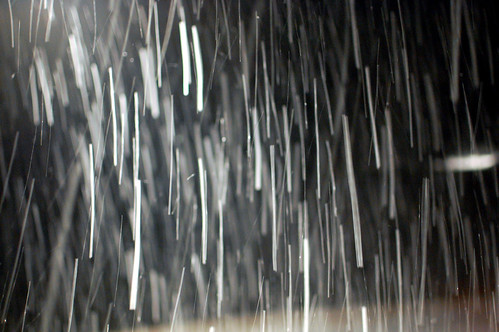
Looks like we're going to get another dumping of snow tonight. Snow, I can handle. Ice? I don't think so. We'll see what happens....
February 7, 2010
Sun Ra Sunday
 Sun Ra & His Blue Universe Arkestra: Universe in Blue (Saturn LP>CDR)
Released as Saturn ESR 5000 IGB in 1972 (in mono), Universe in Blue was recorded live somewhere on the west coast presumably around August, 1971. However, the greatly reduced Arkestra suggests that it could have been recorded “somewhere on the road” in mid-1972, as they straggled across the country on their way back to Philadelphia for good (see Campbell & Trent pp.172-173). To further confuse the matter, “The Good Doctor” at ESP-disk’ provides a firm date of August 17, 1971 but insists the venue is Slug’s Saloon in New York City (see below). Who knows? In any event, behind the striking, psychedelicized album cover awaits a tasty selection of smoky, blues-based compositions, dominated by Ra’s patented “space-age barbeque” organ.
Sun Ra leads the way on the somnambulant title track, a dreamy, slowly smoldering blues, demonstrating his mastery of the tradition while summoning up swelling and percussive Hammond-like sounds from the otherwise cheesy Farfisa organ. After a blissful five minutes, Kwami Hadi enters on trumpet, only to be rudely cut off by the tape running out. Ouch! Some amount of music is missing, with part two picking up with the rhythm section reaching a low boil, with a sparse horn section offering swinging punctuation to Hadi’s bravura trumpet statements. John Gilmore then takes over with his soulful growl for a chorus or two on tenor sax before Ra returns with a brief, understated solo on organ to end. “Blackman” sets up a moderately rocking groove for June Tyson, who evokes a time when “Pharaoh was sitting on his throne, when the Blackman ruled this land.” Over and over she implores, her voice cracking with emotion, “I hope you understand!” When I hear her sing, I think I do understand.
“In a Blue Mood” is another slow burner featuring more fingerlickin’ good organ from Mr. Ra. Campbell & Trent suggest Alzo Wright is playing cello on this gig (p.172), but I can’t hear him at all. In this instance, Sonny is playing a wandering walking bass with his left hand, soloing all the while with his right. This is a truly superb solo performance by Sun Ra. “Another Shade of Blue” concludes the album with a mid-tempo swing number led by Gilmore’s indomitable tenor. Sonny shifts gears seemingly at random with unexpected key modulations while ad libbed horn riffs pop in and out. Unfazed, Gilmore just keeps things cooking -- and good lord, twelve minutes later, he’s still wailing away like a madman as the track fades out. Dang! Yes folks, it’s yet another incredible John Gilmore solo – what more can I say? It must be heard to be believed.
+++
In the summer of 2008, “The Good Doctor” at ESP-Disk’ produced a six-part internet radio tribute to Sun Ra which included over two hours of music from this concert -- recorded in stereo, amazingly enough. Even more surprising, “Universe in Blue Pts.1&2” is presented uncut and it sounds much better than my “needle-drop” of the LP. (Curiously, the rest of Universe in Blue is not found on the broadcast, adding further confusion about possible recording dates.) After some polite applause, a fifteen-minute “Intergalactic Research” follows with another extended tenor workout from Gilmore. “Discipline 27” allows the full ensemble to shine on this sweetly harmonized swing number. The thirty-minute “Blackman” is very different from the LP version, beyond its extraordinary length. Without introduction, Tyson begins by singing a cappella with Marshall Allen soon joining in on some wiggly oboe. Allen then takes over with a thrilling solo as a roiling groove is built up in the rhythm section, Pat Patrick leading the band with the hypnotic three-note riff on baritone sax. Suddenly, a male voice (Eloe Omoe?) starts yodeling and carrying on hysterically, compelling Tyson to resume her incantatory singing. At the eleven minute mark, Ra embarks on a lengthy declamation, assuming the role of the resurrected Pharaoh, who has returned from outer space to lead his people back to Egypt, away from "the path of destruction." “Destiny rules and fate decides and I command both of them!” he exclaims. After twenty minutes of feverish ranting, the piece ends quietly with tick-tock-ing percussion and distant, muted trumpet. Another fifty-three minute segment posthumously entitled, “I Roam the Cosmos,” starts out with a brief solo statement from Danny Davis followed by Tyson singing the newly composed “Astro Black” over a massively slowed-down “Love in Outer Space”-type groove. Soon after, Ra begins hectoring the audience about the usual subjects: race, outer space, and doing the impossible -- “Give up your death for me!” he insists at one point, with Tyson echoing virtually every word of his tirade. Meanwhile, the Arkestra noodles around on the two-chord vamp with Hadi and Akh Tal Ebah providing running commentary on trumpet and flugelhorn, respectively. Overlong, it does get a bit tedious, but Ra’s preaching is simultaneously terrifying and laugh-out-loud funny.
+++
Universe in Blue is another one of those classic Saturn LPs which remains way out of print, originals commanding princely sums on the collector’s market. That’s a shame since this is one of the warmest, most approachable albums in the discography. ESP-Disk’ or Atavistic or Art Yard or some other perspicacious label should compile all this material together and reissue Universe in Blue in a deluxe, two-disc edition; I’m sure it would be a big hit.
February 6, 2010
Playlist: Week of 2-6-10
 * Buxtehude: Sonatas, Op.1 (Holloway/ter Linden/Mortensen) (Naxos CD)
* Buxtehude: Sonatas, Op.2 (Holloway/ter Linden/Mortensen) (Naxos CD)
* Venice Baroque Orchestra (Marcon/Carmignola): Concerto Italiano (Archiv Prod. CD)
* Vivaldi: Cello Sonatas (ter Linden/Mortensen) (Brilliant Classics 2CD)
* Handel: 12 Solo Sonatas, Op.1 (AAM/Egarr) (Harmonia Mundi 2CD)
* Handel: Trio Sonatas, Op.2&5 (AAM/Egarr) (Harmonia Mundi 2CD)
* Boyce: 8 Symphonies (English Concert/Pinnock) (Archiv Produktion CD)
* Ravel: Piano Music (Queffélec) (Virgin CD)
* Ravel: Orchestral Music (selections) (NYPhil/Chicago/Boulez) (Sony 3CD)
* Poulenc: Chamber Music (d.1) (Nash Ensemble) (Hyperion 2CD)
* Sun Ra: The Native Son, Berkeley, CA circa.1971 (SBD CDR)
* Sun Ra: unknown venue, circa.1972 (SBD CDR)
* Sun Ra: Universe in Blue (Saturn LP>CDR)
* Sun Ra: Dramaten, Stockholm, Sweden 10-12-71 (FM CDR)
* Sun Ra: The Antique Blacks (Art Yard CD)
* Pharaoh Sanders: Thembi (Impulse! CD)
* Miles Davis: The Complete Jack Johnson Sessions (d.2-5) (Columbia/Legacy 5CD)
* Miles Davis: The Complete On the Corner Sessions (d.1) (Columbia/Legacy 6CD)
* Henry Threadgill’s Zooid: This Brings Us To, Vol.1 (Pi CD)
* Anthony Braxton 12+1tet: Christ Church Cathedral, Vancouver 1-29-10 (AUD CDR)
* Anthony Braxton Sonic Genome Project: Roundhouse, Vancouver 1-31-10 (AUD 2CDR)
* Susie Ibarra: Songbird Suite (Tzadik CD)
* Bob Dylan: Blood on the Tracks (Columbia SACD)
* Van Morrison: Veedon Fleece (Polydor CD)
* Grateful Dead: Marin Veterans Memorial Auditorium, San Rafael, CA 3-31-84 (SBD 3CDR)
* Grateful Dead: Marin Veterans Memorial Auditorium, San Rafael, CA 4-01-84 (SBD 3CDR)
* Grateful Dead: Fox Theatre, Atlanta, GA 10-29-85 (SBD 3CDR)
* Steely Dan: Gaucho (MCA DVD-A)
* Talking Heads: Remain in Light (Sire/Warner Bros. DVD-A)
* The Police: Zenyatta Mondatta (A&M/Universal SACD)
* The Police: Ghost in the Machine (A&M/Universal SACD)
* My Bloody Valentine: Loveless (Plain LP)
* Robert Pollard: We All Got Out of the Army (GBV, Inc. LP)
* Robert Pollard: “Silk Rotor” (Happy Jack Rock Records 7”)
Commentary:
It is appropriate that my first new records of the year would be by Robert Pollard (photo). By now of course, it is a cliché to say the guy makes too many records, but I am not complaining. As you can see, I love records! We All Got Out of the Army is another slickly produced collection of songs, but this time there’s an air of dark melancholy and dissonant, prog-rock undertones. After only a couple of listens, the songs have yet to sink in, but I like the sound of it very much. The accompanying seven-inch single (on peach-colored vinyl) contains the album track, “Silk Rotor” and two strong b-sides: “Fear of Heat,” a one-note rave-up bordering on Circus Devils-like paranoia and the gently whimsical “Rare Hazel Japan.” Both records feature beautiful collages by Pollard, making them delightful objects d’art as well. Nicely done! A new Circus Devils album, Mother Skinny, is due out on March 30 and two new Boston Spaceship discs should arrive in April and May. Can’t wait! Available directly from Rockathon.
January 31, 2010
Sun Ra Sunday
 Sun Ra: Intergalactic Research (The Lost Reels Collection Vol.2) (Transparency CD)
Campbell & Trent describe two performances at The Native Son in Berkeley, California on June 19 and July 14, 1971 which were recorded by Sun Ra and sold to Black Lion in the infamous tarmac transaction later that year, but never issued (pp.171-172). What’s the deal there? Has anyone heard these? Our intrepid discographers list tantalizing titles such as “Sun-Earth Rock” and “Cosmic Africa.” Huh?! If these tapes still exist, they need to be released! Come on, folks, let’s get busy!
In the meantime, Transparency has released a twenty-five minute fragment purportedly recorded at The Native Son around this time period on Intergalactic Research (The Lost Reels Collection Vol.2). The sound quality is actually quite good; in fact it sounds to me like a low-generation soundboard tape. Which makes me wonder -- could this be from that stash of unissued recordings sold to Black Lion? Who knows? The provenance of Transparency’s releases is sketchy at best.
While mostly a continuous performance, it is cleverly edited, opening with the audience stamping and cheering which is overlaid with music, fading in on an untitled improvisation. John Gilmore launches into a typically marvelous tenor saxophone solo, full of twisty scales and impossible stacks of harmonics and multiphonics. Wow, this is truly an astonishing tour de force. Incredible! It sounds to me like there are two bassists here, one of whom is unmistakably Ronnie Boykins. Perhaps Alzo Wright is playing cello? Whoever it is, he bows away with a maniacal, Strange Strings-like abandon. Oboes and flutes join in the fray, weaving webs of spindly counterpoint until June Tyson enters with mumbling glossolalia, chanting “Strange Worlds” over the reedy din. Gilmore quickly joins in to sing “It’s After the End of the World” and the bumptious “Outer Spaceways Incorporated,” which is anchored by Boykins’s wildly inventive but rock-solid bass. Ra then asks the rhetorical question, “Why Go to the Moon?” while chirpy oboes and a swooping slide-whistle (!) provide gently mocking commentary. An open improvisation follows with the bassists (or bass and cello) engaging in a throbbing duet until someone (perhaps James Jacson) enters with a blisteringly overblown solo on the Neptunian libflecto. This is greeted with a huge round of applause followed by two minutes of stamping and cheering…in fact this is the same stamping and cheering that begins the segment, creating a neat, infinite loop effect. I suspect this particular concert fragment was compiled by Sun Ra himself to be released as an album side. Which begs the question: What did the other side sound like? Will we ever know? Oh, the mysteries of Mr. Ra!
+++
The rest of this CD is taken up with a thirty-two minute concert fragment recorded at an unknown venue on an unknown date circa. 1972. We’ll listen more carefully in due course, but I will note here that it is another decent-sounding board tape containing some very adventurous music. Bootleg or not, this is a must-have disc for the hardcore Ra fanatic.
Wolf Moon
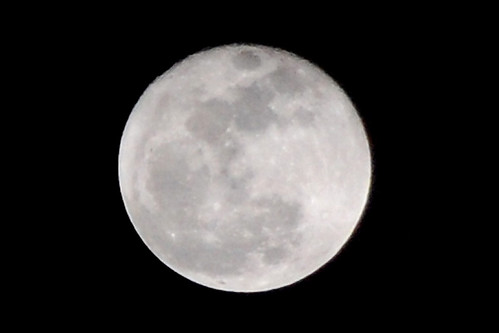
The skies cleared last night, revealing January's full moon, otherwise known as the "wolf moon." It's challenging to take a detailed photograph of the moon. This was the best I could do.
January 30, 2010
Playlist: Week of 1-30-10
.jpg) * Biber: Unam Ceylum (Holloway/Mortensen/Assenbaum) (ECM CD)
* Biber: Unam Ceylum (Holloway/Mortensen/Assenbaum) (ECM CD)* Vivaldi: Cello Sonatas (ter Linden/Mortensen) (Brilliant Classics 2CD)
* Venice Baroque Orchestra (Marcon/Carmignola): Concerto Veneziano (Archiv Prod. CD)
* Schoenberg: Piano Concerto, Op.42, etc. (Cleveland Orch./Boulez/Uchida) (Philips CD)
* Boulez/Barraque: Notations/Sonata (Pi-Hsien Chen) (Telos CD)
* Duke Ellington: Money Jungle (Blue Note CD)
* Duke Elligton Meets Coleman Hawkins (Impulse! CD)
* Duke Ellington and John Coltrane (Impulse! CD)
* Grant Green: Street of Dreams (Blue Note CD)
* Bobby Hutcherson: “Mellow Vibes” (Blue Note mix CDR)
* Sun Ra: The Warehouse, San Francisco, CA 6-10-71 (SBD CDR)
* Sun Ra: The Native Son, Berkeley, CA, circa. Summer 1971 (SBD CDR)
* Sun Ra: Unknown venue, circa. 1972 (SBD CDR)
* Sun Ra: Universe in Blue (Saturn LP>CDR)
* John Coltrane: Crescent (Impulse! CD)
* Miles Davis: The Complete Bitches Brew Sessions (d.3-4) (Columbia/Legacy 4CD)
* Miles Davis: The Complete Jack Johnson Sessions (d.1) (Columbia/Legacy 5CD)
* Herbie Hancock & Headhunters: Music Inn, Lenox, MA 8-31-74 (AUD 2CDR)
* William Parker Violin Trio: Scrapbook (Thirsty Ear)
* Susie Ibarra: Flower After Flower (Tzadik CD)
* DJ Spooky: Optometry (Thirsty Ear CD)
* Ethiopiques 4: Ethio Jazz & Musique Instrumentale 1969-1974 (BudaMusique CD)
* The Beatles: Sgt. Pepper’s Lonely Hearts Club Band (stereo remaster) (Apple/EMI CD)
* The Beatles: Magical Mystery Tour (stereo remaster) (Apple/EMI CD)
* The Beatles: Yellow Submarine (stereo remaster) (Apple/EMI CD)
* Jimi Hendrix Experience: Are You Experienced? (Experience Hendrix/MCA CD)
* Grateful Dead: Public Hall, Cleveland, OH 12-6-73 (SBD 3CDR)
* Grateful Dead: Cameron Indoor Stadium, Duke Univ., Durham, NC 12-8-73 (SBD 4CDR)
* Jerry Garcia Band: Let It Rock: Keystone 11-75 (Rhino 2CD)
* Crosby, Stills, Nash & Young: Déjà vu (Atlantic/MFSL LP)
* Neil Young: Harvest (Reprise LP)
* Tom Waits: Nighthawks at the Diner (Asylum 2LP)
* Tom Waits: Glitter and Doom Live (Anti- 2LP)
* Guided By Voices: Propeller (Scat LP)
* Guided By Voices: King Shit and the Golden Boys (Scat LP)
* Yo La Tengo: Popular Songs (Matador CD)
* My Bloody Valentine: Isn’t Anything (Plain LP)
* Animal Collective: Archa Theatre, Prague 10-14-08 (FM CDR)
* Animal Collective: Merriweather Post Pavilion (Domino CD)
Commentary:
The big news here in Middle Tennessee is of course, snow -- lots of snow. It finally quit snowing around noon today after an overnight coating of sleet and freezing rain. All told, I’d say we got about five inches of ice and snow out here in Kingston Springs and it is seriously slippery out there! Great sledding conditions -- neighborhood kids are having some rare fun -- but it ain’t so good for motorized transportation (or walking around for that matter!). Fortunately, we still have electricity; that means Lizzy and I can enjoy being snowed in together in our cozy home, a fire in the fireplace, and records on the player. Life really doesn’t get better than this.
+++
I’m still on the fence regarding Animal Collective. The live set I dug up was particularly underwhelming and made me appreciate the artifice of the album even more. Nevertheless, Merriweather Post Pavilion seems to make promises it ultimately can’t fulfill. Or maybe it’s me; I’ll keep listening. One thing about that title that tickles my brain: when I think of Merriweather Post Pavilion, I think of a legendary Grateful Dead concert that occurred at this venue just outside of Washington, D.C. on June 30, 1985. Let me tell you, that “Shakedown Street” is mind-bendingly awesome. What does that have to do with Animal Collective? Probably nothing. Heck, these guys were probably not even born yet. But I think of it every time I put on their latest record. One thing Animal Collective shares with the Grateful Dead is an acid-drenched sensibility. That, I like.
January 29, 2010
Snow Day!!

It started snowing at 9:00 a.m. and hasn't stopped yet. I hope we'll be able to get down off this hill once it stops! The snow is beautiful, but dangerous -- folks down here aren' t used to this kind of weather. Please be safe! (More photos are on my Flickr photostream.)
January 24, 2010
Sun Ra Sunday
 Sun Ra: The Creator of the Universe (The Lost Reels Collection Vol.1) (Transparency 2CD)
It is hard to believe, but in 1971 Sun Ra was briefly appointed lecturer at the University of California at Berkeley via the Regents’ Program and the newly-formed Department of Afro-American Studies. As Szwed points out, such an outlandish appointment was “only conceivable in the early 1960s and early 1970s”:
Apparently, the Arkestra was less than vigilant on the afternoon of May 4, 1971, as a tape recording of Ra’s fifty minute lecture survives and can be found on disc two of Transparency’s 2007 release, The Creator of the Universe (The Lost Reels Collection Vol.1). The sound quality is exceptionally good, all things considered, and you can clearly hear the sound of chalk on blackboard and the disconcerted giggling of students. Sonny’s voice is measured and calm, but there is an angry undertone to his discourses on race and black man’s failure to embrace his “alter-destiny.” While it would be easy to dismiss all this as the ravings of a lunatic (or pure charlatanism or fakery), that would, in my opinion, be a grave mistake. Sonny is witty and entertaining but also deadly serious; there is a method to his madness for he believed that by breaking the bonds of logic and received wisdom and thereby “decoding” mystical texts, humans could realize their spiritual nature, transcend earthly existence (death), and “do the impossible”:Every week during the spring quarter of 1971 he met his class, Afro-American Studies 198: “The Black Man in the Cosmos,” in a large room in the music department building. Although a respectable number of students signed up, after
a couple of classes it was down to a handful (“What could you expect with a course named like that,” Sun Ra once chortled). But a large number of local black folks regularly attended, always distinguishable from the students by their party dress. The classes ran like rehearsals: first came the lecture, followed by a half hour of solo keyboard or Arkestra performance. But it was a proper course -- Sun Ra after all trained to be a teacher in college [for one year at Alabama State A&M circa. 1935 (see pp.25-32)] -- with class handouts, assignments, and a reading list which made even the most au courant sixties professors’ courses pale. There was The Egyptian Book of the Dead; Bill Looney’s, Radix, a book of astrology; Alexander Hislip’s Two Babylons; the theosophical works of Madame Blavatsky; spiritually channeled tomes like The Book of Oahspe; Henry Dumas’s, Ark of Bones and Poetry for My People; LeRoi Jones’s and Larry Neal’s, Black Fire; David Livingston’s, Missionary Travels and Researches in South Africa; Theodore P. Ford’s, God Wills the Negro; Archibald Rutledge’s, God’s Children; the Spring 1971 issue of Stylus, the literary magazine of the black students of Temple University (which contained poetry by Sun Ra): John S. Wilson’s, Jazz: Where It Came From, Where It’s At (published by the United States Information Agency); Yosef A. A. Ben-Jochannan’s, Black Man of the Nile and His Family; Count Volney’s, Ruins of Empire; the King James version of the Bible (listed on the syllabus only as “The Source Book of Man’s Life and Death”); P.D. Ouspensky’s, A New Model of the Universe; Frederick Bodmer’s, The Loom of Language; Blackies Etymology; and other books on hieroglyphics, color therapy, the Rosicrucians, Afro-American folklore, and ex-slaves’ writings. When students returned after the first class to tell Sun Ra that the books were not available in the bookstores and were either missing from the library or had never been there in the first place, he merely smiled knowingly.His list of suggested topics for student term papers summed up his interests at the time, but it also showed an astute sense of what universities expect their student’s papers to deal with: “The Striving of the Black Bourgeoisie,” “Negritude,” “Planning for the Future,” “The Role of Technology in Music,” and “Developing Relevant Culture.”
In a typical lecture, Sun Ra wrote biblical quotes on the board and then “permutated” them -- rewrote and transformed their letters and syntax into new equations of meaning, while members of the Arkestra passed through the room, preventing anyone from taping the class. His lecture subjects included Neoplatonic doctrines; the application of ancient history and religious texts to racial problems; pollution and war; and a radical reinterpretation of the Bible in light of Egyptology. Sun Ra the southern black man, the jazz musician, the militant, the hippie icon, the avant-gardist, was now Sun Ra, visiting lecturer (pp.294-295).
I’m talking about something that’s so impossible, it can’t possibly be true. But it’s the only way the world’s gonna survive, this impossible thing. My job is to change five billion people to something else. Totally impossible. But everything that’s possible’s been done by man, I have to deal with the impossible. And when I deal with the impossible and am successful, it makes me feel good because I know that I’m not bullshittin’ (quoted in Szwed, p. 295).
Here, Sun Ra unequivocally claims that, at least sometimes, he is able to successfully “deal with the impossible” and his guileless statement about how this makes him “feel good” indicates this is, in fact, more than just mere bullshit. The truth of this assertion is evidenced by the music and structure of the Arkestra, where true freedom exists within the confines of extraordinary discipline and where a strictly hierarchical organization allows for genuine self-expression within a utopian society based upon the harmonious relations between people. Szwed devotes twenty-five pages to an extended paraphrase of Sun Ra’s philosophy, drawing upon a vast bibliography of interviews and articles in which Sonny expanded upon his ideas, from the nature of God and spirit, good and bad, angels and demons, life and death, truth, history and myth, racial relations, and music’s innate ability to overcome the limitations of language (pp.294-319). Despite surface appearances, all that carrying on about “interplanetary music” was more than just kitschy, space-age theatricality; it was about “creating myths about the future” (p.315): “Myth speaks of the impossible, of immortality” (quoted in Szwed, p. 316). On this recording of Sun Ra’s Berkeley lecture, you can hear him practicing “wordology,” constructing “cosmic equations” based upon “phonetic equivalence, as in homonyms and homophones, and recognizing euphemistic equivalence” (p.305). Listening to it, one feels more like an initiate into an ancient mystery cult than a student at a major research university and it is unsurprising that a permanent faculty appointment was not forthcoming. It is nonetheless a fascinating historical document which provides first-hand insight into Ra’s complex metaphysics. Even if Sun Ra’s cosmology is ultimately dubious, there can be no doubting the sincerity of his beliefs and the goodness of his works.
+++
Disc one contains a forty-eight minute concert fragment recorded at The Warehouse in San Francisco on (supposedly) June 10, 1971. I am skeptical about this date as it would place it a mere two days before the Arkestra’s concert at J.P. Widney Jr. High School in Los Angeles and the band appears to have different personnel. (This concert is not listed in Campbell & Trent – I think it’s time for a third edition!) Specifically, the extended drum solo on track three sounds suspiciously like Clifford Jarvis, who does not appear on the June 12 show. Then again, Ronnie Boykins is definitely present on bass and Tommy Hunter, Lex Humphries, and Jarvis all traveled to Europe in the fall, so I suppose anything is possible. The sound quality is OK, probably recorded from the soundboard (vocals are way up front, drums way back), but it’s degraded in a most unfortunate fashion: the original master probably sounds very good (wherever it might be), but this CD is clearly several generations removed and there was obviously a “Dolby mismatch” along the way, resulting in muffled and swishy upper frequencies, most noticeable in the sound of the cymbals. Oh well, so it goes with Sun Ra’s “unofficial” discography.
The tape opens with an unknown number in the “Discipline” series of compositions, conceptually similar to “Discipline 15” but with differently un-resolving harmonies. Spacey improvisational sections follow statements of the slow, somber theme, featuring Boykins’s inimitable thrumming and bowing and (I’m guessing) Eloe Omoe’s growling and burbling bass clarinet. “Ra Declamation” is just that: a twenty-five minute mytho-poetic polemic full of cryptic admonishments and black-power sentiments, interspersed with moments of bashing free-jazz skronk. It is interesting to compare this to the U.C. Berkeley lecture and his venomous “curse” on Los Angeles two days later as Sonny mines related material absent the scholarly affectations of the former and the abject fury of the latter. Next up is an unknown title for ominous percussion and brooding trumpet which gives way to a lengthy yet oddly compelling drum solo. If this is Jarvis (and that hyperactive bass drum sure sounds like him), he is not as blithely self-indulgent as usual, resulting in a musically satisfying prelude to Sun Ra’s typically inventive synthesizer solo. Ra coaxes worlds of sounds from his MiniMoog, once again demonstrating his quick mastery of that technologically sophisticated instrument over the past year. “Satellites Are Spinning” follows with June Tyson and John Gilmore duetting on the loping sing-along. Sadly, the tape cuts off a mere two minutes into “Enlightenment.” Ouch.
+++
I must admit to having deep ethical qualms about the Transparency label since most of their Sun Ra releases consist of amateur recordings that have circulated amongst collectors for years. As such, these CDs can best be described as “bootlegs.” I read someplace where Marshall Allen has granted Transparency the “moral right” to release these recordings and, in return, the Arkestra receives a percentage from their sales. That is all very well and good, but copyright law does not (as far as I know) recognize “moral rights” and, even if it did, it is questionable whether or not Allen retains those rights with regard to these recordings. Nevertheless, I have to admit that any effort to bring these tapes to light should be applauded by those of us who are fanatically obsessed with Sun Ra’s music. For the merely curious, I would suggest staying away from the Transparency CDs and sticking to the myriad “official” releases on offer. If you already have all that stuff, then by all means, indulge yourself; these recordings are well worth hearing, despite their dodgy provenance. But, as always, caveat emptor!
January 23, 2010
Playlist 1-23-10
.jpg) * Buxtehude: Six Sonatas (Holloway/Mortensen, et al.) (Naxos CD)
* Buxtehude: Six Sonatas (Holloway/Mortensen, et al.) (Naxos CD)* J.S. Bach: Violin Sonatas (Manze/Egarr/ter Linden) (Harmonia Mundi 2CD)
* J.S. Bach: Klavierubung (Alard): Église des Minimes, Brussels 7-25-09 (FM CDR)
* Messiaen: Quatuor pour la Fin du Temps (Shaham, et al.) (Deutsche Grammophon CD)
* Messiaen: 80th Birthday Concert (Ens. Intercontemporain/Boulez/Loriod) (Montaigne CD)
* Charles Mingus: Black Saint & the Sinner Lady (Impulse! CD)
* Charles Mingus: Mingus Plays Piano (Impulse! CD)
* Andrew Hill: Passing Ships (Blue Note CD)
* Andrew Hill: Lift Every Voice (Blue Note CD)
* Andrew Hill: Mosaic Select 16 (d.1) (Mosaic 3CD)
* Bobby Hutcherson: Dialogue (Blue Note CD)
* Alice Coltrane: A Monastic Trio (Impulse! CD)
* Pharoah Sanders: Karma (Impulse! CD)
* Pharoah Sanders: Jewels of Thought (Impulse! CD)
* Sun Ra: Lecture, U.C. Berkeley 5-4-71 (AUD CDR)
* Sun Ra: The Warehouse, San Francisco 6-10-71 (SBD CDR)
* Sun Ra: J.P. Widney Jr. High School, Los Angeles 6-12-71 (AUD 2CDR)
* Sun Ra: Universe in Blue (Saturn LP>CDR)
* The Beatles: A Hard Day’s Night (stereo remaster) (Apple/EMI CD)
* The Beatles: Beatles for Sale (stereo remaster) (Apple/EMI CD)
* The Beatles: Rubber Soul (stereo remaster) (Apple/EMI CD)
* The Beatles: Revolver (stereo remaster) (Apple/EMI CD)
* The Beach Boys: Pet Sounds (Capitol/DCC LP)
* Bob Dylan: John Wesley Harding (mono) (Columbia/Sundazed LP)
* Grateful Dead: The Omni, Atlanta, GA 12-12-73 (SBD 3CDR)
* Grateful Dead: Public Auditorium, Cleveland, OH 11-29-79 (SBD 3CDR)
* Grateful Dead: Stanley Theatre, Pittsburgh, PA 11-30-79 (SBD 3CDR)
* Grateful Dead: Soldier Field, Chicago, IL 6-23-91 (SBD 3CDR)
* The Velvet Underground: The Velvet Underground (Polydor CD)
* Henry Cow: Leg End (Red/Virgin LP)
* Henry Cow: Unrest (Virgin LP)
* Tom Waits: Glitter & Doom Live (Anti 2LP)
* Guided By Voices: Sandbox (Scat LP)
* Guided By Voices: Self-Inflicted Aerial Nostalgia (Scat LP)
* Guided By Voices: Same Place the Fly Got Smashed (Scat LP)
* Animal Collective: Merriweather Post Pavilion (Domino CD)
Commentary:
I finally picked up a copy of the Animal Collective’s Merriweather Post Pavilion album and, after two listens, I am intrigued but not totally convinced of its alleged greatness. What is intriguing to me is their ability to resurrect a much maligned genre like eighties-style synth-pop without resorting to sneering irony; there is a giddy exuberance to their music that is refreshing in an era of calculated cynicism and faux-sincerity. What is lacking, to my ears, is compelling and/or catchy songwriting that I want and expect from pop music. While the electronic textures are trippy and evocative, they fail to cohere into actual songs – at least after only a couple hearings. Perhaps that is intentional and part of their supposed genius. Or perhaps, after further listens, an inner logic will reveal itself beyond the music’s sparkling surface appeal. I will therefore reserve ultimate judgment until after I’ve spent some more time with it. Regardless, this is an interesting and ambitious album and it is encouraging that such a thing could find a (relatively) broad audience in our fractured and fragmented society. That is an unqualifiedly good thing.
Reading:
Citizens United v. Federal Election Commission, No. 08-203, 2010 U.S. LEXIS 766 (U.S. Supreme Court, January 21, 2010) (Opinion by Kennedy)
I try to avoid politics on this blog, and I hesitate to make any comments about the law since I AM NOT A LAWYER, but the latest 5-4 decision out of the Supreme Court is alarming on so many levels, I had to read for myself what our esteemed Justices have to say. I suggest that every citizen turn off the television/internet and do the same. (The slip opinion is available here.) The majority makes an elegant but intellectually dishonest (and procedurally defective) argument to support the idea that corporations should have the same unfettered First Amendment rights to speech (via money) as natural human beings. In so doing, the Court overturns over a hundred years of jurisprudence and resulting statutory schemes. In effect, Thursday’s decision makes it impossible for legislatures to regulate the financing of political campaigns vis-a-vis corporations in any meaningful way. Needless to say, I wholeheartedly agree with Justice Stevens’s eloquent ninety-page dissent which concludes:
In a democratic society, the longstanding consensus on the need to limit corporate campaign spending should outweigh the wooden application of judge-made rules. The majority’s rejection of this principle elevates corporations to a level of deference which has not been seen at least since the days when substantive due process was regularly used to invalidate regulatory legislation thought to unfairly impinge upon economic interests. At bottom, the Court’s opinion is thus a rejection of the common sense of the American people, who have recognized a need to prevent corporations from undermining self-government since the founding, and who have fought against the distinctive corrupting potential of corporate electioneering since the days of Theodore Roosevelt. It is a strange time to repudiate that common sense. While American democracy is imperfect, few outside the majority of this Court would have thought its flaws included a dearth of corporate money in politics. (pp. 296-297)
Worse than the bad result in the instant matter is the Court’s willingness to make sweeping changes in constitutional law on the flimsiest of pretexts. It is essential to note that the appellant in this case had long ago abandoned its constitutional challenge to the statute at issue in the lower courts, only to be revived, sua sponte, by the majority on appeal. This is an astonishing move by the Court. Whether or not one supports the end result, this radical departure from the rules of procedure belies any notion that these Justices are in any way “conservatives,” “originalists,” “strict constructionists” or even remotely interested in the concept of “judicial restraint,” as they have been sold by the presidents who nominated them. They are activist judges of the worst sort, driven by a suspect ideology and they are vigorously enacting their agenda. Whatever one’s political viewpoint, the Court’s actions in this case should give pause. After all, there is no appeal from the Supreme Court and we suffer their decisions for years if not generations.
January 18, 2010
Common Birds at the Feeder: Common Grackle

The Common Grackle (Quiscalus quiscula) is, well, common. But seeing one up close, I can appreciate its brilliantly irridescent coloring. This one didn't like the camera too much, but I got a few shots of him this weekend.
January 17, 2010
Sun Ra Sunday
 Sun Ra and His Intergalactic Infinity Arkestra:
J.P. Widney Jr. High School, Los Angeles, CA 6-12-71 (AUD 2CDR)
After their (semi)triumphant tour of Europe, the Arkestra’s return to the United States must have been something of a letdown, with paying work still somewhat hard to find and the musicians once again scattered between Phildelphia, New York and Chicago. Szwed mentions a gig at the beginning of 1971 at the Village Vanguard as well as a concert at the Metropolitan Museum of Art’s prestigious “Composers in Performance” series in February (p.285). According to Campbell and Trent, the Arkestra also played Sunday and Monday nights at The East Village In in March (and perhaps at other times later in the year) (p.170). But the West Coast beckoned once again and in April, the Arkestra headed out for an extended stay in California appearing at the first UC Jazz Festival at the Greek Theatre in Berkeley on April 23 and a two-night stand at San Francisco’s Harding Theater on April 30 and May 1 (Id.). Tommy Hunter had once again rejoined the group and remembers Sun Ra writing the "Discipline" series of compositions during this time, rehearsing a new one with the band every day (Id. and see also Szwed, p.285).
After a stint in Berkeley, the Arkestra accepted Bobby Seale’s invitation to move into a house in Oakland owned by the controversial Black Panthers. Sonny had generally positive feelings about the Black Panthers’ goals but was skeptical of their incendiary politics; not surprisingly, this move brought the Arkestra some unwanted attention from the authorities:
Sonny was impressed by the practical side of the Panthers -- their ideas for schools, a breakfast program for children, providing groceries for the needy, building a community – and though he did not share their theoretical underpinnings and their violent implications, he thought they had the best program he had heard of for black people. The Arkestra was now at least remotely connected to the group that J. Edgar Hoover declared the biggest threat to American internal security. So as benign as the Arkestra’s activities were – they played a local mental hospital, performed at the wedding at the Rosicrucian Museum in San Jose, worked at clubs like the Native Son, and gave free concerts in the parks – they found themselves under surveillance by both the FBI and the Oakland police (Szwed, p.286).
On June 11, the Arkestra travelled down to Los Angeles where Danny Thompson’s cousin, Alden Kimborough, had arranged a concert at the J.P. Widney Junior High School. A school for handicapped children, it was inauspiciously named after Joseph Pomeroy Widney (1841-1948), one of the first presidents of the University of California -- and a virulent racist. In 1907, Widney published a two-volume manifesto entitled, Race Life of the Aryan People (Funk & Wagnall), which predicted that Los Angeles would some day become the center of white supremacy (Id.). Widney’s malevolent spirit seems to loom over the proceedings: For while the concert was well-received by the audience, “things turned ugly when the custodial staff – not knowing Sun Ra’s practice of playing without regard for time – interrupted the concert by turning off the lights. Sun Ra was furious and lectured the guard and the audience on injustice, race, leadership, and civil order, and ended by putting a curse on the City of Angels” (p.285).
The whole thing (including Sun Ra’s curse) was recorded on a reel-to-reel machine “that was set up right in the middle of the band” (Campbell & Trent, p.171), presumably by Dr. Reggie Scott, who provides some six minutes of embittered commentary at the end of the eighty-two minute tape. The sound quality is, unfortunately, predictably awful, with loud passages overloaded to the point of pure distortion (not to mention the serious wow-and-flutter issues throughout); but the microphone’s position on the stage otherwise provides some immediacy to the music, making less-loud portions (almost) listenable. What is notable about this recording, besides the return of Hunter on drums, is that it marks the first appearance of bassist Ronnie Boykins since his defection for greener pastures in 1968. Somehow, Boykins was cajoled into joining the Arkestra on its California sojourn, perhaps after being informed of the band’s enthusiastic reception in Europe. His distinctive and effortlessly virtuosic bass playing had been integral to the development of Sun Ra’s music during its formative years and his return to the band was certainly most welcome. Boykins would continue to play off and on with the Arkestra through 1974 but Sonny was never able to find anyone else who could really fill his shoes except for perhaps Alan Silva, who had just recently left the band for good. Sadly, although Boykins’s presence can be felt driving the rhythm section, his contributions to this concert are mostly inaudible.
The performance begins with an unidentified title featuring Sun Ra’s portentous electronic keyboards which summon forth a series of hectoring space chants. After a leisurely romp through “Enlightenment,” the ensemble gradually comes together to build up a dense polyrhythmic groove on the lilting “Love in Outer Space,” with Ra taking the lead on organ. As usual, “Watusi” explodes into an extended percussion jam and “Second Stop is Jupiter” serves as a platform for some bluesy, gut-bucket group improvisation, anchored by Boykins’s rock-solid arco riffing. Suitably warmed up, the band launches into the infinitely challenging “Shadow World” at a cartoonishly fast tempo. Unfortunately, the recording is so distorted, it’s impossible to tell what’s going on musically aside from Ra’s furious organ playing and some braying horns. Intermittently, the ensemble drops out, leaving a saxophone or trumpet to solo a cappella. After about fifteen minutes, Ra enters with a dramatic organ chord to introduce the first known performance of “Discipline 15,” a through-composed dirge, similar to the “prototypes” they were playing in Europe. Basically a sequence of sweet but wayward vertical harmonies orchestrated at the extremes of instrumental registers, it is all unresolved tension. This is immediately followed by a snaky improvisation by Marshall Allen on oboe, but he is soon overwhelmed by roaring bass and pounding percussion. June Tyson sings “They’ll Come Back” with a sure-footed sense of pitch and timing over randomly tinkling bells, crashing gongs, clattering percussion, and what sounds like breaking glass (!); but when the full ensemble enters with the theme, the sound quality degenerates into horrific noise. Frankly, it sounds like a cable is loose, creating an electrical short-circuit. Egads! The sound clears up somewhat for the last known performance of “Walkin’ on the Moon,” but the tape quickly fades out after the first couple of minutes.
Apparently, the custodians shut off the lights a short time after, as the tape next picks up in the middle of “The Curse.” And, wow, Sun Ra is pissed off! For more than five minutes, Sonny rains down sheets of radioactive organ and angrily rants about darkness and light, race and righteousness:
The darkness means nothing to you. It’s my home. And my people are dark and black….there’s nothing but darkness anyway and there’s no escape for white, yellow, brown or black for what I represent. And you can believe it if you want to or not; I don’t care! This planet needs me! I don’t need it!…You cannot afford to take a chance. I’m not playing with anything, I’m not Christ, I’m not righteous, I’m so evil…I’ll destroy the whole planet! I’m here to do something! I’m a product of nature! I don’t care anything about the governments of man, I don’t care anything about anyone who is not true and sincere. There is no excuse for any man to mistreat another man. I will not tolerate it! I don’t care if you’re the strongest government on the face of the earth, you are a part of nature!...Do not ever turn the lights out on me! You may be ever so light, but you don’t own anything! You are here by the grace of the god you say you worship!… You will wake up! Black people don’t need to wake up, they got me -- you don’t have nothin’!
Sun Ra ends with an explicit threat: “The birds don’t have to stop playing at one o’clock; why should I? You just had one earthquake…you might expect another!” Whoah. This followed by an eerie minute or so of the audience exiting the auditorium, muttering in stunned disbelief; meanwhile some woman invites everyone to meet “at 4506 Southwest” for further consciousness-raising experiences. The tape concludes with Dr. Reggie Scott’s monologue (over Sun Ra music), in which he recalls an “embarrassing evening for what could have been a perfect evening.” In a coolly angry voice, Dr. Scott laments:
Sun Ra and his band never played better. The crowd never responded better. The people loved and begged for more. But it was ended; ended in another kind of tragic commentary on sensitivity, on responsibility, on man’s -- black man’s -- failure to share the artistic point of view, share the love of art with the artist…The crowd hungered for more, but was not permitted. It was embarrassing to people who love and worship the mighty Sun Ra. The band wanted to play. Sun Ra wanted to play. The audience wanted more…The crowd was at a feverish pitch to hear more Sun Ra and his Intergalactic Infinity Arkestra but it was brought to a halt by the powers that be.
Dr. Scott goes to on to describe the “furious” Sun Ra cursing the City of Los Angeles and concludes: “Sun Ra remains the myth. Sun Ra remains the puzzle. Sun Ra remains undisputed. Sun Ra can only be interpreted in one of two ways: You either go into the galaxy with him or stay left behind. It was that kind of evening. It was that kind of night…” Indeed.
Sun Ra would stay in Oakland until well into 1972, but events would soon overwhelm the Black Panthers when the powers that be turned the lights out on the black power movement (such as it was). And as Ra’s international touring career grew, his political emphasis would necessarily soften into a more pan-racial, intergalactic ecumenicalism. This recording, although of extremely poor fidelity, is a rare document of Sun Ra at his most militant and is worth hearing for “The Curse” alone. Powerful stuff!
January 16, 2010
Playlist 1-16-10
.jpg) * Holborne: Pavans & Galliards 1599 (Guildhall Waits/Consort of Musicke) (L’Oiseau-Lyre LP)
* Holborne: Pavans & Galliards 1599 (Guildhall Waits/Consort of Musicke) (L’Oiseau-Lyre LP)* Morley, et al.: Englische Virginalmusik um 1600 (Leonhardt) (Telefunken LP)
* Die Barocklaute I (Dombois) (ABC/Seon LP)
* Geminiani: Cello Sonatas, Op.5 (ter Linden/Mortensen, et al.) (Brilliant Classics CD)
* Vivaldi: Cello Sonatas (ter Linden/Mortensen, et al.) (Brilliant Classics 2CD)
* J.C. Bach: Sinfonias Op.18, Nos.3 & 5, etc. (Little Orchestra of London/Jones) (Nonesuch LP)
* Schoenberg: String Quartets (Arditti/Upshaw) (d.1) (Montaigne/Naïve 2CD)
* Andrew Hill: The Complete Blue Note Sessions (1963-1966) (d.5-10) (Mosaic 10LP)
* Andrew Hill: Mosaic Select 16 (selections) (Mosaic 3CD)
* Andrew Hill: Grass Roots (Blue Note CD)
* Andrew Hill: Dance of Death (Blue Note CD)
* Sun Ra: J.P. Widney Jr. High School, Los Angeles 6-12-71 (AUD 2CDR)
* Sun Ra: Universe in Blue (Saturn LP>CDR)
* The Beatles: Abbey Road (2009 remaster) (Apple/EMI CD)
* George Harrison: All Things Must Pass (2001 remaster) (Apple/EMI 2CD)
* Elton John: Captain Fantastic & the Brown Dirt Cowboy (MCA/Universal SACD)
* Nick Drake: Five Leaves Left (Island/Universal CD)
* Nick Drake: Pink Moon (Island/Universal CD)
* Nick Drake: Bryter Later (Island/Universal CD)
* Steely Dan: A Decade of Steely Dan (MCA Ultimate Master Disc CD)
* Grateful Dead: Cape Cod Coliseum, South Yarmouth 10-27-79 (SBD 3CDR)
* Grateful Dead: Cape Cod Coliseum, South Yarmouth 10-28-79 (SBD 2CDR)
* Neil Young: On the Beach (Reprise DVD-A)
* Lucinda Williams: Car Wheels on a Gravel Road (Deluxe Edition) (d.1) (Mercury 2CD)
* Guided By Voices: Forever Since Breakfast (Matador CD)
* Guided By Voices: Devil Between My Toes (Scat LP)
* Steven Malkmus: Real Emotional Trash (Matador CD)
* Radiohead: Kid A (Capitol CD)
* Radiohead: In Rainbows (TBD CD)
Commentary:
Mosaic’s ten-LP box set of Andrew Hill’s Blue Note recordings is such a massive object of awe-inspiring beauty that I can hardly bring myself pull it off the shelf to play it. Of course, all this stuff eventually all came out on individual CDs over the years and they are, of course, way more convenient for casual listening. But, wow, these 200g all-analog LPs really do sound amazing! I’ve made my way through the entire thing over the past two weeks and listening to Hill’s development chronologically has given me a whole new appreciation for his unique genius – and Rudy Van Gelder’s alchemical recording technique. For example, the two double-basses on the December 1963 Smoke Stack session have always sounded indistinct on CD, making for a muddled sound quality that has made this album hard for me to appreciate. But on Mosaic’s vinyl, the two basses are not only clearly and separately audible; they fit in perfectly with the drums and piano to reveal the subtle inflections of Hill’s extraordinary set of compositions. Truly stunning.
In a broad sense, Hill’s music moves from post-bop to “avant garde” in the period covered in the box, but none of this music fits comfortably into any particular sub-genre and, for that matter, Hill’s ambitions lie way beyond the freighted and derogatory term “jazz.” In fact, Hill had as a young man studied with the esteemed German composer/theorist, Paul Hindemith (1895-1963), and his compositions are multi-faceted and abstract, never resorting to simple head-solo-head constructions; his harmonic sensibility teasingly hovers between “in” and “out,” tonal and (never quite) atonal yet still maintains forward momentum, tension and resolution. Hill’s compositions are so compelling that alternate takes are just as rewarding as the masters! The music is never obvious, it never does quite what you would expect a “jazz combo” to do and it is sometimes dense and difficult to immediately grasp as a whole -- no doubt making it supremely difficult to play. This makes for some ragged ensembles at times, despite a roster of consistently stellar sidemen, including Sun Ra’s own John Gilmore on two particularly hot sessions. Relentlessly self-critical, Hill refused to release huge swathes of what was recorded for Blue Note, feeling that his conception was not being fully realized by the musicians. It is a measure of Alfred Lion’s devotion that he continued to record Hill’s music at a financial loss -- and it took the equally fanatical Michael Cuscuna to finally bring this intriguing music to the light of day. Bless them both! Despite any imperfections in execution, the musicians are clearly inspired by and dedicated to Hill’s work resulting in near-perfect albums such as Judgment (1964) and Point of Departure (1965).
Hill continued to record for Blue Note from 1967 to 1970, and this music is scattered across several different CDs and I decided to continue the chronological survey. In 2005, Mosaic Select 16 gathered together all the remaining material previously unreleased, including two gorgeous sessions with string quartet and a couple of adventurous sessions where Hill plays organ and harpsichord (!). 1968’s Grass Roots might at first glance appear to be an attempt to cash in with a jazz-funk approach, but again Hill undermines expectations with intricate structures and asymmetrical rhythms, making for a challenging yet loosely danceable record. (The 2000 Blue Note CD appends a tentative earlier session which attempts some of these compositions with a more straight-ahead rhythm section consisting of Reggie Workman on bass and Idris Muhammad on drums.) Recorded in the fall of 1968, Dance of Death marks a return of sorts to Hill’s original angular, swinging style, driven by the vivacious Billy Higgins on drums and featuring a young Joe Farrell on tenor and soprano sax. I’m looking forward to listening to the rest of Hill’s Blue Note recordings this coming week, including the flawed but crucial nonet session recorded in November 1969 and released as Passing Ships in 2003 -- as well as the quirky gospel-choir experiment, Lift Every Voice (1970). Hill abandoned the jazz scene altogether to earn a Ph.D. from Colgate University, later teaching and performing solo piano recitals, only occasionally making records for such labels as Freedom, Soul Note, Steeplechase and Palmetto. Hill returned to Blue Note for a reunion with vibist Bobby Hutcherson on 1989’s Eternal Spirit and again to record a poignantly brilliant final album, Time Lines, in 2006. Andrew Hill, aged 76, died of lung cancer on April 20, 2007.
January 15, 2010
New Moon
I took advantage of tonight's new moon, clear skies, and less bitterly cold temperatures to try and take some more pictures of the stars. These are just experiments with fully manual settings and the tripod and the high ISOs make for a lot of noise, but I'm pleased with how these came out. You can see the others on my Flickr Photostream. Pretty fun!
Subscribe to:
Posts (Atom)