Showing posts with label books. Show all posts

August 30, 2015

Playlist Week of 2015-08-29


* Carter: A Nonesuch Retrospective (selections) (Nonesuch 4CD)
* Boulez: Notations/Explosante-Fixe (Aimard/Ens. Intercontemporain/Boulez) (DG CD)
* Patrick & Thomas Demenga: Lux Aeterna (ECM CD)
* Kenny Burrell: Guitar Forms (Verve LP)
* John Coltrane: Live In Japan (d.1-2) (Impulse!/GRP 4CD)
* Alice Coltrane: Universal Consciousness (Impulse!/Superior Viaduct LP)
* Cecil McBee: Mutima (Strata East LP)
* Collin Walcott: Cloud Dance (ECM LP)
* Marilyn Crispell: Amaryllis (ECM CD)
* Steve Tibbetts: Big Map Idea (ECM CD)
* Grateful Dead: Boston Garden 1991-09-20 (selections) (SBD 3CDR)
* Grateful Dead: Boston Garden 1991-09-21 (selections) (SBD 3CDR)
* V/A: The Perfumed Garden: 82 Rare Flowerings from the British Underground (Past Present 5CD)
* Jade Warrior: Floating World (Island LP)
* Roy Harper: Stormcock (Harvest LP)
* Roy Harper: Valentine (Harvest LP)
* Roy Harper & Jimmy Page: Whatever Happened to Jugula? (Beggars Banquet LP)
* Strawbs: Bursting At The Seams (A&M LP)
* Strawbs: Hero And Heroine (A&M LP)
* Strawbs: Ghosts (A&M LP)
* Strawbs: Nomadness (A&M LP)
* Strawbs: Burning For You (Oyster/Polydor LP)
* Klaus Schulze: Live (Brain 2LP)
* Heldon: Live in Paris 1975 (SouffléContinuum LP)
* Heldon: Live in Paris 1976 (SouffléContinuum EP)
* Stardrive: Intergalactic Trot (Elektra LP)
* Alceu Valenca: Molhado de Suor (Som Livre/Sol Re Sol LP)
* Michael Brook/Brian Eno/Daniel Lanois: Hybrid (Editions EG LP)
* U2: The Unforgettable Fire (Deluxe Edition) (Island 2CD)
* Yo La Tengo: Stuff Like That There (Matador LP)
* Flaming Lips: The Soft Bulletin (Warner Bros. HDCD)
* The Sword: High Country (Razor & Tie 2LP)
* Minsk: The Ritual Fires of Abandonment (Relapse/Gilead Media 2LP)
* Minsk: With Echoes In The Movement Of Stone (Relapse/Bird Dialect 2LP)
* Montibus Communitas: The Pilgrim To The Absolute (Beyond Beyond Beyond LP)
* Beach House: Depression Cherry (Sub Pop LP)
* FKA twigs: LP1 (Young Turks LP)

=iPod/iTunes
=car

Commentary:

Although I do not read a lot of fiction, I recently immersed myself in the first four volumes of Karl Ove Knausgaard’s six-volume, 3200-page novel, provocatively titled My Struggle (Archpelago), which is in the process of being translated from the Norwegian by Don Bartlett. But Knausgaard’s novel is not really fiction so much as an astonishingly vivid recollection of his own life, from childhood to the present, the death of his father, and his attempts to become a writer worthy of his own lofty ambition. More than just memoir, Knausgaard expertly plays with time, slipping into long, multi-hundred-page digressions that effortlessly loop back to where he left off. His lucid, flowing prose captures how it really felt to be a child growing up in the 1970s and ‘80s, a callow youth growing into a husband and father in the ‘90s and 2000s, and an artist wrestling with lacerating self-doubt, failure, and shame. Knausgaard holds nothing back and reading My Struggle feels more like reality than fiction. Moreover, it is the breathtakingly virtuosic writing that sucked me in and I drank down the text in massive gulps. As Knausgaard’s friend Geir tells him in Volume Two, “You can spend twenty pages describing a trip to the bathroom and hold your readers spellbound.” Indeed, he does.

Ultimately, Knausgaard struggles with defining what truly matters in a meaningless world and finds solace (if not meaning) in art and music. Early on in Volume Four, he describes himself as an eighteen-year-old record collector and how his sense of identity and inchoate dreams of the future were tied up in these bits of plastic and cardboard:
Every single one of these records embraced an entire little world of its own. All them expressed quite different attitudes, sentiments, moods. But none of the records was an island, there were connections between them which spread outward […] But the ramifications and connections didn’t only exist between the records, they extended right into my own life. The music was linked with almost everything I had done, none of the records came without a memory. Everything that had happened in the past five years rose like steam from a cup when I played a record, not in the form of thoughts or reasoning, but as moods, openings, space. Some general, some specific. If my memories were stacked in a heap on the back of my life’s trailer, music was the rope that held them together and kept it, my life, in position.
“But this wasn’t its most important aspect,” he goes on. It was “the music itself” which, in the case of the Talking Heads, had the power to get “the world’s least rhythmic eighteen-year-old, sitting there squirming like a snake” stand up and dance. Or how, by contrast, Echo and The Bunnymen’s music was not about “rhythm or drive but sounds and moods, this tremendous wailing that springs from them, all longing and beauty and gloom, which swells and subsides in the music, no, which is the music.” Although seeped in song lyrics and band interviews, Knausgaard realizes that such knowledge “is obliterated by the music.”
[T]he music doesn’t want to know about it, because in music there is no meaning, there is no explanation, there are no people, only voices, each with its own special distinctive quality, as though this is its essential quality, its essence, unadulterated, no body, no personality, yes, a kind of personality without a person, and on every record there is an infinity of such characteristics, from another world, which you meet whenever you play the music.
Then he goes further, revealing just how much of his eighteen-year-old ego and fragile self-worth were tied up in his precious record collection: “It made me someone,” he says.
Thanks to music I became someone who was at the forefront, someone you had to admire, not as much you had to admire those who made the music, admittedly, but as listener I was in the vanguard. Up here in the north probably no one would see that, as hardly anyone in Kristiansand had been aware of it, but there circles where it was seen and appreciated. And that was where I was headed.
As with the rest of the novel (and life itself), the profound and mundane are always on equal footing, the sublimity and the embarrassment of human existence simultaneously filling our minds from moment to moment. He goes about arranging his records “in such a way that the impression made by each one would be enhanced and perhaps lead to surprising new associates for whoever thumbed through them” and then heads to the grocery store.


I can very much relate to the young Knausgaard and his budding record collection—both the ineffably captivating qualities of music itself and the delusions of self-importance those LPs inspired. Of course, now, on the other side of fifty, they no longer represent who I am or my hopes for a future that has already passed—and yet, I remain enraptured by the music contained therein. “I never worked out what it was that possessed me when music possessed me,” Knausgaard writes, “other than that I always wanted it.” That feeling, for me, never went away.

February 6, 2013

Beck @ Spectrum Culture

My review of Beck's Song Reader is also up at Spectrum Culture. I had to give it five stars and spill thirteen-hundred words explaining why. It's his best since Sea Change--but you have to sing the songs yourself.

September 1, 2012

Playlist Week of 9-01-12

Piano at Zeitgest Gallery
* Scriabin: The Complete Piano Sonatas (Laredo) (Nonesuch 2CD)
* Stefan Prins: Fremdkörper (Sub Rosa 2CD)
* Cecil Taylor & Tony Oxley: 26.Jazzfestival, Saalfelden, Austria 8-28-04 (FM CDR)
* Cecil Taylor & Tony Oxley: Teatro Communale, Modena, Italy 10-11-07 (FM 2CDR)
* Cecil Taylor & Tony Oxley: Auditorium, Strasbourg, France 10-02-09 (AUD 2CDR)
* Anthony Braxton: GTM (Iridium) 2007 Vol.3 Set 1 (New Braxton House FLAC)
* Anthony Braxton: GTM (Iridium) 2007 Vol.3 Set 2 (New Braxton House FLAC)
* Terje Rypdal Trio: Sendesall, Bremen, W. Germany 4-04-73 (Pre-FM FLAC)
* Ingrid Laubrock Anti-House: Moers Festival, Germany 5-26-12 (FM FLAC)
* Grateful Dead: Spring 1990 (selections) (GDP/Rhino 18HDCD)
* Pink Floyd: Animals (Pinkfloyd/EMI CD)
* Pink Floyd: The Wall (Pinkfloyd/EMI 2CD)
* Genesis: Three Sides Live (Atlantic 2LP)
* U2: The Unforgettable Fire (Island/Universal 2CD)
* New Order: Power Corruption And Lies (Factory/Rhino 2CD)†
* Talk Talk: Laughing Stock (Verve/Polygram CD)†
* Helios Creed: Galactic Octopi (Transparency 2LP)
* Thurston Moore: Demolished Thoughts (Matador CD)†
* OM: God Is Good (Drag City LP)†
* OM: Advaitic Songs (Drag City 2-45RPM LP)
* Steven Wilson: Grace For Drowning (KScope BD)
* Opeth: Still Life (Peaceville CD/DVD)(†)
* Opeth: Blackwater Park (Legacy Edition) (Sony/Universal CD/DVD)†
* Opeth: Deliverance (Music For Nations/KOCH CD)†
* Opeth: Damnation (Music For Nations/KOCH CD)†
* Opeth: Ghost Reveries (Roadrunner HDCD)†
* Opeth: Watershed (Roadrunner CD)†
* Opeth: Heritage (Roadrunner CD/DVD)
* Storm Corrosion: Storm Corrosion (Roadrunner CD/BD)
* Katatonia: Last Fair Deal Gone Down (Peaceville CD/CDEP)†/‡
* Katatonia: Viva Emptiness (Peaceville CD)†/‡
* Katatonia: The Great Cold Distance (Peaceville CD)†/‡
* Anathema: We’re Here Because We’re Here (KScope CD/DVD)
* Anathema: Weather Systems (The End CD)(†)
* Baroness: Yellow & Green (Relapse 2LP)
* Holograms: Holograms (Captured Tracks MP4)†

†=iPod
‡=car

Commentary: "Composition vs. Improvisation: A False Dichotomy"

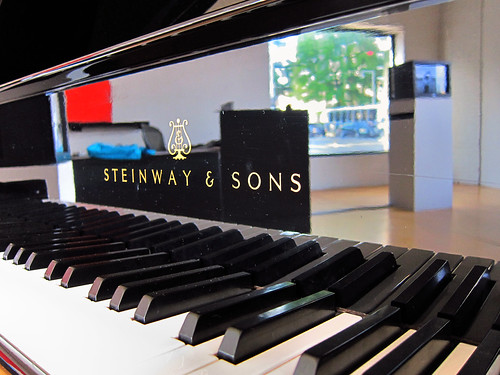
On Thursday, September 6, I will be playing improvised piano/drums duets with my friend and former bandmate, Sam Byrd, at the opening Indeterminacies event at Zeitgeist Gallery. This will be first time I have performed in public since the dissolution of UYA in 1995 and the first time on piano since…when?...1984? I can’t remember. I’m a little bit nervous—not so much about the music (Sam always inspires me to play beyond my abilities—which is why I insisted he travel from Richmond to join me)—but more concerned about the discussion segments, which will be led by Vanderbilt professor, Stan Link. Stan is a good friend and I’m sure he’ll go easy on me, but he is a brilliant and articulate composer with deep suspicions about the whole notion of improvisation as a legitimate artistic practice. Of course, this is what makes Indeterminacies unique: these are not concerts per se; they are investigations into the phenomena of performance and reception, critical thinking and audience participation. The result is unscripted, deliberately indeterminate and always challenging. We will be required to explain and, perhaps, justify and defend whatever it is we’re doing from rhetorical attacks from Stan and a potentially hostile, disapproving audience. Maybe not, but I’d be disappointed if we weren’t.

Consequently, I’ve been reading and re-reading some of the foundational texts regarding improvisational music in order to buttress my argument that improvisation is not only a legitimate practice but the basic expression of our innate human creativity. In Musicking: The Meanings of Performing and Listening (Wesleyan, 1998), Christopher Small helpfully insists that “music” is not a noun, but a verb. “There is no such thing as music,” he writes: 
Music is not a thing at all but an activity, something that people do. The apparent thing “music” is a figment, an abstraction of the action, whose reality vanishes as soon as we examine it at all closely. This habit of thinking in abstractions, of taking from an action what appears to be its essence and giving that essence a name, is probably as old as language; it is useful in the conceptualizing of our world but it has its dangers. It is very easy to come to think of the abstraction as more real than the reality it represents, to think, for example, of those abstractions we call love, hate, good and evil as having an existence apart of the acts of loving, hating, or performing good and evil deeds and even to think of them as being in some way more real than the acts themselves, a kind of universal or ideal lying behind and suffusing the actions. This is the trap of reifications, and it has been a besetting fault of Western thinking ever since Plato, who was one of its earliest perpetrators (p.2).
Small concludes that this kind of thinking is what led to the “privileging of Western classical music above all other musics” (Id. p.3) and the denigration of improvisation. But, as Derek Bailey points out in Improvisation: Its Nature and Practice in Music (Da Capo, 1992), it is “musicking” in its purest form: 
[M]ankind’s first musical performance couldn’t have been anything other than a free improvisation...it is a reasonable speculation that at most times since then there will have been some music-making most aptly described as free improvisation (p.83).
In the context of human evolution, the development of notation and the arrival of the sovereign composer is a comparatively recent event. Bailey explains how idiomatic improvisation was a vital skill cultivated by musicians of the Baroque era, where the continuo parts were generated from skeletal notational symbols, the figured bass functioning like the chord symbols of jazz or the "Nashville Number System." He also reminds us that the virtuoso soloists of 19th Century were expected to improvise their own cadenzas or deliver an off-the-cuff set of themes and variations as an encore. These skills were gradually lost in European tradition with the rise of the “heroic composer”—yet improvisation remains an essential element of Indian music, flamenco and, of course, jazz, rock and every other form of “popular music” around the world. What we call “classical music” is no longer an integral part of a living culture—something people do—it is the realm of professionals: trained specialists who administer the “great works” of long-dead composers for a passive audience of self-selected elites. The truth is: improvisation—especially free improvisation—is something anybody can do, a concept antithetical to “professionalism” with its concomitant barriers to entry. As Bailey points out: 
Its accessibility to the performer is, in fact, something which appears to offend both its supporters and detractors. Free improvisation, in addition to being a highly skilled musical craft, is open to use by almost anyone—beginners, children and non-musicians. The skill and intellect required is whatever is available. It can be an activity of enormous complexity and sophistication, or the simplest and most direct expression: a lifetime’s study and work or a casual dilettante activity. It can appeal to and serve the musical purposes of all kinds of people (Id. pp.83-84).
It is the “dilettante” or “amateur” that is necessarily disparaged and devalued in a musical culture that is administered from above by elite professionals and specialists. But I proudly accept my role as an amateur—that is, a lover of music—and an improvising dilettante. I do not hold myself out as a “musician” but rather “musicking” is simply something that I do—whether it is “good” or worth listening to is beside the point. And I celebrate the fact that, yes, anyone can do it—they are just discouraged by a dominant culture that tries to tell them can’t unless properly vetted and credentialed. Like Small, I believe “musicking” is an innate ability, like speech, but it is deliberately suppressed by the gatekeepers of “professionalism”: 
[I]f everyone is born capable of musicking, how is it that so many people in Western industrial societies believe themselves to be incapable of the simplest musical act? If so, and it seems that many genuinely are, it must be either because the appropriate means for developing the latent musicality have been absent at those crucial times of their lives when the nervous system is still in the process of formation (those who are deprived of speech opportunities at that crucial time also never fully develop their speech capacities) or more often, I believe, because they have been actively taught to be unmusical (Small p.210).
The metaphor of speech or language goes only so far with regards to music, but the absurdity of our musical culture is obvious: it is as if only professional writers and paid speechwriters were allowed to speak and be heard. Like the child who abandons the joy of finger-painting when told by teachers and other authority figures that her drawings do not resemble their subjects, “[i]ndividuals are assumed to be unmusical unless they evidence to the contrary” (Id.)—that is to say, willing and capable of channeling their innate creativity to meet the demands and needs of professionalism. Everyone else is rendered illiterate and mute. It could be argued that this “de-musicking” of our culture is partly responsible for (or at least reflective of) society’s larger ills.

Now, don't get me wrong: I am not suggesting that Stan Link, as a professional composer and credentialed academic is an agent of oppression—far from it. His pedagogy focuses on advanced 20th Century compositional techniques and the critical analysis of film soundtracks while his electroacoustic music is radically subversive of the musical status quo; frankly, he is barely tolerated in a conservatory culture that worships Beethoven above all else. But his suspicions about improvisation are sincere: improvised music oftentimes lacks the rigor and formal coherence of a thoroughly planned composition. However, improvisation is, for most improvisers, not an ideology: there is not an inherent conflict between composition and improvisation. Some of its greatest practitioners are also fine composers, from Duke Ellington to Andrew Hill to Cecil Taylor and Anthony Braxton and they bring a highly developed sense of structure to their improvisations. Moreover, even in free improvisation, a structure or form, however rudimentary or amorphous, is the inevitable result of performance. A common criticism of improvisers is that they are only capable of recycling familiar material. That is true enough, but you can always add new words to your vocabulary. As Joe Morris puts it in his new book, The Perpetual Frontier: The Properties of Free Music (Riti 2012), “you can only play what you know how to play, but you can learn something new instantly in the process of making it” (p.40). Morris lucidly catalogs an ontological array of techniques and methodologies available to the improviser and describes how “synthesis, interpretation and invention” inform the processes of improvisation. At its best, free improvisation eschews schema and clichés to create what Jack Kerouac called, “deep form,” a spontaneous composition.

Theodore Adorno’s vicious attacks on jazz may appear wrong-headed on the surface, but a close reading shows that his real disagreement was merely with its false declarations of originality and its failure to live up to its own promise. In his 1941 essay, “On Popular Music,” Adorno gets at the heart of his criticism: 
Even though jazz musicians still improvise in practice, their improvisations have become so “normalized” as to enable a whole terminology to be developed to express the standard devices of individualization…This pseudo-individualism is prescribed by the standardization of the framework. The latter is so rigid that the freedom it allows for any sort of improvisation is severely limited. Improvisations…are confined within the walls of the harmonic and metric scheme. In a great many cases, such as the “break” of pre-swing jazz, the musical function of the improvised detail is determined completely by the scheme: the break can be nothing other than a disguised cadenza. Hence, very few possibilities for actual improvisation remain (quoted in Peters p.78-79, emphasis added).
In The Philosophy of Improvisation (Chicago 2009), Gary Peters rightly points out that this passage “is not a rejection of improvisation any more than it is a rejection of individuality.” He goes on to say: 
Indeed, the issue for Adorno is precisely that the language or jargon of free individuality alone cannot be actualized when it is spun around a standardized framework that gives it the lie. No, the above amounts to a defense of “actual improvisation” (Id.).
Adorno’s criticism was, for the most part, accurate, at least up through the Bebop era, which, despite its harmonic sophistication, continued to base its improvisations on the cyclical chord changes of standard show tunes. But while he might have been loath to admit it, the music of Ornette Coleman, Charles Mingus, Cecil Taylor and Anthony Braxton clearly allow for “actual improvisation”—and contemporary free improvisation, with its reveling in the hyper-chromatic, dissonant counterpoint of his heroes, Schoenberg and Webern, should be seen as the realization of his dream of an autonomous, dialectical music, the actualization of true freedom in an un-free world.

For me personally, composition and improvisation are simply different means to different ends. Sometimes they work together and sometimes they are in conflict. But, as an amateur—a lover of music of all kinds—I embrace them both equally. I love to listen to classical music and play it on the piano for fun. I love abstract, difficult music as well as the joyful release of a perfect pop song. I love the visceral thrill of loud electric guitars and the ecstatic tribal beat of dance music. I love the loose improvisations of the Grateful Dead and the tightly controlled fury of Opeth. “Horses for courses,” as they say down here. As for what Sam and I will be doing on Thursday, it is, in essence, music as seismograph: what Vyacheslava Ivanov would call the “cryptogram of the ineffable,” or the “hierograph of lived experience” (quoted in Leeman p.35). Our long shared musical history has built up the trust and affection which allows us to telepathically communicate our most personal, inchoate thoughts and feelings in an unmediated, free improvisation. The results may or may not meet the criteria of “good music” as conventionally defined, but the “musicking” will be intimate and honest. 

For Small, the meaning of music is about expressing ideal relationships:
The act of musicking establishes in the place where it is happening a set of relationships, and it is those relationships that the meaning of the act lies.They are to be found not only between those organized sounds which are conventionally thought of as being the stuff of musical meaning but also between the people who are taking part, in whatever capacity, in the performance; and they model, or stand as a metaphor for, ideal relationships as the participants in the performance imagine them to be” (Small p.13). 
In the band, we used to talk about going to “that other, better world” which was only accessibly via improvisation. We hope go there again on Thursday—you can  come too! Please join us on September 6 at Zeitgeist Gallery, 1819 21st Avenue, Nashville from 6:00 to 8:00 pm. The event is free and open to the public--who will be encouraged to challenge us with probing questions and insightful comments. Indeed, an ideal relationship as I imagine it to be.

+++

Special thanks to Steinway Piano Gallery of Nashville for generously providing the gorgeous piano.

+++

You can download music Sam and I have recorded over the past few years in my home studio over at The Internet Archive.

+++

Bibliography:

* Derek Bailey: Improvisation: Its Nature and Practice in Music (Da Capo, 1992)
* Richard Leeman: Cy Twombly: A Monograph (Flammarion, 2005)
* Joe Morris: Perpetual Frontier: The Properties of Free Music (Riti, 2012)
* Gary Peters: The Philosophy of Improvisation (Chicago, 2009)
* Christopher Small: Musicking: The Meanings of Performing and Listening (Wesleyan, 1998)

October 30, 2011

Sun Ra Sunday

Sun Ra - This Planet Is Doomed

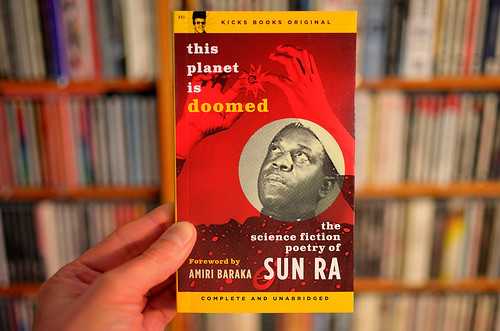
I picked up this cool little book at Downtown Music Gallery while we were in New York: This Planet Is Doomed: The Science Fiction Poetry of Sun Ra, which contains a number of previously unseen poems as well as a forward by Amiri Baraka and an overview of Ra’s literary pursuits by Bhob Stewart. Published by Kicks Books in association with Norton Records and Michael D. Anderson of the Sun Ra Archive, it’s definitely a worthy addition to the Sun Ra bookshelf. Here’s a great example (from page 73):

infinity is the language

all created art is music
art
choreography
sculpture
poetry
artworks
photographs
painting
architectural designs found in nature
trees
flowers
grass
every thing’s vibration is a different
degree of music
there is music everywhere
infinite infinity is the language of
enduring impression


I apologize for the sporadic posting lately (I’ve been busy!) but I’ll be back with more reviews next week—I promise!

May 22, 2011

Sun Ra Sunday

Sun Ra Books

The Sun Ra literature is depressingly thin. Aside from Szwed’s excellent biography and Prof. Campbell’s exhaustive (but now out of date) discography, there’s not much else out there. Fortunately, a couple books came out recently to help to fill the void.

After a long delay, the third and final volume documenting the spectacular 2006 exhibition, “Pathways To Unknown Worlds” was published last year by Whitewalls. Curated by John Corbett, Anthony Elms and Terri Kapsalis, the first volume in the series, The Wisdom of Sun Ra: Sun Ra’s Polemical Broadsheets And Streetcorner Leaflets collects facsimiles (and transcriptions) of Ra’s earliest writings while the second volume, Pathways To Unknown Worlds: Sun Ra, El Saturn And Chicago’s Afro-Futurist Underground 1954-68 serves as a catalog for the exhibition with high-quality reproductions of album art and other business ephemera along with essays by Corbett, Glenn Ligon, Adam Abraham, and Camille Norment. Finally, Traveling The Spaceways: Sun Ra, The Astro Black and Other Space Myths compiles presentations from a two-day symposium held at the Hyde Park Art Center in Chicago in November 2006. I haven’t read the whole thing yet, but our own Prof. Campbell offers his research on Sonny’s earliest years in Chicago and there are essays by all the curators as well as notable critics, Kevin Whitehead and Graham Lock. Like others in the series, it is a slender but lovingly produced volume and, taken together, they make a wonderful reference source regarding Sun Ra’s Chicago years.

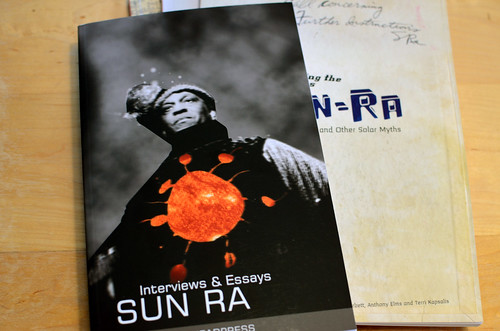
Additionally, good old John Sinclair has put together a book for Headpress simply titled, Sun Ra: Interviews & Essays and it looks pretty interesting. Collecting journalism from various sources, the book makes available writings that would otherwise be impossible to find—like an interview Sinclair conducted with Ra in 1966 for the Detroit Sun or a 1994 interview with trumpter, Michael Ray, published Offbeat. Again, I haven’t had a chance to read much of it yet, but I’m grateful to have it. Saturn Research continues!

+++

I know: I punted again. Tune in next week for more record reviews—I promise!

February 4, 2011

Book Art Video


If you love books (or book arts or just cool stop-frame animation), you need to see this short film made for the New Zealand Book Council. Animated by Andersen M Studio. Via Lizzy, the librarian.

August 28, 2010

Playlist Week of 8-28-10

* Buxtehude: Sonatas, Op.1 (Holloway/Mortensen/ter Linden) (Naxos CD†
* Buxtehude: Sonatas, Op.2 (Holloway/Mortensen/ter Linden) (Naxos CD)†
* Buxtehude: Seven Sonatas (Holloway/Mortensen/ter Linden) (Naxos CD)†
* J.S. Bach: Magnificat, etc. (Collegium Vocale, et al./Herreweghe) (Harmonia Mundi CD)
* J.S. Bach: Violin Sonatas (Manze/Egarr/ter Linden) (Harmonia Mundi 2CD)†
* J.S. Bach: Goldberg Variations and Canons (Egarr) (Harmonia Mundi 2CD)†
* Rebel: Violin Sonatas (Manze/Egarr/ter Linden) (Harmonia Mundi CD)†
* Schoenberg: Pierrot Lunaire, Op.21, etc. (Ens. InterContemporain/Shäfer/Boulez) (DG CD)
* Schoenberg: Suite, Op.29, etc. (Ens. InterContemporain/Boulez) (Sony Classical CD)
* Schoenberg: The Piano Music (Pollini) (DG CD)
* Oliver Nelson: The Blues and The Abstract Truth (Impulse! CD)
* Miles Davis & John Coltrane: The Complete Columbia Recordings (d.1-5) (Columbia 6CD)
* John Coltrane: Live at Birdland (Impulse! CD)
* Roy Haynes Quartet: Out of the Afternoon (Impulse! CD)
* Elvin Jones/Jimmy Garrison Sextet: Illumination! (Impulse! CD)
* Sun Ra: The Mystery Board (11-2 or 3-1972) (SBD/boot 2CDR)
* Anthony Braxton: 9 Compositions (Iridium) 2006 (d.8) (Firehouse 12 9CD+DVD)
* Mary Halvorson Trio: Dragon’s Head (Firehouse 12 CD)
* Mary Halvorson, et al.: Calling All Portraits (Skycap CD)
* Matthew Shipp: Harmony and Abyss (Thirsty Ear CD)
* The Blue Series Continuum: GoodandEvil Sessions (Thirsty Ear CD)
* The Blue Series Continuum: The Sorcerer Sessions (Thirsty Ear CD)
* Antipop Consortium: Antipop Consortium vs. Matthew Shipp (Thirsty Ear CD)
* El-P Featuring the Blue Series Continuum: High Water (Thirsty Ear CD)
* Pat Metheny Group: Quartet (Geffen CD)†
* Bob Dylan: Highway 61 Revisited (mono) (Columbia/Sundazed LP)
* Bob Dylan: Blonde On Blonde (mono) (Columbia/Sundazed 2LP)
* The Beatles: Beatles for Sale (stereo) (2009 remaster) (Apple/EMI CD)
* The Beatles: Rubber Soul (stereo) (2009 remaster) (Apple/EMI CD)
* The Beatles: Revolver (stereo) (2009 remaster) (Apple/EMI CD)
* Rolling Stones: “Handsome Girls” (live July 1978) (d.1-3) (SBD/boot 4CDR)‡
* Van Morrison: Astral Weeks (Warner Bros./Rhino LP)
* Grateful Dead: Carousel Ballroom, San Francisco, CA 3-31-68 (SBD CDR)
* Grateful Dead: Road Trips, Vol.3, No.3 (Fillmore East 5-05-70) (d.1) (GD/Rhino 3+1CD)
* Grateful Dead: Dick’s Picks, Vol.14 (Boston 11-30 and 12-02-73) (GD 4 CD)‡
* Soft Machine: The Soft Machine (ABC/Sundazed LP)
* Soft Machine: Volume Two (ABC/Sundazed LP)
* Soft Machine: Third (Columbia 2LP)
* Genesis: Foxtrot (Charisma – UK LP)
* Genesis: Selling England By the Pound (Charisma LP)
* The Flaming Lips, et al.: Play The Dark Side of the Moon (Warner Bros. CD)
* Robert Pollard: Moses On a Snail (GBV, Inc. CD)
* Circus Devils: Mother Skinny (Happy Jack Rock Records LP)

†=iPod
‡=car

Commentary:

Your letter gave me great pleasure indeed, above all because you are one of the extremely rare kind of people who are of such importance to our musical culture. I mean: it is not the professional musician, the musician who lives by his art, who is needed to keep musical culture going; it is the amateur, and it always has been the amateur who has really promoted and encouraged art. This is all the more gratifying since your profession is one that claims much of your time; and what is astonishing is the way you have come to know my music—I am thinking of piano pieces and scores that are really very difficult to grasp, difficult to read, difficult to decipher, and which demand great knowledge of various aspects of music. I am extremely delighted at having discovered such as musician as you.

It makes me extremely proud to have received such a letter particularly from you, and for me it will remain one of a few letters that have given me the greatest pleasure in my musical career.

-- Arnold Schoenberg: Letter to Jacques Martet, 6 January 1950 (Letters (ed. by Erwin Stein), University of California Press, 1987, p.279).

+++

I planned to tell you what painting meant—means—to me. In fact, it was the same to me as making music. To me it was a way of expressing myself, of presenting emotions, ideas, and then other feelings, and this is perhaps the way to understand these paintings—or not to understand them. … I expressed myself in the same manner as I did in music…[A]s a painter I was absolutely an amateur. I had no theoretical training and only a little esthetic training—this only from general education but not from an education which pertained to painting. In music, it was different [NB: Schoenberg was an autodidact]…They would probably have suffered the same fate as I have suffered. They would have been attacked and scolded, and I don’t know what else I should say: I mean the same would happen to them what happened to my music. They would have been understood or not understood.

-- Arnold Schoenberg: Interview with Halsey Stevens (1949) (quoted in The Visions of Arnold Schönberg: The Painting Years, Hatje Cantz Verlag, 2002, pp.91, 185).

+++

We see that in every painting of Schönberg, the inner wish of the artist speaks in the form which best befits it. Just as with his music (inasmuch as I a layman may affirm), Schönberg also in his painting renounces the superfluous (therefore the harmful) and proceeds along a direct path to the essential (therefore to the necessary). He leaves alone, unnoticed, all embellishments and artistic detail…I should most like to call Schönberg’s art the painting of essence.

-- Wassily Kandinsky: “Die Bilder” (1912) (Id., p.182).

+++

Once, in the army, I was asked if I was really the composer Arnold Schoenberg. “Somebody has to be,” I said, “and nobody else wanted to, so I took it on, myself.”

-- Arnold Schoenberg: Letter of Thanks to Those Who Sent Their Good Wishes on the Occasion of Schoenberg’s 75th Birthday, 16 September 1949 (Letters, p.290).

+++

Image: Arnold Schoenberg: Green Self-Portrait, 1910. Oil on wood 33 x 24 cm. (from The Visions of Arnold Schoenberg, p.100).

July 17, 2010

Playlist Week of 7-17-10

* Biber: Unam Ceylum (Holloway/Mortensen/Assenbaum) (ECM CD)
* Corelli: 12 Concerti Grossi, Op.6 (English Concert/Pinnock) (Archiv Prod. 2CD)
* Handel: Solo Sonatas, Op.1 (AAM/Egarr) (Harmonia Mundi 2CD)
* Handel: Trio Sonatas, Op.2&5 (AAM/Egarr) (Harmonia Mundi 2CD)
* John Coltrane: Impressions (Impulse! CD)
* Wayne Shorter Quartet: Park Den Brandt, Antwerp, Belgium 8-14-05 (FM 2CDR)
* Sun Ra: Slug’s Saloon, New York, NY 8-19-72 (AUD 3CDR)
* Sun Ra: Rehearsal 9-76 (AUD CDR)
* Sun Ra: South St. Seaport Museum, New York, NY 7-09-72 (AUD? CD)
* Lowell Davidson Trio: WBRS-FM Brandeis University 5-08-86 (Pre-FM 2CDR)
* Anthony Braxton 12+1tet: 9 Compositions (Iridium) 2006 (d.6) (Firehouse 12 9CD+DVD)
* Matthew Shipp Trio: Old Customs House, Tampere, Finland 11-03-07 (FM CDR)
* Kip Hanrahan: A Thousand Nights and a Night (American Clavé CD)
* DJ Shadow: Preemptive Strike (Mo Wax/A&M CD+CDEP)
* Marvin Gaye: What’s Going On (Motown/MFSL SACD)
* Bob Dylan: Planet Waves (Columbia SACD)
* Lucinda Williams: Sweet Old World (Elektra CD)
* Grateful Dead: Fox Theatre, Atlanta, GA 4-10-78 (SBD 3CDR)
* Grateful Dead: Madison Square Garden, New York, NY 9-17-91 (SBD 3CDR)
* Grateful Dead: Madison Square Garden, New York, NY 9-18-91 (SBD 3CDR)
* Yes: The Yes Album (Atlantic/MFSL CD)
* Yes: Fragile (Atlantic/MFSL CD)
* Yes: Tales of Topographic Oceans (Atlantic 2LP)
* Genesis: Paris Theatre 3-2-72/BBC 9-25-72 (Pre-FM CDR)
* Genesis: Convention Center, West Palm Beach, LF 1-10-75 (SBD 2CDR)
* Genesis: Empire Pool, Wembley, London 4-15-75 (Pre-FM DVDR-A)
* Peter Gabriel: [2] (a/k/a “Scratch”) (Atlantic LP)
* Steve Winwood: Arc of a Diver (Island LP)
* Can: Landed (Spoon SACD)
* Can: Flow Motion (Spoon SACD)
* Neu: Neu! (Astralwerks CD)
* Uncle Tupelo: Still Feel Gone (Columbia/Legacy CD)
* Uncle Tupelo: March 16-20, 1992 (Columbia/Legacy CD)
* Wilco: Sky Blue Sky (Nonesuch CD)
* Radiohead: Gofferpark, Nijmegen, Netherlands 9-16-00 (FM 2CDR)
* Radiohead: Hail to the Thief (Capitol CD)
* Radiohead: “There There” (Capitol CDEP
* Radiohead: “Go to Sleep” (Capitol CDEP
* Radiohead: In Rainbows (TBD Records CD)
* Panda Bear: “I’m Not”/”Comfy in Nautica” (Uunited Acoustic CD)
* Panda Bear: Person Pitch (Paw Tracks CD)
* Animal Collective: Merriweather Post Pavilion (Domino CD)

Reading:

* Glenn Kurtz, Practicing: A Musician’s Return to Music (Knopf 2007)

I sort of knew Glenn Kurtz when we were both students at The New England Conservatory of Music back in the mid-1980s. I didn’t know him well at all – he was one of those serious classical musicians who spent most his time in practice rooms while I was basically a slacker and a fraud, taking brief refuge in the quirky and nebulous Third Stream Department. But I hung out a lot with some of the characters who populate Kurtz’s memoir and reading it evokes the hothouse environment of the Conservatory with a discomfiting vividness. Moreover, his tale of bitter failure and painful reconciliation hits particularly close to home.

Kutz’s disarming honesty and elegantly crafted prose captures the complex and fraught relationship a musician suffers with an instrument and with music itself. Playing music is (or can be) fun; practicing is no fun at all:

Practicing is striving … a risk, a test of character, a threat of deeply personal failure. I warm up my hands and awaken my ears and imagination, developing skill to equal my experience. I listen and concentrate in an effort to make myself better. Yet every day I collide with my limits, the constraints of my hands, my instrument, and my imagination. Each morning when I sit down, I’m bewildered by a cacophony of voices, encouraging and dismissive, joyous and harsh, each one a little tyrant, each one insisting on its own direction. And I struggle to harmonize them, to find my way between them, uncertain whether this work is worth it or a waste of my time (p.9).

This is how every musician feels as they sit down to practice. It only seems worth it if your love of music and dream of becoming an artist remains intact. For Kurtz (as for many others, such as myself), the dream was cast upon the rocks of a harsh reality and the only response is to just stop playing music altogether:

Like so many people who practice an art in their youth, I couldn’t reconcile my love for music with the demands of adult life or the professional realities of earning a living from art. Perhaps I lacked the talent; perhaps I didn’t work hard enough. Whatever the case, quitting was a catastrophe. For ten years afterward my hands and my habits—the whole history of my playing—seemed like obstacles to music. I lost faith in the power of practicing to lead me forward. The one thing I loved most in life became a torture. It was a devastating loss (p.12).

I can relate to this, even though I lack Kurtz’s talent and worked nowhere near as hard as he did. I took a slightly different path but still achieved a modicum of success playing a kind of punk rock/free jazz hybrid that a few critics and hipsters might adore but most people can’t abide. I never made any money and never would. As I got older this crushing reality become impossible to ignore and my dream of being an artist collapsed in a fit acrimonious self-incrimination. After graduation from NEC, Kurtz traveled to Vienna, hooked up with fellow alum with whom he developed a nightclub act that managed to be moderately lucrative. But it wasn’t satisfying to Kurtz, whose dream was to be another Segovia, a superstar concertizing in prestigious concert halls. For both of us, making a living and making art wound up being mutually exclusive and when we gave up that dream, we gave up on music itself. Playing music became an exercise in futility so we simply stopped doing it.

At music school it is assumed that music is sublime; why that is so is not a subject of study or even serious contemplation. It therefore remains a mystery even to those entrusted with its performance. Indeed it would appear that the power of music is unexplainable and thinking about it too much can be a mortal danger to the professional musician. Kurtz describes an early crisis of faith he experienced while at NEC that he attempted to remedy by going to the library and studying various philosopher’s definitions of what makes music meaningful. Not surprisingly, he came up empty handed despite scholarly investigations dating back to Pythagoras:

For all of these music lovers, music was something other than music. It might be different for each one. But it was always the thing they loved the most. To the astronomer, music is disguised astronomy. To the mathematician, it is disguised mathematics. Leibniz, who invented calculus, was quite certain that “music is an unconscious exercise in arithmetic in which the mind doesn’t know it is counting.” The philosopher Arthur Schopenhauer was equally convinced that “music is an unconscious exercise in metaphysics in which the mind does not know it is philosophizing.” Among my friends at the Conservatory, we took for granted that music recounted the narrative of our emotional struggles. In Susanne Langer’s phrase, music was “our myth of the inner life.” Langer quotes the eighteenth-century theorist J.A. Huller, who expressed our belief, writing, “’Music has fulfilled its mission whenever our hearts are satisfied.’” This sounded right. It still didn’t explain music’s power. But it described how music comes to be the pure metaphor for our desire (pp.91-92).

In the fleeting instance of its sounding, music imposes an illusion of universal harmony and cosmically ordained order within our chaotic and seemingly irrational earthly existence. This is what makes music the most ineffably sublime of all the arts. But how music does this remains wholly speculative. As Katz observes, “We can’t prove our theories of what music means. But each theory reveals what we long for; it proves the truth of our longing” (p.93). A musician aspires to be the vessel of this mystical transubstantiation, but music school does not offer classes in aesthetics, much less alchemy. After all, how do you teach someone to turn a performance into a “metaphor for pure desire”? This is up to the performer alone and the best musicians do it unthinkingly. But as Kurtz flatly admits: “The essence of music is revelation … The essence of life, however, seems to be disappointment … once the music ended, the experience slipped away. Harmony is not eternal, though our need for it may be” (p.99).

For most young musicians, no matter how technically gifted or rigorous their practice regime, the task is too great, the goal will be forever beyond their reach. The wrenching painfulness of this realization one day causes them to quit playing music forever and wonder whether all that effort was for naught. Or they surrender to the exigencies of the marketplace, peddling meaningless aural wallpaper for people willing to pay for it. At one point, Kurtz contemplates a career as a wedding musician, “making pretty, classical-sounding noise to decorate the occasion”:

I could perform Beethoven or I could play scales. Either way people would tell me that it sounded lovely. Maybe that was enough … I shuddered at the thought. A life of loveliness. This was the opposite of everything I wanted. “Lovely” was nothing. It described prettified music drained of all power, of everything that made music great … If there was still the chance I could make great music, then settling for a life of “lovely” would be an unbearable betrayal (p.135).

What Kurtz feared was a “life of insignificance” (Id.) which is, of course, what everyone fears and a fate (almost) everyone nevertheless comes to endure. Coming to terms with this brutal truth is not just the problem of failed musicians, but they tend to feel it most intently. While Kurtz enjoyed playing the “mongrel” music he performed in Viennese cafés and bars, this was really no better than playing weddings in the states. He was an entertainer, not an artist, a musician’s best worst fate. And he comes to realize that his goal of becoming a star soloist was indeed just a shattered dream:

It takes courage to play new music; it takes courage to be a musician at all. But it takes more, so much more, to remain a musician, to let yourself be shaped by music however it speaks to you. Since I was twelve years old, I dreamed of living the life I heard, living an artist’s life. But I’d misunderstood myself, my desires, my ambitions. I misunderstood what it meant to be an artist.

In fact, I was just beginning, just learning how to conduct myself as an artist in the world. But it wasn’t the world I’d been working toward. And in that moment I saw that the distance between where I was and where I wanted to be was impossibly long. It sank in that I wasn’t ever going to arrive, and so it suddenly felt like I was nowhere. All the pent-up bitterness of a desire endlessly deferred broke loose. It devastated my dream world of music. My fingers hadn’t failed me; my technique and talent were not to blame. I’d just imagined the artist’s life naïvely, childishly, with too much longing, too much poetry and innocence and purity. And this image ruined music for me … the guitar had been the instrument of my dreams. Now the dream was over (p.193).

Kurtz returned to America, obtained a Ph.D. in literature from Stanford and settled into a life of writing and teaching. He put his guitar away and didn’t touch it again for more than a decade. But then, still grappling with his feelings of bitterness and inconsolable loss, he began to practice again, but with a different agenda:

I returned to practicing not as a young, aspiring artist, but as a former musician, with a different sense of what it means to play the guitar … My first time through, I practiced badly, chasing an ideal that ruined music for me, turning what I had loved the most into torture. Now I’m pursuing not an ideal but the reality of my own experience. I began to practice again because I felt I could do it better this time (p.207).

Some years after moving to Nashville, I bought a Yamaha Clavinova, an electric piano that looks, sounds and (for the most part) feels like a real acoustic piano. While at the Conservatory, I had taken up the electric guitar even though all of my training to that point had been on the piano (and clarinet, but I never took it very seriously). At the time I was motivated not only by my love of the electric guitar, but by the fact that competition for practice rooms with a decent piano was incredibly fierce at NEC, making it difficult for me to practice, even if I wanted to (which I didn’t). Besides, I was not at the conservatory to study classical music and the piano was, in my mind, forever associated with the stultifying imperiousness of so-called classical music. I loved the guitar because I didn’t know how to play it; not knowing the names of the notes freed me to hear those pitches as music instead of marks on a page. It was punk rock. Amazingly, the Third Stream Department tolerated this approach, at least for a little while. But I abandoned the guitar after the collapse of the band and hadn’t played any music at all ever since. Even so, I still had stacks of sheet music, classical compositions for piano ready-made for the amateur home soloist and I thought taking up the piano again after decades of neglect might rekindle my love of playing music. I began to practice again, re-learning the pieces of my youth on an instrument that felt like a long lost friend. I gradually regained some facility but playing well was not the point. I was regaining a part of myself that had been strangled by the vicissitudes of life. I will never be a musician, but I can still play music – if I take the time to practice. My experience is exactly as Kurtz describes:

I may never again play as well as I did when I was seventeen or twenty-one, may never play as well as I think I could. My hands are not as flexible, and I’ve lost so much time not practicing. But each day now when I sit down, I try to give a performance, opening myself over and over again to what I love the most, knowing each time that I will have to let it go. To play better now means learning to continue, living through what slips away (p.210).

Ultimately, this is a useful lesson for anyone to learn and suggests that all our efforts to live out unrealizable dreams are not totally wasted. Practicing an instrument is like trying to live any kind of meaningful life, full of frustration and failure, but also full of opportunities to find true love and experience moments of transcendent beauty. As Kurtz puts it, practicing teaches us about our limitations, which enables us to improve ourselves:

I think it is the same with anything you seriously practice, anything you deeply love. For me, it was music. The guitar. But whatever “music” is for you, if you practice for real, eventually it will show you everything that is within you. Because as accomplished or as disappointed as you may feel now, you don’t know what remains concealed in your hands. Maybe you’ll never grasp it all. What you want may never yield to your touch. And yet maybe one day a performance will surprise you. Maybe today your music will reveal all the joy and disappointment, all the love and the fear you are capable of, your whole life, the true concord of your own heart (p.211).

Kurtz’s touching memoir is about more than just music and trying (and failing) to become a professional musician; it is about the loss of childhood dreams and the agonizing accrual of adult wisdom. It is about making peace with that loss and having the temerity to carry on practicing anyway because to do otherwise is to die.

July 8, 2010

New Eyeglasses


I was overdue for a new set of glasses. Oh, I used to have perfect vision when I was young; but when I turned forty, my eyesight began to slip. After a year or so of progressively stronger cheapo reading glasses, I finally had to get a prescription. But that was almost three years ago and my vision had gotten noticeably weaker over time. Gosh, it’s nice to be able to read the fine print on my CDs again!

Over at An Overgrown Path (in a post tangentially about Igor Stravinsky and technology), there’s a thought-provoking quote from Jeff Greenwald’s The Size of the World that seems timely:
Arthur C. Clarke once suggested that the invention of eyeglasses (an event that occurred around 1350) may have actually launched the Renaissance by doubling the useful productive life of writers, artists and scientists.

This makes intuitive sense, even if it’s pure speculation. We take for granted such archaic technology and it is difficult to imagine what life would be like without corrective lenses. We certainly wouldn’t be zooming around at 80mph on the freeway talking on our cellular phones if we hadn’t first made it possible to see where we were going. (Not that this is a good idea in practice.)

So, even though as Bob Weir once said, wearing glasses is like “wearing a cage” (and it’s true), we should be eternally grateful for this ancient technology that allows us to see clearly, to read a book, to look at art, to drive a car -- even as we reach middle age and our eyes naturally begin to fail. Indeed our useful productive lives are doubled by this humble invention.

June 12, 2010

Playlist Week of 6-12-10

* Buxtehude: Sonatas, Op.1 (Holloway/Mortensen/ter Linden) (Naxos CD)
* J.S. Bach: Das Wohltemperierte Clavier, Vol.1 (Egarr) (Harmonia Mundi 2CD)
* Vivaldi: Violin Concertos, RV331, etc. (VBO/Marcon/Carmignola) (Archiv Prod. CD)
* Duke Ellington: The Great Paris Concert (Atlantic 2LP)
* Sun Ra: Astro Black (ABC/Impulse! LP>CDR)
* Bobby Hutcherson: Happenings (Blue Note CD)
* Evan Parker Electro-Acoustic Ensemble: Stadtgarten, Köln 5-13-10 (AUD 2CDR)
* Evan Parker Electro-Acoustic Ensemble: WDR, Bismarck-Saal, Köln 5-14-10 (AUD CDR)
* Herbie Hancock: Sextant (Columbia CD)
* Herbie Hancock & Headhunters: Sendsaal, Bremen, W. Germany 11-6-74 (FM CDR)
* Pat Metheny Group: The Road to You (Geffen CD)
* Sly & The Family Stone: A Whole New Thing (Epic/Sundazed LP)
* Bob Dylan: The Times They Are A-Changin’ (mono) (Columbia/Sundazed LP)
* Bob Dylan: Another Side of Bob Dylan (mono) (Columbia/Sundazed LP)
* Bob Dylan: The Freewheelin’ Bob Dylan (mono) (Columbia/Sundazed LP)
* Jeff Beck: Truth (mono) (Epic/Sundazed LP)
* Jeff Beck: Beck-Ola (Epic/Sundazed LP)
* The Who: Who’s Next? (Decca LP)
* The Who: Who Are You? (Polydor/Classic LP)
* Grateful Dead: Winterland June 1977: The Complete Recordings (6/7/77) (GD/Rhino 9+1CD)
* Jerry Garcia Band: After Midnight: Kean College 2/28/80 (Rhino 3CD)
* Yes: The Yes Album (Atlantic/MSFL CD)
* Yes: Fragile (Atlantic/MFSL CD)
* Genesis: Selling England By the Pound (Charisma LP)
* Can: Unlimited Edition (Spoon SACD)
* Saturday Night Fever (original soundtrack) (RSO/Polydor 2LP)
* Big Star: Radio City (Ardent/Classic LP)
* Boston: Boston (Epic LP)
* The Feelies: The Good Earth (Coyote LP)
* Los Lobos: Kiko (Slash/Warner Bros. CD)
* Guided By Voices: Do the Collapse (TVT CD)
* Robert Pollard: Motel of Fools (Fading Captain EP)
* Robert Pollard: Robert Pollard Is Off to Business (GBV, Inc. CD)
* Robert Pollard: “Weatherman and Skin Goddess” (GBV, Inc. CDEP)
* Circus Devils: Ringworm Interiors (Fading Captain Series LP)
* Radiohead: I Might Be Wrong: Live Recordings (Capitol CD)
* Animal Collective: Merriweather Post Pavilion (Domino CD)
* Animal Collective: Fall Be Kind (Domino CDEP)

Reading:

* Roger Scruton, The Aesthetics of Music (Oxford University Press, 1997)

After several previous failed attempts, I finally got through Roger Scruton’s monumentally ambitious The Aesthetics of Music. I can’t really say it was worth the effort. While Scruton makes some interesting observations and comes to some plausible conclusions as to why human beings respond to (certain kinds of) music in the way they (sometimes) do, he undermines an otherwise noble enterprise with a not-so-hidden ulterior motive: the needless rescue of “tonality” and so-called “classical” music from the presumed barbarism of a decadent modern culture. Uh-oh.

He gives the game away from outset by defining what we hear as music is the “transformation of sounds into tones” (p.17). This appears at first a useful definition; but by choosing the word “tone” upon which to build his aesthetics, he then embarks on a philosophical jeremiad against “atonality” (with sneering jibes at “post-modernism,” “pop music” and “Heavy Metal” thrown in for good measure). It seems to me that any comprehensive aesthetic of music would have to account for the widest possible range of musical experiences to be at all insightful. For even though I may not personally like a particular genre or style of music, there remain fundamental standards of “good” and “bad” within such genres or styles and the reason this is so should be the true subject of a musical aesthetics.

Elsewhere, Scruton is more useful. He confronts the ineffable immateriality of music by admitting that “the intentional object of musical perception [] can be identified only through metaphors” (p.108) which allude to the essentially “pure abstract quality” of music (p.122). This is suggestive of the reasons why music is so nutritive to the human spirit -- and so very difficult to write about. “Music inspires and consoles us partly because it is unencumbered by the debris that drifts through the world of life” (Id). Scruton thoroughly demonstrates that music is like “language” only in a strictly metaphorical sense since it lacks any representational ability. Music is always only about itself. Not even Scruton's beloved functional harmony can produce a generative syntax understandable as language. Accordingly, tonal harmony is not a strictly prescriptive grammar but a set of crudely-wrought tools, a certain traditional way of putting music together. But Scruton goes further and insists that this is the only way truly meaningful music can be put together and here his aesthetics veers off into sad polemic and unadulterated snobbery.

He graciously honors the importance of Schoenberg and the Second Viennese School and offers a grudging respect for certain quasi-tonal works such as Berg’s Violin Concerto; but he summarily concludes that the “serialism” of Boulez is utterly unintelligible except by “incorporating what we hear into tonal or quasi-tonal categories” (p.294) and “eliciting the ghost of a tonal order” (p.296) while we listen. He goes on to assert: “The possibility remains that tonal music is the only music that will ever really mean anything to us, and that, if atonal music sometimes gains a hearing, it is because we can elicit within it a latent tonal order” (p.308). Hogwash! This is contrary to my own experience and is further evidence of Scruton’s ideological agenda. Any attempt to mentally impose “a tonal order” upon atonal music is an exercise in frustration and will result in the kind of learned revulsion Scruton feels for Boulez, Stockhausen, Babbitt and the like. This is, of course, the desired result. Scruton refuses to accept that anyone can find musical meaning in these composers’ works and triumphantly declares: “[a]tonal music proved unable either to find an audience or to create one” (p.507). The audience for such music might be small, but it persists.

He has nice things to say about jazz but only to the extent that it serves to bolster tonality’s primacy, while conveniently ignoring its African roots and the “atonal” developments of Cecil Taylor and his ilk. And by the time he starts comparing the “ugliness” of Nirvana to the clever harmonies of The Beatles and the “shapeless cries” of REM to the rounded cadences of Cole Porter, well, it just gets silly:

[M]usic is a character-forming force, and the decline of musical taste a decline in morals. The anomie of Nirvana and REM is the anomie of its listeners. To withhold all judgment, as though taste in music were on a par with a taste in ice-cream, is precisely not to understand the power of music (p.502).
Even if we are to grant Scruton’s contention that “taste in music matters and that the search for objective musical values is one part of our search for the right way to live” (p.391), it does not follow that joining in his crusade to rescue classical music from the bogeymen of (post)modernism is “the right way to live.” He concludes the book with an exhortation to embark on “the great task…of recovering tonality as the imagined space of music, and of restoring the spiritual community with which that space was filled…a rediscovery of the tonal language, which will also redeem the time” (pp.507-508). As far as I can tell, tonality needs no such saving. What is needed is an aesthetic of music that can account for the infinity of its instances. Indeed John Cage demonstrated that even unintentional sounds can be heard as music without being “transformed into tones” as Scruton would, for ideological reasons, insist. This profound cognitive ability is what enables us to ascribe meaning to music of all kinds but Scruton’s tome ultimately fails to elucidate what this meaning might be or why we should care. What a waste.