I’m taking a break for the holiday weekend -- and so should you. Instead of reading my rambling drivel, have a listen to the man himself in this brief interview from WTZA-TV 62 which was aired to promote the Arkestra’s appearance at The Getaway in Saugerties, New York on June 13, 1986. Note that the death of Bennie Goodman, “The King of Swing,” is announced right after Ra’s segment.
May 30, 2010


May 29, 2010
Playlist Week of 5-29-10
.jpg) * Vivaldi: Late Violin Concertos, RV177, etc. (VBO/Marcon/Carmignola) (Sony Classical CD)
* Vivaldi: Late Violin Concertos, RV177, etc. (VBO/Marcon/Carmignola) (Sony Classical CD)* Vivaldi: Late Violin Concertos, RV386, etc. (VBO/Marcon/Carmignola) (Sony Classical CD)
* Duke Ellington: Ellington Uptown (Columbia LP)
* Herbie Nichols: The Complete Blue Note Recordings (d.2) (Blue Note 3CD)
* Horace Silver Quintet: Song for My Father (Blue Note LP)
* Freddie Redd Quartet: Music from the Connection (Blue Note LP)
* Eric Dolphy: Out to Lunch (Blue Note/Music Matters 2-45RPM)
* Jackie McLean: Destination Out! (Blue Note LP)
* Bobby Hutcherson: Patterns (Blue Note LP)
* Bobby Hutcherson: Components (Blue Note LP)
* Sun Ra: Unknown venue, Berkeley, Ca circa.1972 (SBD CDR)
* Sun Ra: Astro Black (Impulse! LP>CDR)
* Ornette Coleman: Virgin Beauty (Columbia/Portrait LP)
* Anthony Braxton Small Ensemble: Wesleyan University 4-23-10 (AUD CDR)
* Anthony Braxton Large Ensemble: Wesleyan University 4-29-10 (AUD 2CDR)
* Mahavishnu Orchestra: Century Theatre, Buffalo, NY 1-27-73 (Pre-FM 2CDR)
* Kip Hanrahan: Desire Develops an Edge (American Clavé 2LP)
* Bob Marley & The Wailers: The Complete Wailers 1967-1972 Pt.II (d.3) (JAD 3CD)
* The Mothers of Invention: The Grand Wazoo (Bizarre/Reprise LP)
* Pink Floyd: The Dark Side of the Moon (Capitol/EMI SACD)
* Grateful Dead: Boston Garden, Boston, MA 9-24-93 (SBD 3CDR)
* Grateful Dead: Boston Garden, Boston, MA 9-25-93 (SBD 3CDR)
* Grateful Dead: Boston Garden, Boston, MA 9-29-93 (SBD 3CDR)
* Grateful Dead: Boston Garden, Boston, MA 9-30-93 (SBD 3CDR)
* Love: Forever Changes (Elektra/Rhino CD)
* The Feelies: Crazy Rhythms (Stiff LP)
* The Flaming Lips, et al.: The Dark Side of the Moon (Warner Bros. CD)
* Robert Pollard: We All Got Out of the Army (GBV, Inc. CD)
* Tortoise: Beacons of Ancestorship (Thrill Jockey LP)
Commentary:
The idea of The Flaming Lips remaking Pink Floyd’s iconic Dark Side of the Moon seems preposterous at first. But then again, when I saw the Lips for the very first time back in 1986 at Molly’s in Allston, Massachusetts, they earnestly plowed through The Who’s Tommy in the middle of their set. Further, various oddball covers litter their discography, including a note-perfect rendition of Queen’s “Bohemian Rhapsody” (which can be found on the At War With the Mystics 5.1 CD/DVD-A). So, the idea is not so far-fetched after all. And if you are at all familiar with this classic album and are a fan of The Flaming Lips, then their take on it will certainly be of interest. Assisted by Star Death and White Dwarfs, Henry Rollins (who handles the speaking parts), and Peaches (who provides a disturbingly uncanny impersonation of Clare Torry’s orgasmic wail on “The Great Gig in the Sky”), the approach is surprisingly sincere and un-ironic. Fortunately, they do not attempt an exact recreation the album and instead re-imagine it in a post-punk style while still evincing a genuine love for the original. But it seems to me a similar affection for The Dark Side of the Moon is necessary to really appreciate this, to get the joke as it were. While it has been a lot of fun for me to listen to, your mileage may vary considerably.
May 23, 2010
Sun Ra Sunday
 Sun Ra: Intergalactic Research (The Lost Reels Collection, Vol.2) (Transparency CD)
By the spring of 1972, the Arkestra’s living situation was becoming increasingly precarious. Sun Ra had returned to the University of California in Berkeley hoping to teach another class in black aesthetics but soon quit after not being paid (Szwed p.330). He claimed the university targeted him due to the controversial subject matter of his lectures, but for whatever reason, his academic career (such as it was) was now over (Id.). Moreover, the Black Panthers evicted the Arkestra out of their house in Oakland due to “ideological” differences” (Id.) -- likely regarding the Panthers’ recent rhetorical turn toward violent revolution. As Sun Ra predicted, this move would doom the Panthers as a legitimate political party or progressive social movement. As Sonny later acidly remarked: “we got kicked out by Eldgridge Cleaver or somebody” (Id.). And so with little paying work and no place to live, the decision was made to leave California in May, 1972 and move back to Marshall Allen’s house on Morton Street in Philadelphia -- this time for good.
Naturally, some band members took off immediately for points elsewhere but, as usual, the core musicians hung in and slowly made their way with Sonny across the country, hustling gigs as they could. Sadly, very little documentary evidence exists of this period. However, a thirty-two minute concert fragment from an unknown venue was issued as part of Transparency’s Lost Reels Collection, Vol.2 and it just might be possible this was recorded in the spring of 1972, prior to the band’s arrival back east. On the other hand, the presence of Pat Patrick on baritone sax and electric bass is suspicious for a later date (he does not appear on the soundtrack or in the film, Space Is the Place). So who knows when exactly this was recorded? In any event, I’m sticking it here for the time being.
While all too brief, it is a remarkably good sounding tape, recorded in mono with on-stage microphones or, perhaps, from the soundboard. It is also a fantastic performance, starting out with a surprisingly subdued MiniMoog solo, full of gentle, swooshing noises and lazy portamentos. This serves as a prelude to an outrageous rendition of “Outer Space” with Sun Ra cueing thunderous space chords to punctuate his mad-scientist-style organ solo before giving way to a powerful tenor sax blowout by John Gilmore. Yes, it’s another incredible Gilmore solo! This leads into a conducted improvisation which begins with some noodling electric bass over a smattering of percussion; but as things start to heat up, Kwami Hadi comes in with some high-register trumpet acrobatics, his rich tone full-bodied and warm. Suddenly, Ra cues the ensemble in an energetic group improvisation which is abruptly silenced by a gigantic blast of organ, the piece ending with some quietly hissing chords. Interesting! Finally, a rare performance of “Intergalactic Research” concludes the tape with its long, loping jam built upon an endlessly repeating two-note figure which is passed around the Arkestra in various instrumental combinations. (Interestingly, Ra is heard on acoustic piano on this track.) Eloe Omoe takes a snaky bass clarinet solo, but he’s off mic and hard to hear but Hadi provides another virtuoso turn on trumpet. After fifteen minutes of groovy vamping, the ensemble returns with the theme only to have the tape fade out. Argh! Too bad the rest of this concert (whenever it was recorded) was not preserved!
It wasn’t all bad news for the Arkestra: producer Ed Michel had recently offered Sun Ra and Alton Abraham a potentially lucrative contract with ABC/Impulse! to reissue most of the Saturn LPs and to go into the studio to make a bunch of new albums (Id. p.333). According to Ra, the label promised "to spend almost a million dollars in publicity" (Id.). ABC/Impulse! was, of course, the home of John Coltrane’s late recordings, which had spawned “The New Thing” and a stream of semi-popular albums by such Coltrane acolytes as Pharoah Sanders and Archie Shepp. At the time, it probably seemed like Sun Ra would fit right in. Ultimately, the deal didn’t quite turn out as well Sonny had hoped; but for a brief while, Sun Ra records were widely available in stores and helped take the band to the next level. The Arkestra would make its first recording for the label, the classic Astro Black, while in Chicago on May 7, 1972 (Campbell & Trent p.185).
May 22, 2010
Playlist Week of 5-22-10
.jpg) * Rebel: Violin Sonatas (Manze/Egarr/ter Linden) (Harmonia Mundi CD)
* Rebel: Violin Sonatas (Manze/Egarr/ter Linden) (Harmonia Mundi CD)* J.S. Bach: 7 Harpsichord Concertos (AAM/Manze/Egarr) (Harmonia Mundi 2CD)
* J.S. Bach: Musikalische Opfer (Maroney, et al.) (Harmonia Mundi CD)
* Satie: L’œuvre pour piano (Ciccolini) (d.1) (EMI Classics 5CD)
* Duke Ellington and Johnny Hodges: Side By Side (Verve/Classic LP)
* Duke Ellington: Blues in Orbit (Columbia/Classic LP)
* Duke Ellington: Jazz Party in Stereo (Columbia/Classic LP)
* Sun Ra: Soundtrack to the Film Space Is the Place (Evidence CD)
* Sun Ra: ESP Radio Tribute (d.2) (selections) (FM 5CDR)
* Sun Ra: Unknown venue, Berkeley, CA circa. 1972 (AUD/boot CDR)
* Sun Ra: Unknown venue, circa. 1972 (SBD?/boot 2CDR)
* Cliff Jordan & John Gilmore: Blowin’ In from Chicago (Blue Note LP)
* Baby Face Willette: Stop and Listen (Blue Note LP)
* Charles Mingus: Tijuana Moods (RCA/Classic LP)
* Charles Mingus: Mingus Ah Um (Columbia/Classic LP)
* The Crusaders: Free As the Wind (ABC/Blue Thumb LP)
* Marvin Gaye: What’s Going On (Motown/MFSL SACD)
* Marvin Gaye: Let’s Get It On (Motown/MFSL SACD)
* Bootsy’s New Rubber Band: Blasters of the Universe (d.1) (Ryko 2CD)
* The Beatles: Rubber Soul (2009 mono remaster) (Apple/EMI CD)
* Grateful Dead: Steppin’ Out With the Grateful Dead: England ’72 (d.1-2) (GD/Arista 4CD)
* Grateful Dead: Capital Center, Landover, MD 7-29-74 (SBD 3CDR)
* Grateful Dead: Dick’s Picks, Vol.31 (8-74) (d.1-3) (GDM 4CD)
* Grateful Dead: Nassau Coliseum, Uniondale, LI, NY 11/1/79 (d.2-3) (SBD 3CDR)
* Grateful Dead: RFK Stadium, Washington, DC 6-24-95 (AUD 3CDR)
* Yes: The Yes Album (Atlantic/MFSL CD)
* Yes: Fragile (Atlantic/MFSL CD)
* King Crimson: The Nightwatch: Amsterdam Concertgebouw 11-23-73 (DGM 2CD)
* Jeff Beck: Truth (mono) (Epic/Sundazed LP)
* Jeff Beck: Beck-Ola (Epic/Sundazed LP) iridescent
* Jeff Beck: Blow By Blow (Epic LP)
* Jeff Beck: Wired (Epic LP)
* Jeff Beck with The Jan Hammer Group: Live (Epic LP)
* Eric Clapton: Slowhand (RSO LP)
* Chicago: III (Columbia 2LP)
* Chicago: V (Columbia LP)
* Chicago: VI (Columbia LP)
* Chicago: VII (Columbia 2LP)
* Chicago: VIII (Columbia LP)
* Chicago: X (Columbia LP)
* The Doobie Brothers: The Best of the Doobies (Warner Bros. LP)
* Steely Dan: Aja (ABC/Cisco LP)
* Rickie Lee Jones: Rickie Lee Jones (Warner Bros./Rhino LP)
* Mudcrutch: Mudcrutch (Warner Bros./Reprise 2LP)
* U2: The Unforgettable Fire (Deluxe Edition) (Island/Universal 2CD)
* U2: The Joshua Tree (Deluxe Edition) (Island/Universal 2CD)
* ABC: The Lexicon of Love (Mercury LP)
* The Pixies: Surfer Rosa (4AD/MFSL SACD)
* The Pixies: Doolittle (4AD/MFSL SACD)
* Yo La Tengo: Popular Songs (Matador CD)
* The Flaming Lips, et al.: The Dark Side of the Moon (Warner Bros. CD)
* Robert Pollard: Elephant Jokes (GBV, Inc. CD)
* Robert Pollard: We All Got Out of the Army (GBV, Inc. CD)
* Boston Spaceships: Zero to 99 (GBV, Inc. CD)
Commentary:
I so enjoyed Rhino’s vinyl reissues of Chicago Transit Authority and Chicago II that I decided to poke around the local record stores and see if I could find the rest of their 1970s albums on LP. It was not very difficult. Of course, Chicago sold a bajillion albums in their day and these records are common as dirt and, therefore, quite cheap -- so long as you’re willing to forego such niceties as near-mint jackets, posters, etc. Fortunately, the vinyl was in decent condition, if extremely dirty. However, my patented deep cleaning process brought them back to life and, gosh, it was like visiting with old friends whom I hadn’t heard from in many, many years -- decades even.
Embarrassingly enough, 1974’s Chicago VII is still my favorite. I played it to death as a kid. Believe it or not, I had it on 8Track! I absolutely loved this stuff. You see, I was a total band geek who took classical piano lessons and hung around trombone players and trumpeters. It seemed to us that Chicago had it all: sophisticated composition, big-band chops and great pop songs everybody seemed to love. Perfection! I remember in the eighth grade a group of us hacked our way through an arrangement of “Saturday In the Park” imagining we sounded pretty good (even though we didn’t). I loved Chicago VII because it marked a return to the sprawling double-album format of their first two records, opening with thirty minutes of audacious jazz-rock fusion but also featuring such radio hits as the Philly-soul infused “I’ve Been Searchin’ So Long” and the lush, dreamy, “Wishing You Were Here.” Moreover, Terry Kath plays typically brilliant guitar throughout and closes side three with two excellent songs, “Song of the Evergreens” and “Byblos.” How could I have ever turned my back on this beautiful music?
Here’s how: I went away to college and was exposed to free jazz and punk rock and Chicago, who, after the tragic death of Terry Kath, became self-parodying purveyors of bland top-40 cheese, was suddenly totally uncool. Their albums were some of the first to be sold off in the name of urban hipsterism -- and also because of a lack of money and space in which to house my growing record collection. That’s OK. I certainly experienced a lot of different music over the years and if it required rejecting one thing to take on another, then so it goes, I guess. But as I get older, I no longer feel the need for such snobbery and exclusion and hearing this music again for the first time after all these years has made me very happy. So am I just another middle-aged loser, vainly reclaiming the ephemera of my lost youth? A look at this week’s extended playlist suggests the answer is, perhaps, yes. Yet listening to these albums again feels like more than just a nostalgia trip -- it is simply good music! What more needs to be said? Nothing.
May 21, 2010
Common Birds at the Feeder: American Crow

We see a lot of American Crows at the suet feeder, but they are extremely skittish birds and therefore hard to photograph. Big, heavy and slow, a crow will usually take off at the first glint of the camera! I got lucky today although the light was poor. The truth is, this crow tolerated my camera out of necessity: it's spring and the birds are not only feeding themselves, but bringing home the bacon to their little ones back at the nest (note this one's beak is jam-packed full of yummy suet). The crows are magnificent birds, with their imposing size, iridescent black feathers, wise eyes and soulful caw. Amazingly, crows will engage Red-tailed hawks in death-defying dogfights to protect their broods. Beautiful, noble birds.
May 16, 2010
Sun Ra Sunday
.jpg) Sun Ra & His Intergalactic Solar Arkestra:
Sun Ra & His Intergalactic Solar Arkestra:Soundtrack to the Film Space is the Place (Evidence CD)
In early 1972, the Arkestra entered a real recording studio for the first time since their relocation to California in order to record the soundtrack and to be filmed for inclusion in the movie, Space Is the Place. The name of the studio is unknown and, in any case, it is long gone by now; but according to producer Jim Newman, it was “on Connecticut Avenue at the foot of Potero Hill in San Francisco” and the crew was borrowed from the legendary Different Fur Trading Company (Campbell & Trent, p.185). While an accompanying album to be released on Blue Thumb is alluded to in the movie, most of the music recorded at these sessions was finally issued for the first time by Evidence in 1993. The material was heavily edited for the film and mostly drawn from the working repertoire of the period, including such live stalwarts as “Watusa,” “Satellites Are Spinning,” “Outer Spaceways Incorporated,” “We Travel the Spaceways,” “Love in Outer Space,” and, of course, “Space Is the Place.” While the performances are rather abbreviated on the CD, the sound quality is excellent and, despite the fact that John Gilmore is heard primarily on drums rather than saxophone, there are several interesting bits of music which make this well worth hearing.
For example: “Under Different Stars” is an intense conducted improvisation featuring trumpeters Kwame Hadi and Wayne Harris bathed in thick reverb while Sonny makes burbling noises on electronic keyboards. And while “Discipline 33” is mis-titled according to Ben Opie (Id.), it is definitely from the Discipline series of compositions with its intricately interweaving horn riffs and Hadi again turns in a tasteful solo; sadly, it fades out too soon never to be played again. “The Overseer” is another free-jazz freakout, tautly reined in by Ra’s orchestral organ sprays while “Mysterious Crystal” evokes the futuristic exotica of Strange Strings, featuring a typically brilliant oboe solo by Marshall Allen. Finally, Sun Ra takes a thoughtful MiniMoog solo on “Cosmic Forces” and launches into some portentous declamations on “I Am the Alter-Destiny” and “I Am the Brother of the Wind,” the latter allowing Eloe Omoe to shine on raspy bass clarinet while the ensemble rages in the background.
According to Campbell & Trent, edited versions of “We’re Living in the Space Age” and the “Unknown Factor” were used in the film but not included on the Evidence CD (Id). Furthermore, the wonderfully atonal piano solo from the hilarious strip club scene is also absent. It seems likely all this music was recorded at a later date as work continued on the film well into 1974, but these have not turned up to date. Additionally, the 2001 ESP Radio Tribute broadcast included extended versions of “Outer Spaceways Incorporated” and “We’ll Wait for You,” which segues into “Strange Worlds” and ends with another spaced-out synthesizer solo. Unfortunately, these tracks are in mono and suffer from slightly degraded sound quality. Even so, completists will want to search them out.
Space Is the Place may have been something of a cinematic failure, but the soundtrack CD is enormously satisfying and makes for an excellent overview of the Arkestra’s music during this period. For casual and fanatical Sun Ra fans alike, it is absolutely essential.
May 15, 2010
Playlist Week of 5-10-10 through 5-15-10
.jpg) * J.S. Bach: Violin Sonatas (Manze/Egarr/ter Linden) (d.1) (Harmonia Mundi 2CD)
* J.S. Bach: Violin Sonatas (Manze/Egarr/ter Linden) (d.1) (Harmonia Mundi 2CD)* J.S. Bach: The Works for Lute (Kirchhoff) (d2.) (Sony Classical 2CD)
* Thelonious Monk with John Coltrane: The Complete Riverside Recordings (Riverside 2CD)
* Thelonious Monk Quartet with John Coltrane: At Carnegie Hall (Blue Note CD)
* Dexter Gordon: Go (Blue Note LP)
* Sonny Clark: Cool Struttin’ (Blue Note/Classic LP)
* Hank Mobley: Soul Station (Blue Note LP)
* Hank Mobley: A Slice of the Top (Blue Note LP)
* John Coltrane Quartet: Ballads (Impulse! CD)
* Roscoe Mitchell Quartet: Chiostro di Villa d’Este, Tivoli, Rome 6-28-09 (FM CDR)
* Henry Threadgill’s Zooid: Auditorium Parco della Musica, Rome 5-04-10 (FM 2CDR)
* Anthony Braxton 12+1tet: 9 Compositions (Iridium) 2006 (d.4) (Firehouse 12 9CD+DVD)
* Matthew Shipp Trio: Saint’Anna Arresi, Cagliari, Italy 9-02-09 (FM CDR)
* John Abercrombie Quartet: Wait Till You See Her (ECM CD)
* Nicky Skopelitis: Ekstasis (Island/Axiom CD)
* The Beatles: A Hard Day’s Night (2009 mono remaster) (Apple/EMI CD)
* The Beatles: Beatles for Sale (2009 stereo remaster) (Apple/EMI CD)
* The Beatles: Help! (2009 mono remaster) (Apple/EMI CD)
* Mothers of Invention: Weasels Ripped My Flesh (Bizarre/Reprise LP)
* The Band: Music from Big Pink (Capitol/MFSL SACD)
* Grateful Dead: Steppin’ Out With the Grateful Dead: England ’72 (d.4) (GD/Arista 4CD)
* Grateful Dead: Coliseum, Hampton, VA 5-01-81 (SBD 3CDR)
* Van Morrison: Beautiful Vision (Warner Bros. CD)
* Can: Future Days (Spoon SACD)
* Robert Pollard w/Doug Gillard: Speak Kindly of Your Volunteer Fire Department (FCS LP)
* Buckethead: Population Override (Ion CD)
* Animal Collective: Merriweather Post Pavilion (Domino CD)
Commentary:
Lizzy recently remarked on her blog that, of all the different kinds of music we listen to, she feels most at home when we’re listening to jazz -- “especially Coltrane, Mingus, Hutcherson, Hill, that warm beautiful music.” I guess I always knew she liked this stuff, but didn’t quite realize the deep emotional response she experienced. After the crazy flooding, our whirlwind travels, and the general angst of these past weeks, I made an effort to put on some “warm, beautiful” jazz in the evenings. Lord knows, I have a lot of it in the collection! It was fun to pull out some stuff I rarely listen to, like Dexter Gordon, Hank Mobley, and especially Thelonious Monk’s legendary recordings with John Coltrane. I used to be a snob about “straight-ahead” jazz, dismissing it as hopelessly old fashioned while ostentatiously announcing my elitist preference for the more difficult and abstract modernist avant garde that followed in its wake. But there is undeniably an embracing feeling of warmth and comfort that comes with snapping your fingers to an effortless swing groove and marveling at the endless melodic inventiveness of the great improvisers. Being a snob is so narrow-minded and unnecessarily limiting! My life is greatly improved by being open-minded and receptive to all things beautiful in this world. Of course, I do love the “weird” stuff as well -- but knowledge of jazz’s rich history can provide context and meaning to what might at first seem austere and forbidding music. For instance, the Roscoe Mitchell Quartet radio broadcast from last June in Rome features a long, complex composition that weaves written-out sections with free improvisation which will require further close listens to fully comprehend; but when they end the set with a joyful rendition of the brightly swinging “Along Came Jazz,” the whole thing intuitively makes sense as the one informs the other. This is a remarkable performance by true master musicians which deserves wide release. At the improbable age 69, Mitchell sounds better than ever on various saxophones and flute. I’m looking forward to pulling out some more great jazz records (old and new) in the coming weeks.
Reading:
Charles Wheelan, Naked Economics: Undressing the Dismal Science (Norton 2002, 2010)
I picked this up at the airport on the way out to Kansas City, intrigued by the title and its promise to make a dry-as-dust subject “witty and entertaining.” Amazingly enough, NPR commentator Charles Wheelan has succeeded in writing a very readable book (with nary a graph or mathematical equation in sight) while cogently explaining such esoteric topics as the Federal Reserve, the alchemy of monetary policy, the complexity of securitization, and (in this fully revised and updated edition) the root causes of the current, ongoing financial crisis. Refreshingly, Wheelan is not a doctrinaire “free market” ideologue, despite his University of Chicago pedigree. In fact, he goes to great lengths to demonstrate the absolute necessity of (uncorrupt) government, (competent) regulatory schemes, (broadly beneficial) public works, and sensible (if not steeply progressive) taxation. However, he does say some things that strike me as downright silly: For example, he repeatedly insists that high rates of taxation cause people to work fewer hours and, conversely, low taxation causes people to work more. In the abstract, this might make some sense regarding how people respond to economic incentives. But in the world I live in, people work as hard as they can (if they can find a job) simply because they have to in order to survive (and perhaps afford a few luxuries) -- regardless of any incremental changes in the tax code. Furthermore, he makes a disturbingly plausible argument that third-world sweat shops are ultimately a good thing for the workers who toil in them because increasing trade will (eventually) raise their standard of living. This may be the case, but there is a moral dimension that is profoundly troubling. The truth is that while economics is “a way of viewing the world,” it is impoverished as philosophy and unproven as science. It is a truism that money cannot buy happiness and the reasons why this is so cannot be answered by economics alone. Nevertheless, a basic understanding of economic principles is essential for an informed citizenry and, as an introductory text, Naked Economics is most highly recommended.
May 10, 2010
Playlist Week of 5-03-10 through 5-10-10
 * J.S. Bach: The Works for Lute (Kirchhoff) (d.1) (Sony Classical 2CD)
* Vivaldi: Cello Sonatas (ter Linden/Mortensen) (d.1) (Brilliant Classics 2CD)
* Herbie Nichols: The Complete Blue Note Recordings (d.1) (Blue Note 3CD)
* Grant Green: Idle Moments (Blue Note CD)
* Sam Rivers: The Complete Blue Note Sam Rivers Sessions (Blue Note/Mosaic 5LP)
* Herbie Hancock: Man-Child (Columbia/MFSL CD)
* The Brothers Johnson: Look Out for #1 (A&M CD)
* The Beatles: Please Please Me (2009 mono remaster) (Apple/EMI CD)
* The Beatles: With the Beatles (2009 mono remaster) (Apple/EMI CD)
* Bob Dylan: Love and Theft (Columbia SACD)
* Jerry Garcia Band: Lunt-Fontanne Theatre, NYC 10-31-87 (d.1-2,4) (Pure Jerry 4CD)
* Van Morrison: Veedon Fleece (Polydor CD)
* Van Morrison: Common One (Warner Bros. CD)
* Van Morrison: Inarticulate Speech of the Heart (Warner Bros. CD)
* Rickie Lee Jones: Pirates (Warner Bros./MFSL SACD)
* BR5-49: Live from Robert’s (Arista CDEP)
* BR5-49: BR5-49 (Arista CD)
* Beck: Sea Change (Geffen/MFSL CD)
* Boston Spaceships: Brown Submarine (GBV, Inc. CD)
Commentary:
It’s a short playlist this week -- not only because of last weekend’s flooding, but also because we made a quick to a trip to Kansas City to see my mom for Mother’s Day. Every time we go out there we try to get to the Nelson-Atkins Museum of Art, which houses one of the country’s great collections (photograph). This time we took my sister and slowly made our way chronologically through the museum and it was interesting to stop and look closely at works I normally would zip right past (e.g. most anything pre-20th Century). Molly has recently developed an interest in art and we thought it would be useful to make a historical survey so as to see the development of art practice through the ages and (perhaps) provide her with some context for some of the weirdo abstract art that we love so much. I don’t know how successful we were on that front, but it was a lot of fun! There are more photos from the museum on my Flickr photostream, if you’re interested.
May 5, 2010
Videos from the Flood
As promised, here are a few videos of the flooding here in Kingston Springs. The first one is from Saturday, May 1, 2010 and shows the bridge at the bottom of our road. The river is already extremely high, but the bridge is traversable and you can see that the old trestle and railroad bridges are still intact:
This one shows the water overflowing the bridge on Sunday, May 2. Note that the left side of the old trestle bridge has been wiped out completely. The violence of the raging river is awe inspiring. No wonder the road was ripped apart:
Finally, the most horrifying video of all: a big beautiful house on East Kingston Springs Road being picked up off its foundations and floating away. This one is painful for me to watch, but it really captures the unprecedented destruction of this storm:
Now playing: Bob Dylan,"High Water (for Charley Patton)."
This one shows the water overflowing the bridge on Sunday, May 2. Note that the left side of the old trestle bridge has been wiped out completely. The violence of the raging river is awe inspiring. No wonder the road was ripped apart:
Finally, the most horrifying video of all: a big beautiful house on East Kingston Springs Road being picked up off its foundations and floating away. This one is painful for me to watch, but it really captures the unprecedented destruction of this storm:
Now playing: Bob Dylan,"High Water (for Charley Patton)."
May 4, 2010
Flood Damage

None of the photographs I took yesterday really capture the devastation of the flood waters. I was pretty much totally freaked out when I saw for myself what nature hath wrought. This is the our road at the bottom of the hill, just before it crosses the Harpeth River. The water lifted up pieces of asphalt and tossed them around like children's toys. They eventually closed the bridge to pedestrians and it will be a long, long time before the road opens again. There are more photos on my Flickr photostream, if you're interested. There's lots of video footage on YouTube which I will post tomorrow. We are lucky to live at the top of the hill and our house suffered no water damage whatsoever. But many people were not so fortunate. Six (6!) houses in Kingston Springs were lifted off their foundations and floated away. Just incredible. My prayers are with all my neighbors who were hardest hit by this 500-year flood. Let's hope it's another 500 years before anything like this happens again
Playlist Week of 5-01-10
.jpg) * Buxtehude: Sonatas, Op.1 (Holloway/Mortensen/ter Linden) (Naxos CD)
* Buxtehude: Sonatas, Op.1 (Holloway/Mortensen/ter Linden) (Naxos CD)* Buxtehude: Sonatas, Op.2 (Holloway/Mortensen/ter Linden) (Naxos CD)
* J.S. Bach: Sonatas & Partitas for Solo Violin (Holloway) (ECM 2CD)
* J.S. Bach: The Works for Lute (Kirchhof) (Sony Classical 2CD)
* J.S. Bach: Die Kunst der Fuge (Maroney) (Harmonia Mundi 2CD)
* Leo Brouwer: Rara (Deutsche Gramophone CD)
* Duke Ellington & Johnny Hodges: Back to Back (Verve/Classic LP)
* John Coltrane: Fearless Leader (d.3) (Prestige 6CD)
* Grant Green: Green Street (Blue Note CD)
* Bobby Hutcherson: “Mellow Vibes” (Blue Note mix CDR)
* Sun Ra: Soundtrack to the Film Space Is the Place (Evidence CD)
* Eric Dolphy: Iron Man (Fuel 2000 CD)
* Eric Dolphy: Conversations (Fuel 2000 CD)
* Cecil Taylor: Student Studies (Fuel 2000 CD)
* Anthony Braxton 12+1tet: 9 Compositions (Iridium) 2006 (d.3) (Firehouse 12 9CD+DVD)
* Bob Marley & The Wailers: The Complete Wailers 1967-1972 Part II (d.2) (JAD 3CD)
* Santana: Abraxas (Columbia/Legacy CD)
* Santana: Santana (III) (Columbia/Legacy CD)
* The Mothers of Invention: Just Another Band from L.A. (Bizarre/Reprise LP)
* Grateful Dead: Coliseum, Hampton, VA 10-8-89 (SBD 3CDR)
* Grateful Dead: Nightfall of Diamonds: Meadowlands Arena 10-16-89 (GD/Rhino 2CD)
* King Crimson: Ladies of the Road (d.1) (GDM 2CD)
* Joni Mitchell: Hejira (Asylum LP)
* Van Morrison: Hard Nose the Highway (Polydor CD)
* Can: Tago Mago (Spoon SACD)
* Can: Ege Bamyasi (Spoon SACD)
* Swell Maps: In ‘Jane from Occupied Europe’ (Rough Trade/Monster 2LP)
* Yo La Tengo: Painful (Matador CD)
* Yo La Tengo: “Shaker” (Matador CDEP)
* Yo La Tengo: “From a Motel 6” (Matador CDEP)
* Palace Music: Guarapero: Lost Blues 2 (Drag City 2LP
* The Orb: Live 93 (Island 2CD)
* Buckethead: Giant Robot (Sony/CyberOctave CD)
* Royal Trux: Twin Infinitives (Drag City 2LP)
* Robert Pollard: We All Got Out of the Army (GBV, Inc. LP)
* Circus Devils: Mother Skinny (Happy Jack Rock Records LP)
Commentary:
The Seventies gets a bad rap, music-wise, what with all the twee, post-hippie singer-songwriters, pompous prog-rock pretenders, simple-minded punk rockers, and, of course, disco. This is unfair and I am fan of a lot of that stuff. But there were also a lot of semi-obscure bands working during the period who created unclassifiable music that was enormously influential and still sounds as fresh and invigorating today as it did back then.
The German band, Can, was formed by former associates of Karlheinz Stockhausen Holger Czukay and Irmin Schmidt in 1968 who sought to combine the formalized experimentalism of the classical avant-garde with the excitement of nascent rock music. Songs were built out of free improvisations which were radically edited and recombined, making for a very different kind of “psychedelic” music. Their 1971 album, Tago Mago, is their magnum opus: a sprawling double-album of hypnotic grooves, abrasive noise, and layered instrumental textures. The follow-up, 1972’s Ege Bamyasi, is smoother and more streamlined, but still utterly compelling. What is interesting to me listening to Can’s music is how all of the instruments and vocals assume equal proportions, with no one aspect being intentionally foregrounded, while traditional song-structure is disposed of in favor of a free-floating, collagist approach. While many bands were duly influenced by Can, none sound quite like them.
Around this time, the brothers Epic Soundtracks (Kevin Paul Godfrey) and Nikki Sudden (Adrian Nicholas Godfrey) were listening to Can’s records as well as those by the glam-rocker T.Rex, and began making crude home recordings in Birmingham, England. It wasn’t until the punk explosion of 1977 that they were able to enter a recording studio to make their first singles, which are in the slash-and-burn style of the day (“Let’s Build a Car” being a classic example). By the time of their second full-length album, Jane from Occupied Europe, the band had synthesized their disparate influences into a unique fusion of Can’s quasi-ambient experimentalism and hard rock’s strutting (but deeply insecure) machismo. Shortly thereafter, the band broke up, leaving behind a handful of records which paved the way for the art-damaged post-punk scene of the Eighties and Nineties. Like the Velvet Underground before them, not many people bought these records at the time, but everyone who did started a band.
One can easily hear the influence of Can on the Swell Maps, and in turn the influence both of them had on bands like The Fall, Sonic Youth, Pavement, and a host of others. When going back to the source, the crackle of inspiration leaps from the speakers, sounding timeless and eternally rewarding. It makes me want to go down to my studio and bang around just for the thrill of it. Maybe I’ll do that!
+++
5-4-10
As you may or may not know, Nashville experienced a 500-year flood this weekend. Just as I was going to post this, the power went out, which didn’t come back on until last night. Tonight, we finally have internet access. Was finally able to get off the hill this morning and go to work, where the Cumberland River reeks of gasoline, diesel fuel and fertilizer. It was a long, arduous weekend and it is still difficult. Almost didn’t get home tonight due to more road closures and bridge failures. There are some not so great photographs on my Flickr stream and will post about it all maybe tomorrow. The theme song these days is Van Morrison’s “You Don’t Pull No Punches, But You Don’t Push the River” from Veedon Fleece. We listen to it over and over. More later.
April 30, 2010
1000 Awesome Things
 Clearly, I am late to the party, but thanks to my awesome wife, I have discovered Neil Pasrichsa's brilliant blog, 1000awesomethings. As The Beatles said, "Sometimes the best things in life are free" and Mr. Pasricha is attempting to catalog one thousand examples of awesome experiences that are freely available to anyone who draws a breath. A selection of his first couple of hundred of awesome things have been published in book form by Amy Einhorn/Putnam. To date, he's only up to 515 aweome things, but I suspect there are more than a thousand awesome things to be celebrated if we just stop to notice. Mr. Pasricha's blog is, well, AWESOME!
April 25, 2010
Sun Ra Sunday
.jpg) Sun Ra & His Intergalactic Solar Arkestra:
Sun Ra & His Intergalactic Solar Arkestra:Space Is the Place (Rhapsody Films VHS)
Soon after their return to California, Sun Ra was approached by film producer Jim Newman about a possible thirty-minute documentary about the Arkestra to be aired on PBS. While that idea never panned out, with the help of director John Coney, a different kind of film was envisioned: Space Is the Place, “part documentary, part science fiction, part blaxploitation, part revisionist biblical epic” (Szwed p. 330).
The final version of the film is easy enough to summarize (if not so easy to understand): having been traveling in space for some years in a rocket ship propelled by music as fuel, Sun Ra locates a planet which he deems suitable for the resuscitation of the black race. He returns to earth and lands in Oakland, circa. 1972 (where in real life the Arkestra was staying and where the Black Panthers were under stack by the police and the FBI). Throughout the film Ra battles with the Overseer, a supernatural pimp who profits from the degradation of black people. Sun Ra offers those who would follow him into space an “alter-destiny,” but the Overseer, the FBI, and NASA ultimately force him to return to space prematurely (Id. pp.330-331).Sun Ra was actively engaged in the film-making process -- to the point of editing out several scenes, including two “sexual situations,” a scene where a junkie responds to Ra’s music by quitting drugs and getting on the spaceship, and one in which Sun Ra saves some white people (!) (Id. p.332). In the end, the movie was cut from ninety minutes to just over an hour and while it’s fun to watch, it’s really not a very good film (we fell asleep watching it last night). My favorite scene is the flashback to 1943 and it is apparently based upon a real event back when Sonny was playing piano in a strip joint during his early days in Chicago: after being threatened by the Overseer, Ra plays an increasingly cacophonous piano solo which literally blows everyone out of the bar in a cloud of smoke and atonal fury. Hilarious!
The film finally opened in 1974 and enjoyed a few screenings in San Francisco and New York, but soon sank without a trace. Over the years, the Arkestra would sometimes project pieces of the movie during concerts and it eventually earned some status as a “cult classic.” But Sonny had high hopes for the movie and was bitterly disappointed in its failure. He later (rather implausibly) claimed that some of his ideas were stolen from him in Star Wars and Close Encounters of the Third Kind (Id. p.333). Rhapsody Films issued it on VHS cassette in 1993 and Plexifilm released an expanded version on DVD in 2003 -- both of which are now long out of print. Here are a couple of clips to give you an idea of what it’s like:
The Arkestra also entered a real recording studio for the first time since leaving New York to record the soundtrack to the film, which was released by Evidence in 1993. We’ll have a listen to that next week.
April 24, 2010
Playlist Week of 4-24-10
 * Rebel: Violin Sonatas (Manze/Egarr/ter Linden) (Harmonia Mundi CD)
* Vivaldi: Cello Sonatas (ter Linden/Mortensen) (Brilliant Classics 2CD)
* Handel: 12 Solo Sonatas, Op.1 (d.2) (Harmonia Mundi 2CD)
* Handel: Trio Sonatas, Op.2 & 5 (AAM/Egarr) (Harmonia Mundi 2CD)
* Handel: Organ Concertos, Op.4 (AAM/Egarr) (Harmonia Mundi SACD)
* Handel: Organ Concertos, Op.7 (AAM/Egarr) (Harmonia Mundi SACD)
* J.S. Bach: The Works for Lute (Kirchhof) (Sony 2CD)
* John Coltrane: Fearless Leader (d.1-2) (Prestige 6CD)
* Sun Ra: Nidhamu + Dark Myth Equation Visitation (Art Yard CD)
* Sun Ra: Soundtrack to the Film Space is the Place (Evidence CD)
* Cecil Taylor: Conquistador! (Blue Note CD)
* Paul Bley Quintet: Barrage (ESP-Disk’ CD)
* Paul Bley: Solo in Mondsee (ECM CD)
* John Abercrombie Quartet: Wait Till You See Her (ECM CD)
* Taylor Ho Bynum Sextet: The Middle Picture (Firehouse 12 CD)
* Taylor Ho Bynum Sextet: Asphalt Flowers Forking Paths (hatOLOGY CD)
* Mary Halvorson/Reuben Radding/Nate Wooley: Crackleknob (hatOLOGY CD)
* Bob Marley & The Wailers: The Complete Wailers 1967-1972 Part II (d.1) (JAD 3CD)
* Various Artists: Nuggets: Original Artyfacts from the First Psychedelic Era (d.3) (Rhino CD)
* The Beatles: A Hard Day’s Night (mono) (Apple/EMI CD)
* Frank Zappa: 200 Motels (United Artists 2LP)
* Grateful Dead: Truckin’ Up to Buffalo: July 4, 1989 (GD/Rhino 2CD)
* Grateful Dead: Crimson, White & Indigo: RFK Stadium 7-7-89 (GD/Rhino 3CD+DVD)
* Santana: Santana (Columbia/Legacy CD)
* King Crimson: The Power to Believe (Sanctuary CD)
* Tom Petty & the Heartbreakers: Echo (Warner Bros. CD)
* Lucinda Williams: Little Honey (Lost Highway CD)
* U2: The Unforgettable Fire (Deluxe Edition) (d.2) (Island/Universal 2CD)
* U2: The Joshua Tree (Island CD)
* Amorphous Androgynous: Tales of Ephidrina (Astralwerks CD)
* Robert Pollard: Kid Marine (FCS LP)
* Fleet Foxes: Sun Giant (Sub Pop CDEP)
* Jim O’Rourke: The Visitor (Drag City LP)
* Animal Collective: Merriweather Post Pavilion (Domino CD)
* Animal Collective: Fall Be Kind (Domino CDEP)
Commentary:
The new Grateful Dead “vault” release is pretty sweet, containing the complete show from RFK Stadium in Philadelphia on July 7, 1989 on three CDs and a DVD. It makes for a nice companion to 2005’s Truckin’ Up to Buffalo, being the next stop on the tour. 1989 was undoubtedly a good year for the Dead: Jerry Garcia was three years out from his diabetic coma and he had by then recovered (most of) his prior facility on the electric guitar. Furthermore, the band was still riding the wave of their first and only top-ten success and they sound about as polished and professional as they ever did. I watched the DVD last night and it was definitely a lot of fun to watch a smiling, animated Jerry bopping around, clear-eyed and sharp. But, truth to tell, this probably isn’t going to convince anyone who never had the opportunity to see Grateful Dead live of what made them so special. For one thing, they weren’t much to look at. Weather-beaten and unkempt in rumpled lounge-wear, they basically just stood there and did their thing. For another, the on-stage perspective of the DVD is wholly different from what the audience experienced and, as such, somewhat insular and clinical. On the other hand, the multi-camera shoot is expertly directed by longtime GD videographer, Len Dell’amico and it offers a well-considered glimpse into the band’s inner dynamics. For example, watching the group think its way through the long “Scarlet Begonias>Fire on the Mountain” sequence is revelatory if you already understand the subtle, improvisatory intricacies of the music. Nevertheless, I mostly felt a weepy nostalgia watching it. I still miss Jerry intensely and, really, I cannot be objective. A Grateful Dead show was not just a concert, it was an experience. Whether the music any good or not was really quite beside the point -- in fact, it could be very bad indeed! But because of their willingness to try for something extraordinary and fail more often than not, their fleeting successes could be moments of utterly transcendent music that were utterly impossible to rehearse and perfect. There are a few of those moments here and, like a said, the band’s playing and singing is at a remarkably high level throughout. And the repertoire encompasses the panoply of American music from New Orleans zydeco to Chicago blues, Bob Dylan to futuristic jazz rock fusion – and original songs like “Ramble on Rose” sound like electric string band music from a hundred years ago. Yet I suspect most folks will watch/listen to this and wonder what all the fuss was about. Capturing the magic of the Grateful Dead is like trapping lightning in a bottle: impossible! As an unrepentant Deadhead, I am grateful for everything they put out; others, however, may want to familiarize themselves with the rest of the canon before picking this up. Then again, what do I know? This is a fine example of the Dead at a late peak and may just turn you on like nothing else can. Available in record stores as of 4-20 (get it?).
Bugs!
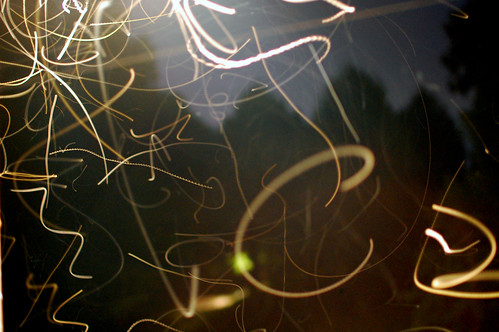
Spring is bursting forth here at Chateau NuVoid: The bugs are out, tornadoes are threatening, and the world has turned myriad shades of beautiful green. I played around with the camera last night and took some long exposures of the insects flying around the floodlights. Gosh, it seems like yesterday I was taking pictures of snow falling. Hooray for spring! (I could do without the tornado warnings, however!)
April 18, 2010
Sun Ra Sunday
 Sun Ra & His Intergalactic Myth Science Solar Arkestra:
Nidhamu + Dark Myth Equation Visitation (Art Yard CD)
In 2009, Art Yard gathered together the remaining Egypt material on a CD entitled Nidhamu + Dark Myth Equation Visitation. Most of this music was previously released on impossible to find Saturn and Thoth Intergalactic LPs over the years, making this an essential companion to the magnificent Horizon CD, also on Art Yard. The CD opens with three additional tracks recorded at the Ballon Theatre on December 17, 1971: “Space Loneliness #2” begins with an unusual ensemble of saxophones, flutes, and oboe with a detuned synthesizer obbligato. The yearning, dissonantly harmonized melody and rubato drums feels conceptually similar to the Discipline series of compositions and may be a completely different piece. Ra then takes an unaccompanied solo on dual synthesizers which focuses more on pitch and rhythm than spaceship noises for a change. After moving to Rocksichord and outlining a bluesy set of changes, the ensemble returns with a lushly orchestrated coda that echoes the big-band riffing of the original “Space Loneliness.” After some polite applause, Ra introduces “Discipline 11” with a spacey organ solo until trumpet, flutes, and saxophones enter with the dirge-like composition. After some more organ chording, Marshall Allen takes a mellifluous, heavily reverb-ed solo on flute until Sonny interrupts with more scary electronic mayhem. A glorious rendition of the stately “Discipline 15” follows with John Gilmore adding his inimitable tenor sax improvisations over the top. Unfortunately, after a short percussion interlude, the track quickly fades out. Even so, it’s a wonderful performance of this rarely played composition.
“Nidhamu” is a long (thirteen minute) double-synthesizer solo recorded at an invitation-only concert at Hartmut Geerken’s house in Heliopolis on December 12, 1971. Ra again demonstrates his mastery of the then new technology, exploring the vast range of sounds available: from space age bleeps and blorps, to sweeping portamentos; pure sine waves to tsunamis of white noise -- all the while maintaining a loose internal structure built around a jittery four note figure that appears and disappears in various permutations throughout the piece. A dignitary who attended this concert invited Ra to appear on Egyptian television on December 16 (Szwed, p.293), and the next four tracks document that event, which was, sadly, not preserved in the station’s archives (Campbell & Trent, p.181). “Discipline 27” fades into Kwami Hadi’s trumpet solo while Tommy Hunter’s voice (probably dubbed later) announces the date and venue. Hadi plays nicely, as usual, supported by a swelling Arkestral accompaniment that gradually resumes the brightly riffing composition before fading out too soon. “Solar Ship Voyage” consists of a brief synthesizer solo in Ra’s rocket-ship style, punctuated with skittering runs of notes and piercing, high-pitched whines. “Cosmo Darkness” is a short group improvisation with squealing horns pitted against Ra’s rumbling electronic organ. Ra wins. “The Light Thereof” opens with an enervated organ solo before the ensemble takes up the mournful, densely arranged composition, which was apparently performed only this one time (Campbell & Trent, p.827). Another lost masterpiece! An ensemble of saxophones, flutes and trumpet improvise simultaneously while Gilmore takes the lead with a display of tenor pyrotechnics until Ra points the finger and the piece stops on a dime, eliciting enthusiastic applause from the small studio audience. Quite a display of avant garde weirdness for Third World television!
The disc concludes with three more tracks recorded on December 12. Ra has been provided an acoustic piano, which he uses to push the band a ragged but still effective performance of “Friendly Galaxy #2,” featuring a twittering flute choir over the insistently repeating trumpet note. Ra then takes a meditative solo, slowing the tempo to a full stop before launching into the sing-a-long arrangement of “To Nature’s God,” which is taken up by June Tyson and Gilmore with gusto. Sonny quickly drops out and everyone takes up percussion instruments to bang along with Pat Patrick’s electric bass vamp, while Tyson and Gilmore sing, dance, chant and parade around the room. Despite the band’s enthusiasm, this was apparently the last performance of this quirky little ditty (Campbell & Trent, p.842). Finally, the disc closes with the bouncy space chant, “Why Go to the Moon,” which, unfortunately, fades out after about two and half minutes. Supposedly, the entire three and a half hour Heliopolis concert was recorded by Tommy Hunter, but it is unknown whether the rest of the tape survives (Id., p.181). Given that none of it appears on this Art Yard CD, it seems unlikely. But you never know what might surface…
+++
The Egyptian sojourn was supposed only last a few days, but they wound staying two weeks “as they rode camels, shopped, hitchhiked, and went sightseeing” (Szwed, p.293). They even ventured into the great pyramids, where the lights dramatically went out as soon as they entered the mystical King’s Chamber. As they made their way back out in pitch darkness, Sonny calmly remarked, “Why do we need light, Sun Ra, the sun is here” (Id.). All this was no doubt great fun, but the trip was taking its toll on the Arkestra’s already precarious finances:
One night near the end of their stay in Cairo, Geerken saw Sun Ra seated at a table in the hotel with a candle and piece of paper covered with long rows of numbers. It was not numerology; they were again out of money, with not even enough to pay the hotel bill. This was becoming a regular occurrence on tours, as Sonny loved traveling and became depressed when they returned to Philadelphia. Geerken once saw Sun Ra pay for a $1000 phone bill by selling the rights to a master tape of the band. This time, members of the band sold personal items to get the money. And Sonny left his Sun harp with Geerken as security against money he loaned him (Id., pp.293-294).1972 would turn out to be another lean year for the Arkestra and they would not return to Europe again until the fall of 1973. They did, however, make a movie: the pseudo-Blaxploitation classic, Space is the Place and sign a recording contract with a major label, ABC/Impulse! Coming up next on Sun Ra Sunday!
April 17, 2010
Playlist Week of 4-17-10
 * Vivaldi: Double Violin Concertos (VBO/Marcon/Carmignola/Mullova) (Arkiv Prod. CD)
* Vivaldi: Cello Sonatas (ter Linden/Mortensen) (Brilliant Classics 2CD)
* J.S. Bach Violin Sonatas (Kuijken/Leonhardt) (d.1) (Harmonia Mundi 2CD)
* Handel: 12 Solo Sonatas (AAM/Egarr) (d.1) (Harmonia Mundi 2CD)
* Venice Baroque Orchestra (Marcon/Carmignola): Concerto Veneziano (Arkiv Prod. CD)
* Venice Baroque Orchestra (Marcon/Carmignola): Concerto Italiano (Arkiv Prod. CD)
* Poulenc: Works for Piano (Parkin) (d.2) (Chandos CD)
* Sun Ra: Horizon (Art Yard)
* Sun Ra: Nidhamu + Dark Myth Equation Visitation (Art Yard CD)
* Cecil Taylor: Air (Candid CD)
* Henry Grimes Trio: The Call (ESP-Disk’ CD)
* Matthew Shipp: 4D (Thirsty Ear CD)
* Mahavishnu Orchestra: Palace Theatre, Waterbury, CT 5-17-73 (SBD 2CDR)
* Mahavishu Orchestra: Vienna 8-29-75 (FM CDR)
* Pat Metheny Group: We Live Here (Geffen CD)
* Bob Marley & The Wailers: The Complete Wailers 1967-1972 Part I (JAD 3CD)
* Various Artists: Nuggets: Original Artyfacts from the First Psychedelic Era (d.1-2) (Rhino CD)
* Jimi Hendrix: Valleys of Neptune (Experience Hendrix/Sony CD)
* Pink Floyd: The Dark Side of the Moon (Capitol SACD)
* Grateful Dead: Berkeley Community Theatre, CA 8-24-72 IIx (SBD CDR)
* Grateful Dead: Dick’s Picks Vol.26: Cow Palace, Daly City, CA 3-23-74 (GD 2CD)
* Jerry Garcia Band: How Sweet It Is (GD/Arista CD)
* Chicago Transit Authority: Chicago Transit Authority (Rhino 2LP)
* Chicago: Chicago II (Rhino 2LP)
* The Band: Rock of Ages (Capitol/MFSL SACD)
* Bob Dylan: Desire (Columbia SACD)
* Van Morrison: Astral Weeks (Warner Bros. LP)
* Van Morrison: Moondance (Warner Bros. LP)
* Van Morrison: Tupelo Honey (Polydor CD)
* Van Morrison: Common One (Warner Bros. CD)
* Tom Waits: Glitter & Doom (Live) (Anti- 2LP)
* Can: Guildhall, Plymouth, England 5-xx-72 (AUD CDR)
* U2: The Unforgettable Fire (Deluxe Edition) (d.1) (Island/Universal 2CD)
* Sonic Youth: Rather Ripped (Geffen CD)
* Stereolab: Emperor Tomato Ketchup (Elektra CD)
* DJ Spooky: The Secret Song (Thirsty Ear CD)
Commentary:
Happy Record Store Day! I slept in a bit this morning and so didn’t get over Grimey’s in time to snag any of exclusive releases. That’s OK; there wasn’t really anything I felt I had to have. Nevertheless, it was a beautiful day and when I finally got there, around 11:00 a.m. there was still line out the door just to get in! Holy smokes, the place was PACKED. Every aisle in the store was jammed with people, young and old, either trying to shop or forming ad hoc lines to the cash registers. It was truly an anarchic madhouse, but everyone was happy to be there and totally cool amidst the chaos. Indeed music tames the savage beast!
I took advantage of the sale and grabbed a few things that had been on my (ever expanding) wantlist and immediately got into what appeared to be a check-out line. While it took almost an hour to finally pay for my stuff, I enjoyed chatting with folks while we waited – it turned out the guy behind me also lives here in bucolic Kingston Springs! We agreed it’s a delightful place to live. I stashed my loot in the car and made my way back to the parking lot where there was live music, beer, and many crates of used records and CDs. I managed to catch most of How Cozy’s set, which was great! Alumnus of Southern Girls Rock and Roll Camp, these youngsters have written some smart songs executed with simple but effective guitar/drums/vocal instrumentation. Good stuff! I rummaged through the bins for a while and enjoyed a tasty pulled pork sandwich from Jimmy Carl’s Lunch Box along with a zesty Pale Ale from Nashville’s own superb Yazoo Brewing Co. and split. As I was walking down the alley to my car, I saw this totally destroyed record sitting on top of the trunk of this car. It appeared to me to be an appropriate work of public art inspired by Record Store Day, so I took a photograph (above). (There are more photos from the event on my Flickr photostream, but they’re really not very good. Click the link on the sidebar if you’re interested.)
What did I wait in line to buy on Record Store Day? I’m almost ashamed to say it’s once again (mostly) more music from my youth. I guess I really am just another middle-aged fuddy-duddy. The truth is I would rather spend my hard-earned money on lovingly reissued albums from the seventies and eighties than take a chance on something new. What can I say? (Van Morrison would say this: “There’s no why, just is.”) Ever since Sam Byrd sent me that “mystery disc” which reacquainted me with Chicago (the band), I have wanted to splurge on the 2009 Rhino vinyl reissues of their first two albums. So I did. These things are done right: the exact-repro packaging is first rate and the all-analog 180-gram discs sound amazing! I also picked up Mobile Fidelity’s recent SACD of The Band’s Rock of Ages, their expansive live album, and it greatly benefits from MoFi’s meticulous, high resolution mastering job. While I’m not that big of a U2 fan, I have always been fond of The Unforgettable Fire, if only for the lush production job by Brian Eno and Daniel Lanois. My original LP is more than a little beat up so I bought the new “deluxe edition” 2-CD set, which includes all the B-Sides, remixes and other bonus tracks. The mastering job is decent, the slipcased, hardbound-book packaging is truly “deluxe,” and it’s nice to have this old friend in conveniently digital form. Finally, John Abercrombie’s latest album on ECM had been sitting forlornly in the jazz bin for months, so I rescued it and brought it home. Haven’t listened to that one yet, but I’m sure it will be perfect for a mellow evening. In all, it was an excellent Record Store Day!
Folks keep insisting that sound recordings sold as physical products is a moribund industry, but after today you might think otherwise. Ten or fifteen years ago, it looked like the LP was utterly obsolete, but today I saw more folks shelling out (sometimes) big bucks for vinyl than anything else – and, like I said, the store was jam-packed with eager customers. This gives me hope that records – and record stores – will remain a viable concern in the Twenty-First Century. They are some of my most favorite things in the world.
April 14, 2010
Record Store Day!
 Hey, just a reminder that Record Store Day is this coming Saturday. If you're like me, you love record stores as much as records themselves: the thrill of the hunt, the unexpected treasure, the discovery of new sounds...the smell of old vinyl...Well, here in Nashville, Grimey’s knows how to do Record Store Day right with live music, beer, barbeque and lots and lots of records. I can’t wait! Check out what your local record store is doing to celebrate -- and buy records!
April 11, 2010
Sun Ra Sunday
 Sun Ra & His Intergalactic Myth Science Solar Arkestra:
Horizon (Art Yard CD)
With the money obtained from Black Lion, the Arkestra was able to board the waiting plane and travel to Cairo, arriving in the evening of December 7, 1971. But they did not know anyone in Egypt and neither did they know where they were going to stay nor how they were going to pay for it. Szwed describes the scene:
When they landed they were held up at Egyptian customs because of the unlikelihood of an entire orchestra arriving as tourists and because of the name on Sun Ra’s passport. To be named after the sun god twice was really a bit too much. On the latter objection Sun Ra resourcefully suggested the guard call the curator of the National Museum of Antiquities with whom he was ready to discuss Egyptology. They let him in, but customs kept most of their instruments just in case. The band took cabs to the Mena House Hotel outside of Cairo, and they woke up the next day to see the morning fog slowly lifting to reveal the pyramid of Giza. A day later Tommy Hunter began taking motion pictures of members of the Arkestra as they faced the pyramids, while the wind made their costumes billow so it appeared they were flying. These were the films that Sun Ra would later project behind the band at Slug’s and at concerts (p.292).
Here is the film:
Thanks to Sun Ra fan, Hartmut Geerken, a German writer and free musician who was teaching at the Goethe Institute in Cairo, a series of performances were arranged, including an invitation-only concert at Geerken’s home in Heliopolis on December 12. While most of the Arkestra’s instruments were still being held by customs, they were aided by a most unlikely personage named Salah Ragab:
[He was] a brigadier general and the head of military music in the Egyptian army and himself a jazz drummer. Though he was later disciplined for the contact, he continued to meet with the band under various disguises, including once when he came with the son of [Egyptian President] Gamal Abdel Nasser, also a jazz musician. Musicians and dancers were jammed into the house with several dozen guests, but they still managed a light show and dancing, and a march throughout the house and into the garden (while the Egyptian secret police kept watch from outside) (pp.292-293).
The Arkestra also performed at the famed Ballon Theatre in Cairo on December 17 courtesy of the Egyptian Ministry of Culture, who had cancelled ballet previously scheduled for that date (p.293). The concert was recorded from the stage (in mono) by Tommy Hunter and released on various impossible-to-find Saturn LPs over the years (see Campbell & Trent, pp.180-183). Most of this material was finally compiled onto a CD entitled, Horizon, and released by Art Yard in 2008. It is a truly special performance: after the cold, grueling tour of Europe, the Arkestra sounds well-rested and inspired by the ancient, mystical-- and warm -- environment. Ra sets the stage with some ominous electronics before a brief “Theme of the Stargazers” and a howling a cappella solo from Danny Davis on alto sax. The band then launches into “Discipline 2,” a moody and mysterious piece that begins with throbbing, densely harmonized horns which give way to a twittering flute choir before returning with a somber coda. Sonny then signals “The Shadow World” and we’re off to the races. This is a spectacular, seventeen minute rendition, with Ra driving the band hard and the ensemble responding with near-perfect execution of the extraordinarily complicated melody lines. Ra takes the lead with a skittering organ solo before an energetic group improvisation section that yields to Gilmore’s furiously wailing tenor sax. Yes, it’s another incredible Gilmore solo! Kwami Hadi also takes a turn on trumpet and acquits himself well, ranging around from high-wire acrobatics to smeared, low-register noodling before Ra signals the reprise. After a brief pause, Ra lightens the mood by moving into “Enlightenment,” which is joyfully taken up by June Tyson and her male choir. “Love In Outer Space” predictably follows and while this version lacks the menacing darkness heard in Paris, there’s plenty of exciting organ work and another tasty solo from Hadi.
The neo-big-band swing of “Third Planet” follows with the Arkestra again nailing the ensemble sections and supporting Hadi’s bebop-ish solo with swelling riffs. Hadi’s really in the spotlight at this concert! Ra takes a bumptious, barbequed organ solo as the rhythm section starts to really heat up, only settling down again for the return of the head. Sonny then lurches into some dissonant organ clusters to introduce “Space is the Place.” Pat Patrick grinds out the repetitive bassline, percussion sets up a quasi-Latin groove, the singers chant, clap and dance, and meanwhile Marshall Allen squeals and moans on alto saxophone. It was likely quite a spectacle. “Horizon” begins with Ra blasting off with his Moog synthesizer, punctuated with a searing space chord at the end. An eerie organ swell signals “Discipline 8,” with its oscillating ensemble chords over rumbling, rubato drumming. Eloe Omoe emerges from the thicket of harmony to blow some honking bass clarinet until Gilmore takes over with a blistering display of high-pitched harmonics, howling multiphonics, and low-register growls, joined at the end by the altos in an all-out saxophone battle. After reaching a feverish pitch, the saxophones subside, leaving Hadi to brood. All the while, the Arkestra’s riffing continues to heave and sigh, rising and falling with contours of the soloists' excursions. After a cued ending, June Tyson chants “We’ll Wait for You” with the Arkestra echoing her lines antiphonally. While Sonny outlines a narrow harmonic area, the Arkestra briefly engages in some free-jazz freakouts before Ra signals “The Satellites Are Spinning,” which closes the CD with its optimistic chanting about the “great tomorrow,” accompanied by some bitingly skronky saxophone solos and supported by a propulsive groove laid down by Clifford Jarvis’s skillful drumming and Pat Patrick’s workmanlike bass playing. You can hear the Egyptian audience starting to get into it, whooping and hollering as the Arkestra parades off the stage.
While the set list is typical of the period, the performance is particularly focused and intense. Given the pleasantly spacious acoustic of the recording, this makes for a must-have CD for any Sun Ra fan. In 2009, Art Yard released Nidhamu + Dark Myth Equation Visitation, which contains three more tracks from this concert, along with portions of the Heliopolis performance and a TV appearance taped on December 16. We’ll have a listen to that one next week.
April 10, 2010
Playlist Week of 4-10-10
.jpg) * Dowland: ‘Flow My Teares’ (Guillon/Bellocq): Église Abbatiale, Saintes 7-18-09 (FM CDR)
* Dowland: ‘Flow My Teares’ (Guillon/Bellocq): Église Abbatiale, Saintes 7-18-09 (FM CDR)* Biber: Missa Christi resurgentis (English Concert/Manze) (Harmonia Mundi SACD)
* Rebel: Violin Sonatas (Manze/Egarr/ter Linden) (Harmonia Mundi CD)
* Vivaldi: Concertos and Sinfonias for Strings (VBO/Marcon) (Arkiv Prod. CD)
* J.S. Bach: The Works for Lute (Kirchhof) (Sony Classical 2CD)
* Holloway/Mortensen/ter Linden: Garrison Church, Copenhagen 4-08-08 (FM 2CDR)
* Berio: Coro (Kolner Rundfunkchor/Sinfonie-Orchester/Berio) (DG CD)
* Sun Ra: Calling Planet Earth (DA Music/Freedom CD)
* Sun Ra: Horizon (Art Yard CD)
* Sun Ra: Nidhamu + Dark Myth Equation Visitation (Art Yard CD)
* Cecil Taylor Quartet, et al.: At Newport (1957) (Verve CD)
* Cecil Taylor Unit/Roswell Rudd Sextet: Mixed (Impulse! CD)
* Cecil Taylor: Nefertiti, the Beautiful One Has Come (Revenant 2CD)
* Cecil Taylor: Unit Structures (Blue Note CD)
* Mary Halvorson Trio: The Vortex, London, England 12-14-09 (FM CDR)
* Herbie Hancock: Secrets (Columbia LP)
* Mahavishnu Orchestra: Berkeley Community Theatre, CA 11-9-72 (Pre-FM 2CDR)
* Praxis: Transmutation (Mutatis Mutandis) (Axiom/Island CD)
* The Beatles: Abbey Road (2009 remaster) (Apple/EMIT CD)
* Rolling Stones: Unsurpassed Masters, Vol.1 (fan/boot CDR)
* Rolling Stones: Unsurpassed Masters, Vol.2 (fan/boot CDR)
* Bob Dylan: Together Through Life (Columbia 2LP)
* The Mothers of Invention: Burnt Weeny Sandwich (Bizarre/Reprise LP)
* Frank Zappa: Hot Rats (Bizarre/Reprise LP)
* Frank Zappa: Chunga’s Revenge (Bizarre/Reprise LP)
* Grateful Dead: Winterland, June 1977: The Complete Recordings (d.7-9) (GD/Rhino 9+1CD)
* Fleetwood Mac: Fleetwood Mac (Reprise LP)
* Tom Petty & the Heartbreakers: Into the Great Wide Open (MCA LP)
* The Style Council: The Cost of Loving (Polydor LP)
* Spacemen 3: The Perfect Prescription (Genius CD)
* Chemical Brothers: Exit Planet Dust (Astralwerks CD)
* Future Sound of London: The Isness (FSOL/Hypnotic CD)
* The Flaming Lips: The Soft Bulletin (Warner Bros. DVD-A)
* David Gray: White Ladder (RCA CD)
* Robert Pollard: We All Got Out of the Army (GBV, Inc. LP)
* Circus Devils: Mother Skinny (Happy Jack Rock Records LP)
Commentary:
You might have noticed that I’m slowly making my way chronologically through the Frank Zappa catalog (on original vinyl, I might add). I was exposed to Zappa’s music at an early age by my middle school/high school music teacher, the (now legendary) (Dr.) Gary Sousa. I was maybe a bit too young -- I can’t imagine a junior high school teacher getting away with playing this stuff for kids today, but things were different (perhaps better) back then. Mr. Sousa was a great teacher and a profound influence on me, way beyond Zappa records -- he could (sometimes) make those ragtag bands sing! In any event, boy did Zappa’s music ring my bell -- and not just the pre-pubescent thrill at hearing dirty words coming out of the hi-fi. No, I immediately recognized the compositional brilliance and virtuosic musicianship behind the snickering, jokey veneer. You see, I was also by then deep into piano studies with composer, Dr. Allen Brings, who inculcated a love for modernistic weirdness, but who abhorred popular music of all stripes. Zappa was someone who didn’t take it all so darn seriously and could make “classical music” rock. I was in heaven. To me, “Inca Roads” was perfect! I thought this was the future! Furthermore, Zappa instilled a burning desire to play electric guitar -- after all, you can’t bend the pitch or, better yet, generate howls of feedback on a piano! It was not until much later that I finally “plugged in,” but in the meantime I bought all of Zappa’s records I could get my hands on. The Verve albums were long out of print and are still hard to find, but the Discreet albums were readily available and I loved the new stuff like Sheik Yerbouti and Joe’s Garage, which even garnered some radio play at the time.
I saw him once at the Hartford Civic Center in 1981, but I was sorely disappointed. He pranced around the stage in hot pink, skin tight trousers singing the stupidest songs in the repertoire, only strapping on the guitar for a couple of condescending, carelessly tossed off solos over simplistic (yet emptily hyperactive) one-chord vamps. After going away to college, my love affair with Zappa soured completely and I eventually sold all my albums in a fit of pique after discovering punk rock (a genre which Frank had gone out of his way to ridicule). I thereafter dismissed Zappa as a sneering, cynical purveyor of pompous, puerile junk -- which is true enough, but misses the point.
After moving to Tennessee, I had a change of heart and I started re-buying all the original LPs I could find, listening to them once and filing them away. I enjoyed hearing them again, but mostly I just had to have them, if only to reclaim some lost part my lost childhood. Music, like smell or taste, has the innate ability to summon up the past with an immediacy that mere memory can never equal. And there is that compositional brilliance and instrumental virtuosity that is still compelling, despite all the toilet humor. 1969 was a good year for Frank: Uncle Meat is probably The Mothers of Invention’s most perfectly realized conception, but Zappa’s first solo album, Hot Rats, is more immediately enjoyable, focusing on musicianship for its own sake rather than relegating it to the service of arch social commentary.
So it goes with Frank and me. The music is uniformly great, but the jokes are stale and the politics dubious. Ultimately, I think Zappa did himself a disservice with his insistence on being as irreverent and offensive as possible while also desperately wanting to be taken seriously as a composer. Then again, this was just a measure of his peerless integrity: he did it his way and couldn’t care less what I (or anyone else) thought about it. For myself, I can only listen to this music when I feel like I can tolerate being insulted in return for musical kicks. That doesn’t happen very often, but I have enjoyed listening to this stuff over the past couple weeks. We’ll see how far I get in this chronological survey before I abandon ship. The seas really get rough from this point forward.
NB: In Zappa’s own perverse fashion, he messed with the 1960s-era albums when transferring them to compact disc, going so far as to overdub new rhythm section parts on some and digitally remixing just about the whole catalog. Accordingly, the CDs represent a questionable revisionist history and make the original vinyl LPs highly desirable. I’m sure Frank thought the CDs sounded better and maybe in some objective ways they do; but they don’t sound anything like the original albums.
Subscribe to:
Posts (Atom)