November 27, 2011

Sun Ra Sunday


Ronnie Boykins: The Will Come, Is Now (ESP-Disk’ CD)

Ronnie Boykins was one of the first members of Sun Ra’s fledgling Arkestra, joining the band in early 1958 and his innovative yet rock-solid bass playing was a key element in the music’s rapid development up through the mid-1960s (it was also Boykins’s car that carried the band from Chicago to Montreal in 1961 and, thence, to New York City). Boykins had been classmates with John Gilmore and Pat Patrick at Du Sable High School (where he played sousaphone in the band) but he had already established himself as an in-demand bassist prior to joining the Arkestra, having played with such diverse figures as Muddy Waters, Johnny Griffin and Jimmy Witherspoon. In 1966, Boykins left the Arkestra to pursue other opportunities, (notably including work with Rahsaan Roland Kirk) and, as we’ve seen, Sonny had a hard time finding his replacement, opting on many occasions for doing without the bass altogether. Boykins intermittently performed with Arkestra thereafter with his last known appearance being at Hunter College on June 16, 1974 (portions of which were released as Out Beyond The Kingdom Of ). While Prof. Campbell suggests he might been a part of the two-week stand at The “New” Five Spot in June, 1975, he is not present on the bootleg tape which circulates (Campbell & Trent p.220). According to Szwed, growing animosity between Boykins and Ra over money and lack of composer credit for some of the Arkestra’s recordings caused him to quit the band for good sometime during this period (Szwed p.119).

But ESP-Disk’s Bernard Stollman recognized Boykins’s genius early on:

I first met Sun Ra during the October Revolution festival in the Cellar Café (in 1964), and he invited me to hear the Arkestra perform in a loft in Newark, New Jersey. It was there that I singled out Ronnie Boykins, and invited him to record for ESP. He told me he would let me know when he felt he was ready. During the decade that followed, I heard his work in the Arkestra, and late night sessions with Sam Rivers in Studio Rivbea on Bond Street, and in Ornette Coleman’s Prince Street loft. Ronnie called me in 1975, to announce he was ready to record his first album as a leader (liner notes).


As it turned out, Boykins waited too long and The Will Come, Is Now is the only record Boykins ever made under his own name—he died suddenly of heart attack in 1980 at the age of 45. And ESP-Disk’ was in serious decline by 1975, this being one of the last few recordings the label released before finally going under. Accordingly, it was cheaply made, pressed in miniscule quantities and poorly distributed, resulting in one of the rarest ESP discs of all. Fortunately, the resurrection of the label at the turn of the century has brought nearly the entire catalog back in print on CD, including Boykins’s one and only solo album, nicely remastered from the original tapes. Although neither Sonny nor any of the Arkestra appear on it, Boykins’s importance to the Sun Ra saga is undisputed and, therefore, The Will Come, Is Now merits a mention here.

Perhaps my expectations were too high, but I found this album to be something of a disappointment. It certainly looks promising: Boykins composed six ambitious pieces for the album, featuring a septet of himself on bass and sousaphone; Joe Ferguson, Monty Waters and James Cass on saxophones and flutes; Daoud Haroom on trombone; Art Lewis on drums; and George Avaloz on congas. And, to be sure, each of the pieces showcases Boykins’s unique compositional voice and his flair for rich orchestration but the album suffers from a basic lack of rehearsal and slip-shod recording technique. The title track is typical: a loping ostinato in 7/4 with a twisty, complex head arrangement followed by a series of modal solos—but the sound is boxy and indistinct and the off-center groove never quite solidifies, almost dissolving completely during Boykins’s bowed bass solo. “Starlight At The Wonder Inn” appears to be an evocation of the early days in Chicago: a slightly old-fashioned ballad form with sweet ‘n’ sour horns and Boykins carrying the melody on arco bass—but, this time, intonation problems undermine the piece’s nostalgic beauty.

On the other hand, the three-minute “Demon’s Dance” works a bit better, a riffing post-bop number with everyone soloing at once, Dixieland-style. Even more intriguing is “Dawn Is Evening, Afternoon,” which sets yearning, unresolved harmonies and dissonant counter-melodies against a swinging solo section. The humorously titled, “Tipping On Heels,” is an appropriately tipsy, stop-start, big-band type number where, after stating the theme, soloists pair up for duo improvisations. At least here the ensemble sounds like they’re in their element but the abrupt ending appears to be a clumsy splice rather than a planned conclusion. The last track, “The Third I” could have been a real masterpiece: it begins with a ritualized percussion segment with everyone clanking on cowbells, shaking rattles and jangling tambourines before Boykins starts rumbling away on the giant sousaphone. Unfortunately, the blast of low frequencies caused the recordist to panic (Marzette Watts as it happens), resulting in disconcerting volume fluctuations throughout the rest of the track. Oh well. This eventually gives way to a genially meandering jam for flutes and horns which finally coalesces into a 15/8 ostinato laid down by Boykins on the bass. Finally, at around the ten-minute mark, the full band comes in with stabbing horn tattoos and a weirdly harmonized melody—exciting!—but then the track fades out just as they get going. Argh! Obviously, this piece continued for quite a while longer but was cut down to save space for other works on the album. That is really frustrating since "The Third I" might be the most compelling thing on the album. And so it goes…

Ultimately, The Will Come, Is Now is all unrealized potential and it is tempting to fantasize about what the Arkestra could have brought to this material, even with limited rehearsal time and amateurish sound quality (which was, after all, the norm for them). It is also reasonable to speculate on what sort of music Sonny would have made with Boykins continuously at his side. Well, for whatever reason, it was not meant to be and, sadly, Boykins has never achieved the acclaim he deserves. Even though he played with several luminaries of the loft-jazz scene in the 1970s, very little of it was recorded, leaving this as his only solo statement. As such, The Will Come, Is Now is an important document of Boykins’s wide-ranging musical conception and inimitable instrumental prowess. But it is less than completely satisfying on a musical level, if only because it could have been so much better. Then again, my expectations might be too high.

November 26, 2011

Playlist Week of 11-26-11

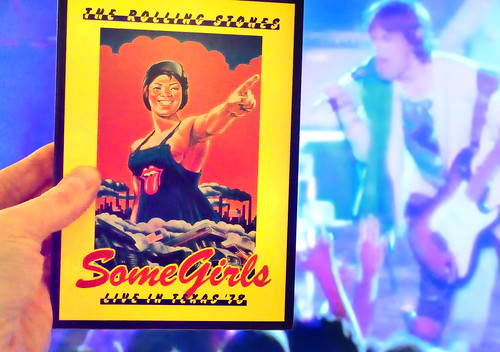
Rolling Stones - Some Girls Live in Texas '78

* Purcell: Fantasias For The Viols 1680 (Savall, et al.) (Alia Vox SACD)
* J.S. Bach: The Works for Lute (Kirchhof) (Sony Classical 2CD)
* J.S. Bach: Harpsichord Concertos, etc. (AAM/Egarr) (Harmonia Mundi 2CD)†
* Carter: Piano Concerto, etc. (Nashville Symphony/Schermerhorn/Wait) (Naxos CD)
* Sun Ra: Live At Montreux (Inner City/Universe 2CD)
* Ronnie Boykins: The Will Come, Is Now (ESP-Disk’ CD)
* Cecil Taylor: Jazz Advance (Transition/Blue Note CD)
* David S. Ware String Ensemble: Threads (Thirsty Ear CD)
* John Abercrombie: Cat ’n’ Mouse (ECM CD)
* John Abercrombie: Class Trip (ECM CD)
* John Abercrombie Quartet: Wait Till You See Her (ECM CD)
* Gary Burton/Chick Corea/Pat Metheny/Roy Haynes/ Dave Holland: Like Minds (Concord CD)
* Aretha Franklin: I Never Loved A Man The Way I Love You (Atlantic/Mobile Fidelity CD)
* Aretha Franklin: Lady Soul/Aretha Now (Atlantic/Mobile Fidelity CD)
* William S. Burroughs: Dead City Radio (selections) (Island CD)
* The Rolling Stones: Exile On Main St. (Deluxe Edition) (Promotone/Universal 2CD)
* The Rolling Stones: Some Girls (Deluxe Edition) (Promotone/Universal 2CD)
* The Rolling Stones: Some Girls Live In Texas ’78 (Promotone/Eagle Rock DVD+CD)
* The Rolling Stones: Some Girls Sessions (fan/boot 2CDR)
* Bob Dylan: Bringing It All Back Home (mono) (Columbia/Sundazed LP)
* Bob Dylan: Highway 61 Revisited (mono) (Columbia/Sundazed LP)
* Van Morrison: Astral Weeks (Warner Bros./Rhino LP)
* Jeff Beck: Truth (mono) (Epic/Sundazed LP)
* Jeff Beck: Beck-Ola (Epic/Sundazed LP)
* Jeff Beck: Blow By Blow (Epic LP)
* Grateful Dead: Fairgrounds, Lille, France 5/13/72 (GDP/Rhino 3CD)
* Grateful Dead: La Grande Salle du Grand Theatre, Luxembourg 5/16/72 (GDP/Rhino 2CD)
* Grateful Dead: Kongressaal, Munich, W. Germany 5/18/72 (GDP/Rhino 3CD)
* Grateful Dead: Park West Ski Area, Park City, UT 9-04-83 (selections) (SBD 3CDR)
* Jerry Garcia Band: After Midnight: Kean College 2/28/80 (JGE, LLC/Rhino 3CD)
* David Crosby: If I Could Only Remember My Name… (Atlantic DVD-A)
* Jean-Luc Ponty: King Kong: Plays The Music of Frank Zappa (Blue Note/Friday Music LP)
* Frank Zappa & The Mothers: Fillmore East June 1971 (Bizarre/Reprise LP)
* Frank Zappa: Wazoo (Vaulter Native/Zappa.com 2CD)
* Frank Zappa: Imaginary Diseases (Zappa Records CD)
* Yes: Yesshows – Expanded (Atlantic/Friday Music 2CD)
* Alan Parsons Project: I Robot (Arista LP)
* ELO: Greatest Hits (Columbia LP)
* The Doobie Brothers: Greatest Hits (Warner Bros. LP)
* Los Lobos: Kiko (Slash/Warner Bros. CD)†/‡
* U2: Achtung, Baby (Deluxe Edition) (d.1) (Island/Universal 2CD)†
* Anton Fier: Dreamspeed/Blindlight (Tzadik 2CD)†
* Guided By Voices: “We Won’t Apologize […]”/”The Unsinkable Fats Domino” (Matador 7”)
* Boston Spaceships: Let It Beard (GBV, Inc. 2LP)
* Jim O’Rourke: The Visitor (Thrill Jockey LP)
* Mastodon: Crack The Skye (Reprise CD)(†)
* Mastodon: The Hunter (Reprise CD)(†)

†=iPod
‡=car

Commentary:

I’m not the hugest Rolling Stones fan, but I do have a fondness for their 1978 album, Some Girls, which has recently received the “deluxe edition” treatment. Of course, I picked up a copy—even though I knew I was in for a let-down.

Some consider this the last great Stones album and it’s easy to agree. The rise of disco and punk was threatening to overturn the complacent hegemony of rockstars like the Rolling Stones and, snapping out of their usual torpor, they responded with their best record in years, one which managed to fuse the rhythms of dance music with the energy and guitar noise of punk while still sounding like the Stones of old. Personal turmoil added an unexpected edge to the songwriting: Keith Richards’s trial over the Canadian heroin bust was impending, resulting in the coy but recondite “Before They Make Me Run” and Bianca Jagger’s bitter divorce proceedings are reflected in positively venomous songs like “Lies” and “Respectable.” They sound like they really mean it and the album has aged well, unlike a lot of the “crossover” attempts that would follow. While the danceable numbers like “Miss You” and “Beast of Burden” were appropriately huge hits, the whole album is strong from start to finish, a rare thing indeed in the Stones discography.

Unfortunately, this re-re-mastering is abysmal: loud, brickwalled and ear-bleedingly bright. Ouch! That kind of approach might have brought some much-needed clarity to the murky Exile on Main St. (reissued in a “deluxe edition” last year) but it totally wrecks this otherwise decent-sounding album. Interestingly, the “bonus disc” of unreleased songs sounds much—much!—better. I have to ask: in this day and age, why couldn’t they have given the album proper that kind of treatment? Oh well; a wasted opportunity—and possibly the last one we’ll get. And, also like the Exile “bonus disc”, Sir Mick has overdubbed new vocals onto old backing tracks and sometimes it works and sometimes it doesn’t. Fortunately, the unaltered “Petrol Blues” is here, sounding like it was actually taken from my bootleg copy. Taken for it is, the “bonus disc” is a pretty decent Stones record in its own right, with songs like “Claudine” and “No Spare Parts” being worthy of the canon, new vocals and all—but that hardly makes up for the atrocious mastering of Some Girls. Reportedly, the expensive 180-gram vinyl sounds no better—what a shame.

Well, whatever. More pleasing is the DVD/Blue-Ray/CD release of Some Girls Live in Texas ’78. With the new album hitting the charts, the Stones hit the road for a short tour of the U.S., playing a variety of venues from small theaters to enormous stadiums, with several of the shows being recorded for broadcast on "The King Biscuit Flour Hour" (bootlegs of which have circulated widely). In addition, the complete concert from July 18, 1978 at the Will Rogers Memorial Center in Fort Worth, Texas was professionally filmed but the footage has languished in the Stones vault until now. Too bad, as it shows them diligently making a sincere effort to reclaim their title as the World’s Greatest Rock ‘n’ Roll Band. Gone are the horns and back-up singers, elaborate lighting rigs and the giant, inflatable phallus. Instead, it’s just five guys (supplemented by nearly invisible keyboardists) getting back to basics, playing the hits but also delivering the new material with startling vigor. Jagger acts the clown, of course, but he has not quite become the total self-parody of later years, even stopping to sing with soulful conviction now and then and periodically adding his clangorous guitar to the din. It’s the rest of the band that carries the day: newcomer Ronnie Wood is the perfect foil for Keith Richards, their riffing guitars meshing perfectly into a tightly knit wall of rock; meanwhile Charlie Watts mans the backbeat along with Bill Wyman’s stoically inventive bass playing. It’s not punk, it’s not disco—it’s the kind of sublime synthesis the Stones were capable of—but they’re digging in like it still matters. My problem with the Stones has always been their apparent laziness but, here, they’re working hard to remain relevant—and succeeding (at least) one last time. Sound and video quality is excellent and, as an added bonus, the band’s appearance on “Saturday Night Live” is included along with a contemporaneous news story hosted by none other than Geraldo Rivera and a brand new interview with Mick Jagger. Highly recommended!

Also of interest to Stones fans is the official (albeit download only) release of The Brussels Affair, one of the most highly-regarded bootlegs of all time. This 1973 concert has been remixed from the original master tapes and the 320k MP3 files are available here for a (comparatively) reasonable $4.99. I have yet to commit (I still have a hard time paying money for lossy computer files), but it sure looks tempting since there are presently no plans to release this on CD. It’s surely one of the great concerts from the Mick Taylor years and I’d love to hear it cleaned up, even if it’s an MP3. So, while the treatment of the “official” catalog continues to be shoddily presented, these archival releases are a surprising treat. But like I said, I’m not the hugest Rolling Stones fan, so I don’t care that much. I’d still like to find a clean, original pressing of Some Girls someday—I stupidly sold mine in a fit of fashion-conscious pique—but they’re hard to find these days. Well, as they say: “You can’t always get what you want, but sometimes you just might find you get what you need.”

November 20, 2011

Sun Ra Sunday


MY WORLD IS A SPACE AWAY

my world is a space away
and that's the way to another dimension
of living
the arial concept of being alive
out on the vibrating planes of outer space

my world is a space away
the broad road that never ends
an endless channel
that connects worlds upon worlds
of cosmic space
there is the doorway of my world
pause at the threshold, think a while
before you enter
but once having entered
there is no turning back

--Sun Ra

November 19, 2011

Playlist Week of 11-19-11

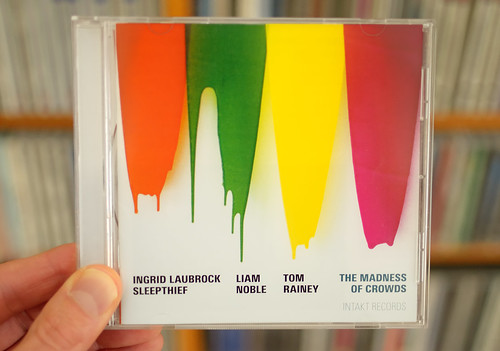
Sleepthief - The Madness of Crowds

* Buxtehude: Seven Sonatas, Op.2 (Holloway/Mortensen/ter Linden) (Naxos CD)
* Biber: Unam Ceylum (Holloway/Mortensen/Assenbaum) (ECM CD)
* Biber/Muffat: Der Türken Anmarsch (Holloway/Mortensen/Assenbaum) (ECM CD)
* Ravel: Piano Works (Queffélec) (Virgin Classics 2CD)
* Debussy: Chamber Music (Athena Ensemble) (Chandos CD)
* Feldman: Rothko Chapel/Why Patterns? (California EAR Unit, et al.) (New Albion CD)
* Lachenmann: String Quartets (Stadler Quartet) (NEOS SACD)
* Dusapin: String Quartets (Arditti Quartet) (æon 2CD)
* Sonny Clark Trio: The 45 Sessions (Blue Note—Japan CD)
* Sun Ra: Jordan Hall, New England Conservatory, Boston, MA, Dec, ’75 (AUD CDR)
* Sun Ra: Live At Montreux (Inner City/Universe 2CD)
* Ronnie Boykins: The Will Come, Is Now (ESP-Disk’ CD)
* Bill Dixon Orchestra: Intents And Purposes (RCA-Victor/International Phonograph CD)
* Bill Dixon: Bill Dixon In Italy Vol.I (Black Saint/Soul Note CD)
* Bill Dixon: Bill Dixon In Italy Vol.II (Black Saint/Soul Note CD)
* Ingrid Laubrock Anti-House: Anti-House (Intakt CD)†
* Ingrid Laubrock Sleepthief: The Madness Of Crowds (Intakt CD)
* Muddy Waters: Folk Singer (Chess/MCA/Mobile Fidelity CD)
* Sly & The Family Stone: There’s A Riot Goin’ On (Epic/Sundazed LP)
* Grateful Dead: Concertgebouw, Amsterdam, Holland 5/10/72 (GDP/Rhino 4CD)
* Grateful Dead: Grote Zaal De Doelen, Rotterdam, Holland 5/11/72 (GDP/Rhino 4CD)
* Grateful Dead: Winterland Arena, San Francisco, CA 2-24-74 (SBD 4CDR)‡
* Neil Young & Crazy Horse: Live At The Fillmore East 1970 (Reprise DVD-A)
* Pink Floyd: Obscured By Clouds (Pinkfloyd/EMI CD)
* Pink Floyd: Animals (Pinkfloyd/EMI CD)
* Pink Floyd: The Wall (Pinkfloyd/EMI 2CD)†
* Golden Palominos: This Is How It Feels (Restless CD)†
* Golden Palominos: Pure (Restless CD)†
* Guided By Voices: “We Won’t Apologize…”/”The Unsinkable Fats Domino” (Matador 7”)
* Robert Pollard: Space City Kicks (GBV, Inc. LP)
* Circus Devils: Capsized! (Happy Jack Rock Records LP)
* Radiohead: Kid A (Capitol CD)
* A Perfect Circle: Mer De Noms (Virgin CD)†
* A Perfect Circle: Thirteenth Step (Virgin CD)†
* A Perfect Circle: eMOTIVe (Virgin CD)†
* Mastodon: Crack The Skye (Reprise CD)†(‡)
* Mastodon: The Hunter (Reprise CD)†
* Ray Lamontagne: Trouble (Stone Dwarf/RCA LP)

†=iPod
‡=car

Commentary:

Of all the weird and wonderful CDs I picked up while in New York, there’s one in particular I keep coming back to: Ingrid Laubrock’s latest Sleepthief record, The Madness of Crowds (Intakt). The trans-national trio of the German-born Laubrock on saxophones, British pianist, Liam Noble, and American drummer, Tom Rainey was formed back when Laubrock was living in London and their eponymous CD, released in 2008, was, in a way, her breakthrough album, garnering near-unanimous critical praise. Shortly thereafter, she moved to New York, to be quickly assimilated into the burgeoning downtown jazz scene and where her unique sound and wide-ranging versatility found a welcoming home. And she keeps getting better and better: last year’s Anti-House (also on Intakt) is one of my very favorite records of all time. But whereas the Anti-House band showcases Laubrock’s knotty, genre-splicing compositional voice, Sleepthief is pure improvisation, non-idiomatic and free. As their first album amply demonstrated, these musicians are masterful improvisers, but The Madness of Crowds takes it to a whole other level, beyond technique and style where the music seems just inevitable and true. This music invites—no, demands—repeated listenings, rewarding the ear with its spirited and boundless creativity.

It helps that the sound quality is astonishingly good. Most modern jazz albums are adequately if indifferently recorded, naturalistic in affect but usually sounding somewhat flat and dry. But The Madness of Crowds sounds shockingly vivid, almost hyperreal. Rainey’s bass drum is HUGE, Noble’s piano occupies a solid, three-dimensional space and when Laubrock comes in, it sounds like she’s standing right there in the room with you. Wow! Recorded by Andrew Taub and Ben Liscio at Brooklyn Recording and mixed and mastered by Andrew Tulloch at The Blue Studio in London, The Madness of Crowds has been given the kind of high-class treatment this music truly deserves. Ultimately, free improvisation is all about sound for its own sake, from the quietest of subtleties (as when Laubrock blows bubbles in a goblet of water on “You Never Know What’s in the Next Room”) to the most aggressive cacophony imaginable and it is accordingly difficult (if not impossible) to capture the magic of live performance on disc. The Madness of Crowds is that rare thing: not only a masterpiece of improvisational music but an audiophile spectacular. Seriously, it needs to be heard to be believed. Record of the year!

November 13, 2011

Sun Ra Sunday


Sun Ra & His Arkestra: Jordan Hall, Boston, MA December 1975 (AUD CDR)

Ah, The New England Conservatory of Music, NEC, my alma mater (of sorts), otherwise known by my cohorts at the time as “The Disturbatory” or “Not Exactly College” (among other amusing epithets). It’s frankly hard to imagine Sun Ra and his spaced-out, ragtag Arkestra gracing the stage at Jordan Hall in December 1975. But although NEC was (and always will be) a bastion of stuffed-shirted classical music snobbery, its president at the time was Gunther Schuller, who was hip enough to allow Ran Blake to start the “Third Stream” department (where weirdoes like me were admitted) and encouraged the development of a “jazz” curriculum to compete with the Berklee College of Music down the street. So I guess it’s not so surprising that Sonny was invited to perform in one of the most acoustically perfect concert halls in the country—not that you would know it from the sound of this primitive audience recording. Gosh, it sounds awful! Hissy, warbly, distorted, unbalanced and, to make matters worse, most tracks cut off with a loud pop. Ugh! Upon close listening, it seems the original master might have sounded decent, but generational loss has obliterated what fidelity there was. Still, you can still hear Ra on his best behavior in this prestigious venue, introducing some well-rehearsed new material and keeping the polemical excesses in check.

The seventy-one minute tape (unlisted in Campbell & Trent) contains almost a complete set, cutting in on the opening improvisation which features Marshall Allen’s keening oboe over ominous percussion. Suddenly, Ra queues “Love In Outer Space” with some blasting organ chords—but the taper apparently didn’t care for this tune (or experienced technical difficulties) as the recording cuts off just as it gets going. Oh well. Eddie Thomas announces “Images” and, after a moody organ introduction, the tune takes off at brisk tempo. Kwami Hadi was out of the band at this point so the high-trumpet part has been assumed by Ahmed Abdullah and he takes a long, winding solo over several choruses. The hotshot bass player we heard at The "New" Five Spot is still present, holding down the swinging rhythm section and closely following Abdullah as he takes it increasingly “out” and deftly leading the band through the reprise of the head. A stellar tour de force from Abdullah and Mr. Anonymous! Not to be outdone, John Gilmore takes over—a cappella at that—doing his best post-Coltrane tenor thing. Without missing a beat, the rhythm section slips in behind him and, supported by Ra’s piano, he really starts to fly! Yep—another incredible Gilmore solo! Get used to it! Ra follows with some impressionistic piano, showing off his underappreciated keyboard skills before the Arkestra returns with the finale. A superb rendition of this classic tune—too bad it sounds so crappy!

Sonny then moves to the Rocksichord, to which he’s attached a whooshing phase-shifter—a sound that would dominate the Cosmos album the following summer (one of my favorite Ra albums of all time). This unknown title would have fit right in on that record, opening with a long introduction from Ra that moves from pretty, modal chords to roiling, industrial dissonances and back again before the band comes in with a stately melody. With its lumbering rhythms and sweet’n’sour harmonies, the piece brings to mind the Discipline series of compositions but with the relaxed, languid feel of Ra’s hypnotically grooving space ballads. A short bass clarinet solo almost sounds like Gilmore but Abdullah soon takes the reins with some more high-wire trumpet. Mostly, though, it’s Sun Ra’s creamy Rocksichording that keeps things interesting. Again, it’s a terrble shame the sound quality on the tape is so poor since the gently floating, interlocking bass and percussion parts are just about impossible to make out. Well, it’s a rare and beautiful composition, badly recorded.

“Space Is The Place” follows but is presented as a hyperactive rhumba, with Eddie Thomas and June Tyson deleriously singing the lead. Predictably, it descends into cheerful chaos soon enough, but the audience gets a big kick out of the spectacle, whooping, hollering and clapping along. “Journey To Saturn” is more of the same, climaxing with a honking alto solo from Danny Davis and ending with weird portamento organ effects from Ra. “Discipline 27-II” slows things down for a series of space chants, Eddie Thomas doing the substitute preaching—interestingly, Sonny keeps his mouth shut throughout and the pontificating is kept mercifully brief. The following “mini-set” of old jazz chestnuts is just two tunes, but they’re perfectly executed: “How Am I to Know” is a maudlin torch song made famous by Billie Holiday (and, later, Frank Sinatra) and here it showcases some of the most goopily romantic playing of Ra’s career, incongruously performed on his swelling, roller-rink organ. Meanwhile, Gilmore plays smoky tenor. It shouldn’t work, but it does—just lovely! Up next is the jump swing standard, “Rose Room, with more full-throated Gilmore and pealing trumpet from Abdullah, all punctuated by Ra’s relentlessly stabbing organ chords. Finally, the concert concludes with a vanishingly quick “Calling Planet Earth” and a fast-paced romp through “We Travel the Spaceways,” as the band marches off the stage to wild cheering and hearty applause. From the sound of it, the swells at NEC were surprisingly welcoming to Ra and his space men! Sun Ra's star was finally starting to rise.

It’s a strong show, but the tempos are generally too fast and there’s no real opportunity for wild improvisation, as if time constraints required Ra to truncate his usual set. Yet, despite the atrocious sound quality, there’s enough interesting music here to make it worthwhile to fanatical collectors. “Images,” “How Am I To Know?” and especially the unidentified Cosmos-like piece are obvious highlights. Ordinary people, however, will be suitably repulsed by the noise and distortion; you are hereby dutifully warned.

November 12, 2011

Playlist Week of 11-12-11

Blue VU

* Marais: Pieces De Viole des Cinq Livres (Savall, et al.) (d.4-5) (Alia Vox 5SACD)
* J.S. Bach: Solo & Double Violin Concertos (AAM/Manze/Podger) (Harmonia Mundi SACD)
* Miles Davis: The Complete Live At The Plugged Nickel 1965 (d.3-4) (Columbia/Legacy 8CD)
* Miles Davis: Bitches Brew (Legacy Edition) (d.1-2) (Columbia/Legacy 2CD+DVD)
* Bobby Hutcherson: Components (Blue Note CD)
* Sun Ra: The “New” Five Spot, New York, NY 6-11-75 (AUD CDR)
* Sun Ra: Jordan Hall, New England Conservatory, Boston, MA Dec.’75 (AUD CDR)
* Anthony Braxton: Trio (Wesleyan) 2005 (New Braxton House MP3)†
* Anthony Braxton: Septet (Pittsburgh) 2008 (New Braxton House MP3)†
* Anthony Braxton: Quartet (Mannheim) 2010 (New Braxton House MP3)†
* Myra Melford Trio M: Bimhuis, Amsterdam, Holland 5-08-11 (FM 2CDR)
* Ingrid Laubrock Sleep Thief: Sleep Thief (Intakt CD)
* Ingrid Laubrock Sleep Thief: The Madness Of Crowds (Intakt CD)
* Spring Heel Jack: Live (Thirsty Ear CD)†
* Emmylou Harris: Wrecking Ball (Elektra/Asylum CD)
* The Beatles: Abbey Road (2009 remaster) (Apple/EMI CD)
* The Beach Boys: Smile Sessions (d.1) (Capitol 2CD)
* Grateful Dead: Bickershaw Festival, Wigan, England 5/7/72 (GDP/Rhino 4CD)
* Grateful Dead: Road Trips Vol.4 No.5: Boston Music Hall 6-9-76 (GDP/Rhino 3CD)
* Pink Floyd: Meddle (Pinkfloyd/EMI CD)
* Pink Floyd: Wish You Were Here (Experience Edition) (Pinkfloyd/EMI 2CD)
* Steely Dan: Aja (ABC/Geffen/Cisco LP)
* The Smiths: The Sound Of The Smiths (Warner Bros./Rhino 2CD)
* U2: The Joshua Tree (Deluxe Edition) (Island/Universal 2CD)
* Thurston Moore/Talk Normal: Three Songs/Gold Dime (Fast Weapons 7”EP)
* Prick Decay w/Thurston Moore: Electricity vs. Insects (Chocolate Monk Audio Artifacts 7”EP)
* Guided By Voices: Live In Daytron 6°? (GBV, Inc. MP3)†/‡
* Robert Pollard: “Silk Rotor” (Happy Jack Rock Records 7”EP)
* Psycho & The Birds: Check Your Zoo (Fading Captain Series 7”EP)
* Circus Devils: Capsized! (Happy Jack Rock Records LP)
* Beck: Modern Guilt (Geffen CD)†/‡
* Radiohead: Kid A (Capitol CD)†
* Radiohead: Amnesiac (Capitol CD)†
* Radiohead: Hail To The Thief (Capitol CD)†
* Radiohead: In Rainbows (TBD CD)†
* Radiohead: The King Of Limbs (TBD/XL CD)†
* Radiohead: TKOL RMX 1234567 (Ticker Tape/XL 2CD)†(‡)
* Wilco: The Whole Love (dBpm/Epitaph 2LP)
* Deerhoof w/Jeff Tweedy/The Raccoonists: “Behold…”/”Own It” (Polyvinyl 7”)

†=iPod
‡=car

Commentary:

I’m mesmerized by the big, blue VU meters in my living room—and too enraptured by the sound to write anything except, “music is the best!”

November 6, 2011

Sun Ra Sunday


Sun Ra & His Arkestra: The “New” Five Spot, New York, NY 6-11-75 (AUD CDR)

Over the past couple of years, Sun Ra had introduced a few Swing-Era jazz standards into the Arkestra’s live sets but, for the most part, they were loosely arranged and casually executed. By 1975, this repertoire would suddenly become an integral part of every live performance, with “mini-sets” of historical big-band numbers, expertly re-orchestrated and performed with astounding authenticity. Szwed suggests that this was a shrewd business maneuver as much as anything:

It was a move both oppositional and prescient: he had seen the limits of the avant-garde, and sensing a shift beginning in American sensibilities, he was unwilling to give up the large audiences he had drawn (p.338).

Indeed, the free jazz scene had virtually disintegrated, at least in the United States. While it might have seemed like a good idea for Impulse! to sign Sun Ra to a multi-album deal back in 1972, by 1975 it was a bust and the records were deleted and sold off as “cut-outs,” thereby depriving Ra of any royalities otherwise due him. Accordingly, Ra’s revival of the standard jazz repertoire might seem to anticipate the rise of 1980s conservatism and the shallow, “well-dressed jazz” of Wynton Marsalis and his ilk. But Sun Ra was deeply affected by the recent deaths of Louis Armstrong and Duke Ellington (Id. p.337) and it must be remembered he was also of that era. Ra was by now in his sixties, much older than most of the members of the Arkestra and his growing audience of college students and urban hipsters. Moreover, I’m not sure this old-timey music had much commercial appeal at the time—it certainly took me a while to come around to liking it, much preferring the wild spacey stuff. Instead, I believe Sun Ra’s intention was mostly pedagogical, to teach his musicians and audience about this beautiful, highly disciplined music that was in danger of disappearing into the past (or coopted and smoothed over for contemporary, postmodern tastes).

This monophonic audience recording from The “New” Five Spot in New York City on June 11, 1975 opens with a fully-developed “mini-set” of Big-Band era classics and, unlike the loosey-goosey renditions previously heard, the Arkestra sounds super-tight and thoroughly well-rehearsed. When they tear through this old repertoire, they sound rough-and-ready and totally into it! This is probably how this stuff actually sounded on roadside bandstands during its glory years of the 1920s and ‘30s—it is more than just “authentic,” it’s real. The recording's primitive sound quality simultaneously enhances and detracts from the listening experience. On the one hand, the hissy mono recording sounds like it’s from a distant time-zone, an intergalactic transmission faintly audible on our humble earthbound receiver units. Nevertheless, it sure would be nice to hear this in high fidelity! Well, we take what can get and this one is a keeper, despite its sonic flaws. Sonny rhapsodizes on “Yesterdays” at the piano for a few minutes before Gilmore solemnly announces: “And now, Duke Ellington’s 'Lightnin’'!”—and they’re totally smoking, with Ra turning in a rollicking piano solo. Ellington’s “Slippery Horn” from 1932 is presented in an unusual arrangement with Robert Northern taking the lead on French horn (!) and Gilmore making a rare appearance on clarinet. Just lovely! Finally, the “mini-set” ends with a romantic piano interlude and a rip-snorting “King Porter Stomp.” Gilmore helpfully informs the crowd it was “composed by Jelly Roll Morton and arranged by Fletcher Henderson.” Taken at a slightly more relaxed tempo than later versions, the performance is confident and assured with newcomer Ahmed Abdullah coming through with a weirdly swinging trumpet solo. In all, a scintillating ten-minute history lesson from the Sun Ra and his Arkestra.

The rest is more typical of the era, but played at an extremely high level. Notable is the presence of a very fine bassist, whose identity is, sadly, unknown. Although Prof. Campbell suggests Ronnie Boykins or John Ore could be present (p. 218), I’m not so sure it’s either one of them. Whoever it is, he confidently holds down the groove on a lengthy jam on “Moonship Journey,” which moves through a series of space chants/songs including “Third Heaven,” “Journey to Saturn” and “Outer Space Employment Agency” without ever losing a beat. A dramatic synthesizer solo leads into “The Shadow World,” always a welcome occurrence. After blazing through the hyper-complicated head, everyone gets a chance to solo—including Northern’s French horn—but Gilmore steals the show with a ferocious outburst of saxophone pyrotechnics. Yes, it’s another amazing Gilmore solo! After a quick reprise, the set concludes with “Space Is The Place,” but cuts off just as it starts to get going. Oh well. Interestingly, my copy tacks on “Space Is The Place/We Roam The Cosmos” from the side-B of What’s New. Aside from a slight change in sound quality and volume level, the ambience and energy of the performance fits right in with the rest of the “New” Five Spot show—the unknown bass player certainly sounds the same. Could this be from the same gig? Is this “bootleg” actually an on-stage recording copied from Sonny’s stash, another “Lost Reel”? Who knows? In any event, this track works better in the context of an entire set than as a stand-alone (and far too brief) album side, making it a satisfying bit of filler.

Despite the less-than-perfect sound quality, this “bootleg” recording is worth hearing, if only for the expertly performed “mini-set” of obscure jazz classics and spectacular version of “The Shadow World.” That it may also contain the missing material from What’s New just makes it all the more tantalizing.

November 5, 2011

Playlist Week of 11-05-11

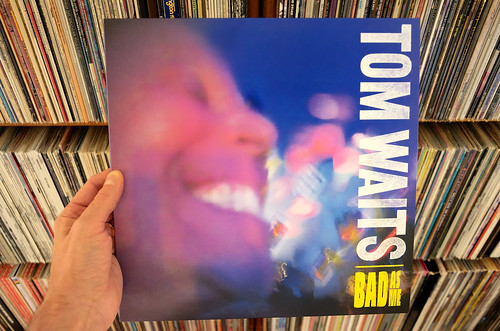
Tom Waits - Bad As Me

* Marais: Pieces De Viole des Cinq Livres (Savall, et al.) (d.3) (Alia Vox 5SACD)
* J.S. Bach: Motetten (Collegium Vocale Gent/Herreweghe) (PHI/Outhere CD)
* J.S. Bach: Violin Sonatas (Manze/Egarr/ter Linden) (Harmonia Mundi 2CD)
* J.S. Bach: Suites for Violoncello (ter Linden) (Harmonia Mundi 2CD)†
* J.S. Bach: Sonatas for Viola da Gamba (Pandolfo/Alessandrini) (Harmonia Mundi CD)†
* Miles Davis: Complete Live At The Plugged Nickel (d.1-2) (Columbia/Legacy 8CD)
* John Coltrane: Live Trane: The European Tours (d.2) (Pablo 7CD)
* Grant Green: Idle Moments (Blue Note LP)
* Sun Ra: The “New” Five Spot, New York, NY 6-11-75 (AUD CDR)
* Bill Dixon & Tony Oxley: Papyrus Volume I (Black Saint/Soul Note CD)
* Bill Dixon & Tony Oxley: Papyrus Volume II (Black Saint/Soul Note CD)
* Ingrid Laubrock Sleepthief: Sleepthief (Intakt CD)
* Sylvie Courvoisier: Lonelyville (Intakt CD)
* Mephista: Black Narcissus (Tzadik CD)
* Mark Nauseef/Ikue Mori/Evan Parker/Bill Laswell: Near Nadir (Tzadik CD)
* David Torn: Prezens (ECM CD)
* Tortoise: It’s All Around You (Thrill Jockey CD)†
* Tortoise: Beacons Of Ancestorship (Thrill Jockey CD)†
* Grateful Dead: Olympia Theatre, Paris, France 5/4/72 (GDP/Rhino 4CD)
* Led Zeppelin: I (Atlantic CD)†
* Led Zeppelin: II (Atlantic CD)†/‡
* Led Zeppelin: III (Atlantic CD)†/‡
* Led Zeppelin: IV (Atlantic CD)†/‡
* Led Zeppelin: Houses Of The Holy (Atlantic CD)†/‡
* Led Zeppelin: Physical Graffiti (Swan Song/Atlantic 2CD)†/‡
* Led Zeppelin: Presence (Swan Song/Atlantic CD)†/‡
* King Crimson: Heavy ContruKction (d.1-2) (DGM 3CD)†
* Fleetwood Mac: Rumours (Warner Bros. 2-45RPM LP)
* Emmylou Harris: Wrecking Ball (Asylum CD)
* Tom Waits: As Bad As Me (Anti-/Epitaph LP/1+1CD)
* U2: Achtung Baby (Deluxe Edition) (Island/Universal 2CD)
* Phil Collins: Face Value (Atlantic/Audio Fidelity CD)
* U2: Zooropa (Island CD)
* Tool: Opiate (Zoo/BMG/Volcano CDEP)†
* Tool: Aenima (Zoo/BMG/Volcano CD)†
* Tool: Lateralus (Volcano/Tool Dissectional CD)†
* Tool: 10,000 Days (Volcano/Tool Dissectional CD)†
* The Flaming Lips: The Soft Bulletin 5.1 (stereo) (Warner Bros. CD/DVD-A)
* Robert Pollard: Robert Pollard Is Off To Business (GBV, Inc. CD)†
* Robert Pollard: Moses On A Snail (GBV, Inc. CD)†
* Circus Devils: Capsized! (Happy Jack Rock Records LP)
* Beck: Sea Change (Geffen/MoFi 2LP)
* Wilco: The Whole Love (dBpm/Epitaph 2LP)
* Fleet Foxes: Helplessness Blues (Sub Pop 2LP)
* Broken Bells: Broken Bells (Columbia LP)
* Broken Bells: Meyrin Fields EP (Columbia EP)

†=iPod
‡-car

Commentary:

The release of Tom Waits’s first proper album in seven years is reason enough for celebration for his fans, yet Bad As Me is such a good record that newcomers may well become converts. Waits’ gravelly voice has been described by critic Daniel Durchholz as sounding “like it was soaked in a vat of bourbon, left hanging in a smokehouse for a few months, and then taken outside and run over by a car” but, as with Bob Dylan’s distinctive croak, it seems to get more expressive with age. Waits sounds better than ever, even stretching to a sweet falsetto on “Talking At The Same Time” or a crooning tenor on “Pay Me.” In contrast to the clattering, politically-charged Real Gone from 2004, Bad As Me is mostly a collection of semi-conventional love songs like “Back In The Crowd” or “Kiss Me”; lost-love weepers like “Face To The Highway”; and earnest homages to domestic bliss like “Raised Right Men” or “Satisfied.” Shockingly, Waits sounds almost downright happy! However, the penultimate track, “Hell Broke Luce,” is as bracingly avant-garde as anything he’s ever done: Told from the point of view from a war-damaged soldier, Waits barks out the embittered words in a frantic military cadence while the sound of helicopters, bombs and machinegun fire threatens to engulf the roaring electric guitars and pile-driving percussion. Whew! A truly harrowing listening experience! Stylistically, the album surveys the wide range of Waits’s obsessions from pre-War Americana to Tin Pan Alley torch songs; Brechitian theatrics to dissonant industrial noise—all of which he has managed to subsume into his own inimitable musical persona: the bard of Skid Row. And, as usual, he’s accompanied by a stellar line-up of musicians, including Marc Ribot, Keith Richards, David Hidalgo, Charlie Musselwhite, and Gino Robair. “Hell Broke Luce” aside, this is possibly Waits’s most accessible album in years.

The vinyl is beautifully pressed and packaged and seeing as it contains a copy of the CD, it’s definitely the way to go. But true fanatics and record collectors should seek out the limited edition 2-compact disc version which contains three additional songs and a handsome, hardbound book; the touchingly childlike “Tell Me” is well worth the cost of admission. Either way, fans will be pleased and the merely curious will be amply rewarded with the best of what Tom Waits has to offer. Highly recommended! Check out this video for the title track and see for yourself:

October 30, 2011

Sun Ra Sunday

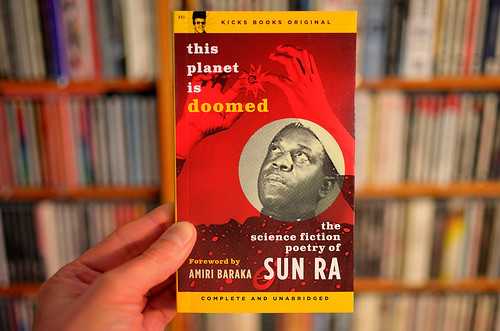
Sun Ra - This Planet Is Doomed

I picked up this cool little book at Downtown Music Gallery while we were in New York: This Planet Is Doomed: The Science Fiction Poetry of Sun Ra, which contains a number of previously unseen poems as well as a forward by Amiri Baraka and an overview of Ra’s literary pursuits by Bhob Stewart. Published by Kicks Books in association with Norton Records and Michael D. Anderson of the Sun Ra Archive, it’s definitely a worthy addition to the Sun Ra bookshelf. Here’s a great example (from page 73):

infinity is the language

all created art is music
art
choreography
sculpture
poetry
artworks
photographs
painting
architectural designs found in nature
trees
flowers
grass
every thing’s vibration is a different
degree of music
there is music everywhere
infinite infinity is the language of
enduring impression


I apologize for the sporadic posting lately (I’ve been busy!) but I’ll be back with more reviews next week—I promise!

October 29, 2011

Playlist Week Of 10-29-11


* Tristan Perich: 1-Bit Symphony (Cantaloupe Music)
* John Coltrane: Live Trane: The European Tours (d.1) (Pablo 7CD)
* Andrew Hill: Judgment! (Blue Note CD)†/‡
* New Air: Live At Montreal International Jazz Festival (Black Saint/Soul Note CD)
* New Air: Air Show No.1 (Black Saint/Soul Note CD)
* Henry Threadgill’s Very Very Circus: Spirit Of Nuff…Nuff (Black Saint/Soul Note CD)
* Henry Threadgill: Song Out Of My Trees (Black Saint/Soul Note CD)
* Henry Threadgill’s Flute Force 4: Flutistry (Black Saint/Soul Note CD)
* Henry Threadgill’s Very Very Circus: Too Much Sugar For A Dime (Axiom/Island CD)†
* Bill Dixon: November 1981 (Black Saint/Soul Note CD)
* Bill Dixon: Thoughts (Black Saint/Soul Note CD)
* Bill Dixon: Son Of Sisyphus (Black Saint/Soul Note CD)
* Bill Dixon: Vade Mecum (Black Saint/Soul Note CD)
* Bill Dixon: Vade Mecum II (Black Saint/Soul Note CD)
* Roscoe Mitchell Trans-Atlantic Art Ensemble: Composition/Improvisation No.1-3 (ECM CD)†
* Evan Parker Trans-Atlantic Art Ensemble: Boustrophedon (ECM CD)†
* Steve Noble/John Edwards/Ingrid Laubrock: BBC Jazz on 3, London, England 2-21-08(FM CDR)
* Paradoxical Frog (Davis/Laubrock/Maneri/Sorey) Vision Festival, NYC 6-11-11 (FM CDR)
* Ingrid Laubrock Anti-House: Anti-House (Intakt CD)†
* Ingrid Laubrock Anti-House: The Vortex, London, England 1-18-10 (FM CDR)
* Ingrid Laubrock Anti-House: Agosto Jazz Festival, Lisbon, Portugal 8-06-11 (AUD 2CDR)
* Ingrid Laubrock Quintet: Red Hook Jazz Festival, Brooklyn, NY 6-18-11 (AUD CDR)
* Mephista: Black Narcissus (Tzadik CD)
* Mephista: Entomological Reflections (Tzadik CD)
* Spring Heel Jack: Masses (Thirsty Ear CD)†
* Spring Heel Jack: Amassed (Thirsty Ear CD)†
* David Torn: Best Laid Plans (ECM CD)†
* David Torn: Cloud About Mercury (ECM CD)†
* Tortoise: TNT (Thrill Jockey CD)†
* Tortoise: Standards (Thrill Jockey CD)†
* The Disco Box (d.1-2) (Rhino 4CD)
* Emmylou Harris: Spyboy (Eminent/ CD)
* Grateful Dead: Musikhalle, Hamburg, W. Germany 4/29/72 (GDP/Rhino 3CD)
* Grateful Dead: Olympia Theare, Paris, France 5/3/72 (GDP/Rhino 4CD)
* Santana: Caravanserai (Columbia/MoFi SACD)
* Pink Floyd: The Dark Side Of The Moon (Experience Edition) (d.1) (Pinkfloyd/EMI 2CD)†
* Pink Floyd: Wish You Were Here (Pinkfloyd/EMI CD)†
* Pink Floyd: Animals (Pinkfloyd/EMI CD)†
* King Crimson: Discipline (DGM CD)†
* King Crimson: Beat (DGM CD)†
* King Crimson: Three Of A Perfect Pair (DGM CD)†
* King Crimson: Thrak (DGM CD)†
* Tom Waits: Bad As Me (Anti LP)
* Chris Bell: I Am The Cosmos (Deluxe Edition) (Ardent/Rhino Handmade 2CD)†/‡
* Sonic Youth: Sonic Nurse (Geffen CD)†(‡)
* Thurston Moore: Demolished Thoughts (Matador 2LP)
* Robert Pollard: Let It Beard Boombox Demos (GBV, Inc. CD)
* Boston Spaceships: Let it Beard (GBV, Inc. CD)†
* Circus Devils: Capsized! (Happy Jack Rock Records LP)
* Those Bastard Souls: Debt And Departure (V2 CD)† (‡)
* Animal Collective: Strawberry Jam (Domino CD)†
* Animal Collective: “Peacebone” (Domino CDEP)†
* Animal Collective: Merriweather Post Pavilion (Domino CD)†
* Deerhoof: Friend Opportunity (Kill Rock Stars CD)†

†=iPod
‡=car

Commentary:

What a week! I’m still catching up from our trip to New York, processing photographs and slowly going through the batch of rare and wonderful CDs I picked up at Downtown Music Gallery—stuff that is pretty much unavailable anywhere else. Of course, I expected to like the box set of Henry Threadgill’s Black Saint/Soul Note records (and I do!) but I was completely blown away by the Bill Dixon box on the same label, which I bought purely upon the enthusiastic recommendation of a friend. I was mostly unfamiliar with his music until now but, wow, this stuff is beautiful! I have to admit I’m not the biggest fan of the trumpet as a solo instrument but Dixon’s playing is superb: moody, dark, spacious, deeply melodious with a rich, burnished tone—and his compositions for improvising ensembles are uniquely compelling, unlike anything else I’ve ever heard. I’m still not through all nine discs, but each one is a masterpiece of understated genius. There’s more great stuff in the pile of discs I brought home but I can barely begin to comment on any of it. Frankly, it’s been a crazy week, what with going back to work after a long vacation (and the intendant backlog), capped off with seeing Adrian Belew Power Trio with Tony Levin’s Stickmen at the Belcourt Theater last night. It was a long evening of prog-rock mayhem and, man, I’m beat! Sometimes, I think I’m too old to rock’n’roll…Anyway, I hope to get back into the swing of writing on the blog next week, so please stay tuned.

October 22, 2011

Playlist Week of 10-22-11

Mary Halvorson - The Stone, NYC 2011-10-15

* Miles Davis: Relaxin’ With The Miles Davis Quintet (Prestige/DCC CD)†
* Miles Davis: Cookin’ With The Miles Davis Quintet (Prestige/DCC CD)†
* Miles Davis: The Complete In a Silent Way Sessions (d.1,3) (Columbia/Legacy 3CD)†
* Miles Davis: Agharta (CBS/Sony 2CD)
* Miles Davis: Pangaea (CBS/Sony 2CD)
* John Coltrane: The Heavyweight Champion: The Complete Atlantic Recordings (Atlantic/Rhino 7CD)†
* John Coltrane: Impressions (Impulse! CD)†
* John Coltrane: Coltrane (Impulse! CD)†
* John Coltrane: Crescent (Impulse! CD)†
* John Coltrane: Ballads (Impulse! CD)†
* Bill Evans: The Complete Live At The Village Vanguard 1961 (Riverside/Concord 3CD)†
* Stan Getz & Jao Gilberto: Getz/Gilberto (Verve CD)†
* Stan Getz & Charlie Byrd: Jazz Samba (Verve CD)†
* Antonio Carlos Jobim: The Composer of Definado, Plays (Verve CD)†
* Air (Henry Threadgill/Fred Hopkins/Steve McColl): Live Air (Black Saint/Soul Note CD)
* Air (Henry Threadgill/Fred Hopkins/Steve McColl): Air Mail (Black Saint/Soul Note CD)
* Bill Dixon: Bill Dixon In Italy, Volume One (Black Saint/Soul Note CD)
* Bill Dixon: Bill Dixon In Italy, Volume Two (Black Saint/Soul Note CD)
* Joëlle Léandre/Phillip Greenlief: That Overt Desire Of Object (Relative Pitch CD)
* Ingrid Laubrock Sleepthief: Sleepthief (Intakt CD)
* Ingrid Laubrock Sleepthief: The Madness Of Crowds (Intakt CD)
* Paradoxical Frog (Kris Davis/Ingrid Laubrock/Tom Rainey): Paradoxical Frog (Clean Feed CD)
* Tomas Fujiwara & The Hook Up: Actionspeak (482 Music CD)
* LTJ Bukem: Journey Inwards (Kinetic 2CD)†
* Grateful Dead: Jahrhundert Halle, Frankfurt, W. Germany 4/26/72 (GDP/Rhino 4CD)
* Wilco: The Whole Love (dBpm/Epitaph 2LP)

†=iPod

Commentary:

Just got back from a weeklong vacation in New York City—the Big Apple, The City That Never Sleeps—and we had an amazing trip. We timed it so we could see our favorite guitarist, Mary Halvorson, on Friday and Saturday at The Stone and she did not disappoint. The first night was devoted to Halvorson’s new quintet/septet with saxophonists Ingrid Laubrock and Tim Berne, Jonathan Finlayson on trumpet, Jacob Garchik on trombone, John Hebert on bass and Ches Smith on drums and she introduced all new compositions for the expanded ensemble. Unfortunately, she didn’t really let loose on the guitar until the very end, preferring to leave the solo spaces open to others, with Laubrock putting on a particularly breathtaking display of tenor madness during the first septet piece. But instead of freewheeling improvisation, the focus was on the richly textured compositions, which happily evoke the post-bop big-band idiom while bending and stretching it into something altogether new, fresh and exciting. Saturday night featured Halvorson with violist Jessica Pavone in what was supposed to be a record-release party for their new CD on Thirsty Ear, but manufacturing delays caused it to be unavailable. Nevertheless, they played the entire album from start to finish and demonstrated the continued development of their unique brand of electric chamber music. Sounding more like Henry Cow than Eric Dolphy (complete with charmingly weird and dissonant art-songs), they still encored with a wonderfully twisted cover from Out To Lunch. Halvorson is the most interesting guitarist around in my opinion and I was privileged to get to meet her after the show—and she is as nice and down-to-earth as could be. I can’t wait to hear what she does next.

On Sunday evening, we trekked down to Downtown Music Gallery, the world’s greatest record store for out-jazz and avant-garde music of all kinds, where I did a little shopping and saw a brief set by bassist Dominic Lash and clarinetist Alex Ward. Holy smokes! Words cannot even describe how intensely beautiful it was! The level of musicianship was just extraordinary and their telepathic musical communication was astonishing to behold. I need to hear more of these two immediately! Finally, on Monday night I went with my friend Scott to Clemente Soto Vélez Cultural Center (a converted schoolhouse in a seriously funky neighborhood in the Lower East Side) to see Ingrid Laubrock again, this time with bassist Joshua Abrams’s group with drummer Gerald Cleaver. This band can groove and it was interesting to hear Laubrock doing her thing in a different context. The night ended with a duo performance by cellist Tomas Ulrich and bassist Michael Bisio that was simply mindblowing. These guys attacked their acoustic instruments like Pete Townsend (or Jimi Hendrix)—I halfway expected them to smash them to bits and set them on fire at the end! Yet their playing was extraordinarily sensitive as well, with a touching rendition of John Coltrane’s “Alabama” thrown in amidst the extended improvisations. I was completely blown away.

After four nights in a row, that was it for music; we spent the rest of the week looking at art and sightseeing. It seems we could have stayed a month and not seen all we wanted to. But we did see the big De Kooning retrospective at MOMA; David Smith sculptures at The Whitney; the 100-year exhibition at the New York Public Library; “Steiglitz and His Artists: Matisse to O’Keefe” at The Met; “Ingres at The Morgan” at the Morgan Library; “Picasso’s Drawings, 1890-1921: Reinventing Tradition” at the Frick Collection; as well as a gallery tour of Chelsea, where we saw Richard Serra’s massive torqued spirals at Gagosian, paintings by Agnes Martin at Pace, and Nick Cave’s “sound suits” at Mary Boone. Even so, it felt like we barely scratched the surface of the NYC art world. But we also took the “Harbor Lights” cruise on the Circle Line; took the elevator to “The Top of The Rock”; and strolled through Central Park and along the new High Line Park downtown. Best of all, our hotel room—a “junior suite”—at the Sofitel was dee-luxe! It was so nice to stay in such a nice place while we were there; it made the trip much more relaxing—we could even listen to my iPod on the in-room stereo! The weather was (mostly) delightful and we got to see old friends as well as a rare visit with Lizzy’s brother, David, who had just flown in from Tokyo to give a paper at Princeton (!). Oh, and the restaurants! The Modern! Mercato! Cafe Un Deux Trois! Candle 79! Kellari! Yummee! It was a really special trip, vastly exceeding my wildest expectations, and I will forever have such fond memories. Sure, it’s nice to be home—but I can’t wait to go back again some day.

October 16, 2011

Sun Ra Sunday


POINTS OF THE SPACE AGE

THE SPACE AGE CANNOT BE AVOIDED.

The greater future is the age of the space prophet
The scientific airy minded second man.
The prince of the power of the air.
The air is music.
The music is power.
The power of the past was its music.
The greater power of the future greater
Is its greater music.

Greater music is art.
Art is the foundation of any living culture.
Living culture is skilled culture
Skilled beautifulness, aim and care
And love of beauty is the only way to produce art.

Skilled culture is the new weapon of nations,
The new measure of determination as to whether a nation
Is ready to be a greater nation is art.
A nation without art is a nation without a lifeline.
Art is the lifeline because art is the airy concept
Of greater living. It is the airy foundation of the airy
Kingdom of the future.

TOMORROW BEYOND TOMORROW IS THE GREATER KINGDOM.

--Sun Ra (1984)

October 15, 2011

Playlist Week of 10-15-11

CDs 2011-10-15

* Hildegard von Bingen: 11,000 Virgins (Anonymous 4) (Harmonia Mundi CD)
* Istanbul: Dimitrie Cantemir 1673-1723 (Hespèrion XXI/Savall) (Alia Vox SACD)
* Miles Davis: Seven Steps: The Complete Columbia Recordings 1963-64 (d.1-5) (Columbia 6CD)
* Sun Ra: The “New” Five Spot, New York, NY 6-11-75 (AUD CDR)
* Bobby Hutcherson: “Mellow Vibes” (Blue Note mix CDR)†
* Bill Evans Trio: The Complete Live At The Village Vanguard (Riverside 3CD)†
* Evan Parker Electro-Acoustic Ensemble: Memory / Vision (ECM CD)†
* Henry Threadgill’s Zooid: This Brings Us To Vol.I (Pi CD)†
* Henry Threadgill’s Zooid: This Brings Us To Vol.II (Pi CD)†
* Anthony Braxton: Trio (Wesleyan) 2005 (New Braxton House MP3)†
* Anthony Braxton: Quartet (Mannheim) 2010 (New Braxton House MP3)†
* Andrew Raffo Dewar: Six Lines of Transformation (Porter CD)
* Mary Halvorson Trio: WFMU, New York, NY 12-17-08 (FM CDR)
* Mary Halvorson Trio: The Vortex, London, England 12-14-09 (FM CDR)
* Mary Halvorson Trio: Willisau, Switzerland 8-25-10 (FM CDR)
* Mary Halvorson & Jessica Pavone: WFMU, New York, NY 9-10-06 (FM CDR)
* Mary Halvorson Trio: Dragon’s Head (Firehouse 12 CD)†
* Mary Halvorson Quintet: Saturn Sings (Firehouse 12 CD)†
* Ingrid Laubrock Anti-House: Anti-House (Intakt CD)†
* Tom Rainey Trio: Pool School (Clean Feed CD)†
* David Torn’s Prezens: The Vortex, London, England 1-14-08 (FM CDR)
* Grateful Dead: Beat-Club, Bremen, Germany 4/21/72 (GDP/Rhino CD)
* Grateful Dead: Rheinhalle, Dusseldorf, W. Germany 4/24/72 (GDP/Rhino 4CD)
* Sonic Youth: A Thousand Leaves (Geffen CD)†
* Sonic Youth: Murray Street (Geffen CD)†
* Sonic Youth: The Destroyed Room (Geffen CD)†
* Thurston Moore: Demolished Thoughts (Matador CD)†
* Spiritualized: Royal Albert Hall October 10 1997 Live (Arista 2CD)†
* UNKLE: Psyence Fiction (MoWax CD)†/‡
* DJ Shadow: Preemptive Strike (MoWax CD)†/‡
* DJ. Shadow: The Private Press (MCA CD)†/‡
* Radiohead: TKOL RMX 1234567 (tbd/Ticker Tape 2CD)


†=iPod
‡=car

Commentary:

No time to write!

October 9, 2011

NuVoid Interview With Indeterminacies Co-Curators, Lesley Beeman & Lain York

Lesley Beeman and Lain York with Kurt Wagner’s “Beautiful Millionaire,” Zeitgeist Gallery, Nashville, TN October 4 2011

Lesley Beeman and Lain York with Kurt Wagner’s “Beautiful Millionaire 2000,” Zeitgeist Gallery, Nashville, TN October 4, 2011


In this year’s “Best Of Nashville” issue, the Nashville Scene just recently awarded Indeterminacies “Best Contemporary Classical Series” and I wholeheartedly agree with their assessment! Indeterminacies is the brainchild of architect Lesley Beeman and visual artists Lain York, based at the Zeitgeist Gallery, which shares its space with Manuel Zeitlin Architects in picturesque Hillsboro Village. The storefront gallery shows contemporary work from local and international artists while the firm is responsible for some of the most beautifully modern buildings in Nashville. A synergetic dialogue between fine art, architecture and design has been the defining principle of Zeitgeist/MZA since its opening in 1994 and has increasingly utilized the gallery as a venue for cutting edge music, dance and experimental performance art. The series derives its name from John Cage’s idea of “indeterminacy,” art as “processes whose outcome is not predetermined” and, to that end, audience participation is actively encouraged. In an interview with Theatre Intangible, Lain York stated their artistic “goal is to push someone else into carrying the conversation further” while Lesley Beeman spoke of the desire to build a “library of criticism for new music” through “a critical dialogue” between composers, performers and listeners. As you can see, Indeterminacies is much more than a mere concert series.

On Tuesday October 11, Indeterminacies continues with a program of music by Andrew Raffo Dewar performed by Pulse New Music Ensemble and guitarist, Brady Sharp, who will play “Box With Strings” (2003) a composition of prepared electric guitar (!). Your humble blogger will be moderating the discussion and I’m very pleased (and surprised!) to have been asked to participate. The music is certainly right up my alley: Mr. Dewar studied with Anthony Braxton, one of my biggest heroes, and plays (woodwinds) on some of my all-time favorite records, including Braxton’s mammoth 9 Compositions (Iridium) 2006 box set (Firehouse 12) and 12+1tet (Victoriaville) 2007 (Victo) as well as Bill Dixon’s final magnum opus, 17 Musicians In Search Of A Sound: Darfur (AUM Fidelity). But he’s also a respected composer in his own right as well as an ethnomusicologist and Assistant Professor of Interdisciplinary Arts at The New College & School of Music at the University of Alabama. There is wonderful CD of his music entitled, Six Lines of Transformation, available on Porter Records, and is highly recommended. The works presented on October 11 are exquisite examples of “ergodic notation,” graphic scores which transcend the confines of traditional notation and require the musician’s own imagination and creativity to interpret. It is not exactly improvisation—the instructions are quite explicit—but the result is, well, indeterminate. It is sure to be scintillating evening of music and, hopefully, enlightening discussion.

I recently had an opportunity to chat with Lesley Beeman and Lain York about the Indeterminacies series and they graciously allowed their words (and image) to be published on the blog:

+++

RC: This season’s Indeterminacies line-up is suitably eclectic: On September 13, the Portara Ensemble performed David Lang’s Pulitzer prize-winning vocal piece, “The Little Match Girl Passion”; on October 11, Andrew Raffo Dewar presents some of his “ergodic” scores performed by the Pulse Ensemble and Brady Sharp; and on November 8, the season concludes with a program featuring theorist/composer John Latartara. Can you tell me a little about how you came up with this year’s schedule of events?

Lesley: This is the fourth year we've been doing events like this in the gallery, although they've had different titles. It seems that each year's concept grows from something in the year before. This year's series grew out of a program we did about critical thinking with Jonathan Neufeld and Matt Walker [director of ALIAS Chamber Ensemble]. Long story short-er, short-ish, this year we set out to try to build a library of criticism of new music. So, we combine new music by local composers with critics to engage us in a rigorous discussion of the music. The first person we contacted was John Latartara whose striking electronic music introduced me to an exciting new genre of music.

Lain: Conversations outside institutional confines overwhelmingly indicate that folks want to talk and be more engaged; they want more focused conversation and are not short on opinions. It seems, however, that when a platform for these conversations is presented it takes some doing to get people (a) to the venue and (b) get them sharing. In 2006, “dialogues” related to visual art group shows sought to “confront” a studio community that was frustrated on a number of levels. Results were mixed but at least we were all set on a trajectory. Not sure if it is that we are in the South but shoes are still a bit too tight. Hopefully this year’s Indeterminacies will continue to see the conversations that folks say they want to see tabled. Would love to see more area outfits playing with formats that will induce “sharing” in both physical and virtual space.

RC: You have taken a step in that direction, with last month’s program being streamed from Indeterminacies Facebook page and I assume that will continue in the future. In the interview with Theatre Intangible, Lain described the Indeterminacies program as a “dialogue” and an attempt to “push the conversation further.” To that end, the presence of a moderator and an audience participation segment is an integral part of each event and I’m honored to have been asked to host the Andrew Raffo Dewar program. I understand it is something more than just a Q&A with the composer, yet audiences (and composers and musicians) can be difficult to draw out. How do you envision the ultimate Indeterminacies program? Where does the “conversation” go from here?

Lesley: Art, architecture, music, design fundamentally search for something new or a new way of looking at something familiar. Conversation is a critical part of this enterprise. The ultimate Indeterminacies program would engage the presenters and the audience in that search.

RC: Well, I’m happy to do my part! For me, one of the things that is so refreshing about the Indeterminacies events is hearing serious, cutting edge music is presented in a contemporary art gallery space. One of my bailiwicks is that most people—including many musicians—do not consider music to be “art.” The proof is in their general contempt of modernism when it comes to music. Nobody who wants to be taken seriously in the fine art world would be caught dead making jokes about, say, Cy Twombly, yet John Cage is still grossly misunderstood and forever controversial in the “classical music” world. Painting, sculpture, theatre, film, architecture have all canonized and cannibalized their modernist heroes and moved on; meanwhile so-called “classical music” is confined to the narrow confines of a misconstrued 19th Century. Is music in an art gallery different from music in a concert hall? Is music art?

Lain: First of all, I have always felt that John Cage is a painfully underrated visual artist. Love hearing him mentioned in the same breath as Twombly (Twombly being Kingboss as far as I’m concerned). If “art” is a vehicle for expression, association, and conversation I certainly think of music (writing, film making, choreography/dance, skateboarding, etc.) as art. The gallery has always been interested in curatorial projects by artists. The idea of exhibitions in a physical, institutional gallery space for viewing visual art critiquing and deconstructing institutional gallery spaces for viewing visual art is, I believe, very timely. Through curated exhibitions and performances, the space plays with the idea of “programming” making the shows and the space itself a nexus for showcasing particular studio practices, networking the shows themselves, and for visual artists working in particular media. It’s there to deconstruct and define in new ways the nature of these physical spaces and the influences they have on what was shown on the walls (and vice versa)and should directly affect how these works are translated into more formal/traditional venues. In the age of virtual space, people gathering in physical spaces has new meanings and in a relatively small cultural market traditionally lacking in institutional support such as Nashville, this can be a lot of fun.

We have all been seeing artists/musicians/writers/film makers, etc. interacting in interesting ways for years and the argument for/against compartmentalizing and specializing is taking on new meanings. The tools available now on the internet for individual expression and sharing are making these very exciting times. Museums, concert halls, cinemas, etc. (and the canons they reflect) are all having to absorb new vocabularies introduced on the periphery. Kicking and screaming in some instances.

RC: I, for one, very much appreciate the work you’re doing to push things forward! When Theatre Intangible asked who some of your influences are in your own art, Lesley replied: “John Cage’s book ‘Silence’ is the best book on architecture ever written.” Well, that statement sort of blew my mind! Discovering that book while at the Conservatory changed my life forever! I’ve re-read it many times and it is certainly one of the best books about music ever written. Can you elaborate on how it influenced your practice as an architect? Can you give an example where music directly impacted a building you designed?

Lesley: For me "Silence" is a book primarily about creating spaces that enhance a connection to the present, in Cage's sense a musical space but can also be an architectural space. It's about a stillness or an anchoring to a place in space or a place in time. Cage asks us to be still and listen to what is happening around us. Great architecture asks us to be still and be aware of our surroundings. The two are exactly the same. I'm not sure I can point to a building I've worked on that explicitly demonstrates this quality, but it is how I try to think about making architecture. It's a struggle and I'm certainly not always successful, but I hope to think more about space, experience and stillness than about making a "building."

RC: That makes a lot of sense and helps to explain why architecture can, like music, be the catalyst for a profoundly moving experience. Cage was truly a renaissance man: musician, philosopher and also a fine visual artist. Lain, can you describe his influence on your work?

Lain: I believe he cuts right across genres, disciplines, whatever you have. I see him as a strategist and philosopher, much like Duchamp, using drawing, printmaking, sound, etc. as a vehicle for his line of inquiry. I see creative process as using a particular or broad based skill set to flesh out associations related to particular ideas. His skill set definitely proved more broad and articulate than most. With that in mind, his approach to drawing has been most intriguing: the most immediate response to the most complex ideas.

RC: Works by artists Wayne White and Kurt Wagner (leader of the legendary alt-country band, Lambchop) are currently showing at Zeitgeist Gallery. Did the schedule of art openings influence your programming for Indeterminacies?

Lain: Janice [Zeitlin] and I do not consciously curate with the performances in mind; there’s something already in the water. Kurt is an internationally recognized musician and friend who we’ve wanted to show for ages. I spoke at length with Kurt about the Indeterminacies programming and he was super supportive. He’s familiar with Lang and loves the idea of the gallery as an interdisciplinary platform. Kurt was hoping to find some young bluegrass musicians, some that were just starting out to play at the reception with Wayne. Wayne also plays banjo and the thought of these relative novice players with pure intent was definitely appealing. Could not get that together, though.

RC: That would have been fun! Can you tell you me about future exhibitions?

Lain: The November gallery show will feature Ward Schumaker who is San Francisco-based. His background is in illustration and design but I find him to be a phenomenal painter and is currently getting picked up by galleries in LA, New York, and Shanghai. Upon initially meeting him, we somehow launched into a discussion on La Monte Young. Ward’s San Francisco gallery recently began hosting performances.

RC: That’s definitely a trend I like to see. What’s on the horizon for Indeterminacies in 2012?

Lesley: I have absolutely no idea, but it will doubtless involve something unexpected. Any suggestions?

RC: Well, I’d love to see more of Braxton’s progeny such as Mary Halvorson, Taylor Ho Bynum and Jessica Pavone be given the opportunity to play in Nashville since they so gleefully transcend the boundaries of composition and improvisation, “classical” and “jazz,” while developing a highly personalized voice on their respective instruments—but I don’t know how feasible it would be! Thank you both so much for taking the time to offer such thoughtful responses to my questions and for inviting me to participate on Tuesday!

+++

With beautiful fall weather we’re having, Tuesday’s event will take place outdoors, in the courtyard behind Retropolitan and Cotten Music Center, located just a few doors down from Zeitgeist at 1813 21st Avenue South. The program starts at 6:00pm and is free and open to the public, so I hope to see you there! In the meantime, go to Theatre Intangible and download these high-quality podcasts of previous events by composers Stan Link, Mark Snyder and Mark Volker. Good stuff!

October 8, 2011

Playlist Week Of 10-08-11

Grateful Dead - Complete Europe 72 (interior)

* Rebel: Violin Sonatas (Manze/Egarr/ter Linden) (Harmonia Mundi CD)†
* Vivaldi: Concertos, RV 331, etc. (VBO/Marcon/Carmignola) (Archiv Produktion CD)
* Vivaldi: Concertos For Two Violins (VBO/Marcon/Carmignola/Mullova) (Archiv Produktion CD)
* Miles Davis: The Complete In A Silent Way Sessions (Columbia/Legacy 3CD)
* Herbie Hancock: Sextant (Columbia/Legacy CD)†
* Anthony Braxton: Trio (Wesleyan) 2005 (New Braxton House FLAC>CDR)
* Anthony Braxton: Septet (Pittsburgh) 2008 (New Braxton House MP3)†
* Anthony Braxton: Quartet (Mannheim) 2010 (New Braxton House FLAC>CDR)
* John Fahey: Of Rivers And Religion (Reprise LP)
* Grateful Dead: Wembley Empire Pool, London, England 4/7/72 (GDP/Rhino 3CD)
* Grateful Dead: Wembley Empire Pool, London, England 4/8/72 (GDP/Rhino 3CD)
* Grateful Dead: City Hall, Newcastle, England 4/11/72 (GDP/Rhino 3CD)
* Grateful Dead: Tivoli Concert Hall, Copenhagen, Denmark 4/14/72 (GDP/Rhino 4CD)
* Grateful Dead: Stakladen, Aarhus University, Aarhus, Denmark 4/16/72 (GDP/Rhino 3CD)
* Grateful Dead: Tivoli Concert Hall, Copenhagen, Denmark 4/17/72 (GDP/Rhino 3CD)
* Allman Brothers Band: At Fillmore East (Deluxe Edition) (Mercury/Universal 2CD)†/‡
* Allman Brothers Band: Eat A Peach (Deluxe Edition) (selections) (Mercury/Universal 2CD)†/‡
* Stephen Stills: Manassas (Atlantic 2LP)
* Carole King: Tapestry (Columbia Mastersound LP)
* King Crimson: Absent Lovers: Live in Montreal 1984 (DGM 2CD)†
* King Crimson: Vroom Vroom: Live in Mexico City and On Broadway 1995-96 (DGM 2CD)†
* Adrian Belew: Lone Rhino (Island LP)
* Adrian Belew: Twang Bar King (Island LP)
* Tony Levin/David Torn/Alan White: Levin Torn White (Lazy Bones CD)†
* Brand X: Product (Passport LP)
* Cocteau Twins: Echoes In A Shallow Bay (4AD/Capitol CDEP)†
* Cocteau Twins: Tiny Dynamine (4AD/Capitol CDEP)†
* Thurston Moore: Demolished Thoughts (Matador CD)†
* Spiritualized: Lazer Guided Melodies (Arista CD)†
* Spiritualized: Pure Phase (Arista CD)†
* Spiritualized: Ladies And Gentlemen, We Are Floating In Space (Arista CD)†/‡
* Spiritualized: Let It Come Down (Arista CD)†
* Spiritualized: Amazing Grace (Spaceman/Sanctuary CD)†
* Spiritualized: Songs In A & E (Spaceman/Sanctuary CD)†
* My Bloody Valentine: Loveless (Sire/Warner Bros. CD)†
* Wilco: Yankee Hotel Foxtrot (Nonesuch CD)†/‡
* Wilco: A Ghost Is Born (Nonesuch CD)†(‡)
* Wilco: The Whole Love (dBpm/Epitaph 2LP/1+1CD)(†)(‡)

†=iPod
‡=car

Commentary:

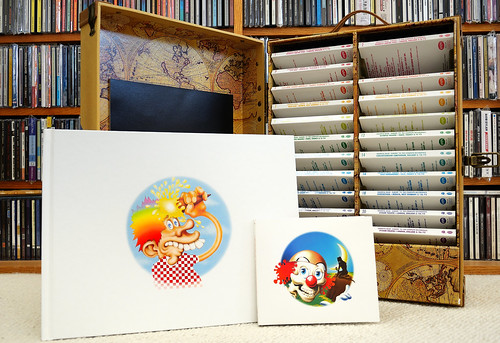
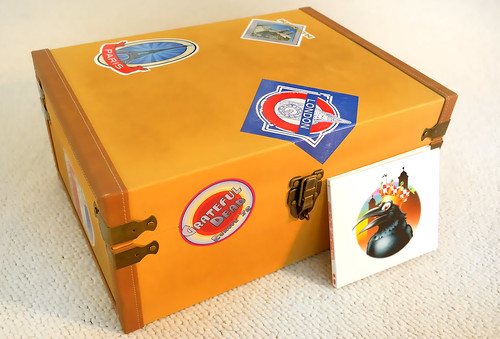
OK, all is forgiven. Europe ’72: The Complete Recordings is by far the most audacious box set ever: twenty-two full concerts spread across seventy-three CDs with a 100-page hardback book of essays and photos plus a reproduction of “The Book of The Dead” handed out at the Lyceum Ballroom, all packaged in an oversized, leather-bound “steamer trunk” festooned with vintage travel stickers from London, Newcastle, Paris, Munich, Luxembourg, Amsterdam, Frankfurt, Copenhagen and Rotterdam. The presentation alone is worth the price of admission: it’s a gorgeous object d’art and a fitting monument to what was arguably the Grateful Dead’s finest hour.

This was Pigpen’s last tour and, despite his failing health, he gives it his all, as if he knew he was soon to die. Photographs show him looking thin and pale, bundled up against the cold and dreary European spring. But he’d written a number of new songs for the occasion (including uptempo swingers like “Mr. Charlie” and “Chinatown Suffle” and the heartrending ballad, “Two Souls In Communion”) and he belts out classic numbers like “Good Lovin’”, “(Turn On Your) Lovelight” and “Caution (Do Not Stop On The Tracks)” just like the old days, complete with freewheeling raps and bloodcurdling screams. He even adds some soulful organ to many songs, giving lie to the idea that he was somehow inadequate as an instrumentalist. This was also Donna Godchaux’s first tour singing with the band who along with her husband, Keith, on keyboards, brought a refreshing creative boost to the group. While her banshee wails on “Playing In The Band” are a bit over the top, Donna Jean’s harmony vocals elsewhere add a sweetness and feminine energy that balanced perfectly with Jerry Garcia’s reedy tenor and Bob Weir’s idiosyncratic yelp. Keith had been with the band about six months by this time and he fits in perfectly: whether it’s a rollicking boogie-woogie, a tender country-western ballad, the furthest reaches of spaced-out improvisation or full-tilt rock ’n’ roll, he’s right there with supportive comping and a sparkling flourish. The band was inspired enough to write a bunch of new songs, many of which were debuted on this tour and would go on to become staples of their repertoire: songs like “Cumberland Blues,” “Ramble On Rose,” “Tennessee Jed,” “Brown-Eyed Women,” and “He’s Gone” tap the rich vein of American folk music, sounding like they could have been written sometime in the late-19th Century, yet still sound timeless and hip, like a psychedelicized, electric string band from the planet Neptune. While the band would soldier on and write many more great songs, things would never be quite the same with Pigpen’s passing. Europe ’72: the Complete Recordings offers a panoramic view of the glorious final days of the so-called “primal” era of Grateful Dead music.

I’m of two minds regarding the sound quality of these discs. On the one hand, they lack the Technicolor vividness of 2002’s Steppin’ Out With The Grateful Dead: England ’72 (Arista), one of the best-sounding releases in their catalog. On the other hand, Jeffrey Norman’s simple and directed approach to mixing the original sixteen-track tapes (necessitated by the time constraints imposed by the sheer enormity of the project) offers a more honest representation of the band’s sound, warts and all. Sometimes the balance is muddled and there’s a midrange graininess that is a little distracting; nevertheless, these discs are very pleasing to listen to—certainly much better than the old “bootleg” soundboard tapes which circulate. But what really makes these CDs worthwhile is the high-tech time alignment performed by Plangent Processes: the pitch is rock solid and any azimuth smear or wow-and-flutter issues are completely eliminated. I wish all their releases would get this kind of treatment, particularly the lowly cassette sources, which were notorious for extreme time-based problems (e.g. some of the Road Trips releases). So while the mix on these discs is a little bit slapdash, they still sound delightful to these ears—especially at, um, “realistic” volume levels. It would have been nice if a DVD of their television appearances in Copenhagen and Bremen had also been included to make it truly “complete” but maybe they will be released separately sometime in the future; in the meantime, my fuzzy boot of the broadcasts will have to suffice.

I’m slowly making my through the box in chronological order (it’s all I can do not to jump ahead to the Rotterdam “Dark Star”) and, quibbles aside, I’m in Deadhead heaven. Dead.net’s customer service left something (a lot!) to be desired, but the thing did finally arrive—and it’s truly extraordinary. No doubt I’ll have more to say about this set as I listen further. Stay tuned.

October 3, 2011

Wilco @ The Ryman 2011-10-02

Wilco with Nick Lowe - Ryman Auditorium 2011-10-02a

SETLIST: 1.Less Than You Think 2.Art of Almost 3.I Might 4.Black Moon 5.Ashes of American Flags 6.I Am Trying to Break Your Heart 7.Pot Kettle Black 8.Born Alone 9.Side with the Seeds 10.One Sunday Morning 11.I'll Fight 12.Impossible Germany 13.Open Mind 14.Handshake Drugs 15.Dawned on Me 16.Shot in the Arm 17.Hummingbird Encore: 18.Whole Love 19.36 Inches (with Nick Lowe) 20.I Love My Label (with Nick Lowe) 21.California Stars 22.Late Greats 23.Heavy Metal Drummer 24.Red Eyed and Blue 25.I Got You (At the End of he Century)

Wilco put on an incredible show last night at the Ryman Auditorium, even better than I expected--and that's saying a lot! Right from the get-go, the band was on their game, opening with an unexpected "Less Than You Think," which segued into a lengthy bout of pure electronic noise before launching into the terrific new song, "Art of Almost." Whew! And that was just the beginning! The concert was just about exactly perfect, end-to-end. The light show was also amazing, expertly choreographed to the music and augmented with what appeared to be sculptural wads of tissues strung from the rafters, reflecting the spotlights and projections and which, themselves, contained even more lights. It was quite beautiful to look at without distracting too much from what was happening on the stage. Legendary New-Waver, Nick Lowe, was an inspired choice as an opener and his solo acoustic set was charming, funny, suave and debonair—and he joined the band for a couple of encores, which was a lot of fun (photo). Tweedy suggested he should join the band full time: “We could call ourselves WicLo,” he said. Ha-ha. Interestingly, Nels Cline played Duane Allman’s famous gold-top Les Paul on a few songs, borrowed from The Allman Brothers Band Museum in Macon, Georgia—and, I swear, he sounded even more inspired than usual during his extended solo on “Impossible Germany.” Tweedy remarked that they’d taken up a collection to buy it for him, since it made him so happy—but they came up “about nine-hundred-and-ninety-thousand dollars short.” I sort of wish we’d gone the night before (about half their set was completely different) but it was, according to Tweedy, a typical Saturday night in Music City: completely out of control, with pungent “whiffs of vomit” wafting through the air, a lady passed out “with her chin on the stage” and yahoos “dangling from balcony.” Uh, actually I’m probably just as glad to have missed it. Still, Wilco was so damn good it makes me want to quit my job and follow them around, Grateful-Dead-style. Well, that isn’t going to happen—but I’m looking forward to the next opportunity to see them. Wilco just gets better and better. Bravo!

October 1, 2011

Playlist Week of 10-01-11

Wilco - The Whole Love

* Vivaldi: Late Concertos, RV 386, etc. (VBO/Marcon/Carmignola) (Sony Classical CD)
* Vivaldi: Late Concertos, RV 177, etc. (VBO/Marcon/Carmignola) (Sony Classical CD)
* Miles Davis: Miles Davis Quintet 1965-1968 (Columbia/Legacy 6CD)
* Sun Ra: The “New” Five Spot, New York, NY 6-11-75 (AUD CDR)
* Sun Ra: Jordan Hall, New England Conservatory, Boston, MA Dec. 1975 (AUD CDR)
* Ronnie Boykins: The Time Will Come, Is Now (ESP-Disk’ CD)
* Anthony Braxton: Three Compositions Of New Jazz (Delmark LP)
* Anthony Braxton Ensemble: Carnegie Hall, New York, NY 6-27-76 (FM CDR)
* Henry Threadgill’s Zooid: Jazz Gallery, New York, NY 6-23-11 (AUD 2CDR)
* David Torn: Best Laid Plans (ECM CD)
* Tony Levin/David Torn/Alan White: Levin Torn White (Lazy Bones CD)†
* ProjeKct One: Live At The Jazz Café (DGM CD)†
* ProjeKct Two: Live Groove (DGM CD)†
* ProjeKct X: Heaven And Earth (DGM CD)†
* Tortoise: Tortoise (Thrill Jockey CD)†
* Tortoise: Millions Now Living Will Never Die (Thrill Jockey CD)†
* Nuggets: Original Artyfacts From The First Psychedelic Era 1965-1968 (d.4) (Rhino 4CD)†/‡
* Nuggets: Original Artyfacts From The British Empire & Beyond (d.1-2) (Rhino 4CD)†/‡
* Jimi Hendrix: The Jimi Hendrix Experience (Experience Hendrix/MCA 4CD)
* Nick Drake: Five Leaves Left (Island/Brytermusic CD)†
* Nick Drake: Bryter Later (Island/Brytermusic CD)†
* Nick Drake: Pink Moon (Island/Brytermusic CD)†
* Pink Floyd: The Dark Side Of The Moon (Experience Edition) (Pinkfloyd/EMI 2CD)
* Pink Floyd: Wish You Were Here (Pinkfloyd/EMI CD)
* Pink Floyd: Animals (Pinkfloyd/EMI CD)
* Pink Floyd: The Wall (Pinkfloyd/EMI 2CD)
* The Fall: This Nation’s Saving Grace (Omnibus Edition) (d.2) (Beggar’s Banquet 3CD)
* Beck: Mutations (Geffen CD)†
* Beck: Sea Change (Geffen/MoFi CD)†
* Stephen Malkmus & The Jicks: Real Emotional Trash (Matador CD)
* Stephen Malkmus & The Jicks: Mirror Traffic (Matador CD)
* Wilco: Sky Blue Sky (Nonesuch CD)†/‡
* Wilco: Wilco (the album) (Nonesuch CD)†/‡
* Wilco: The Whole Love (dBpm/Epitaph 2LP/1+1CD)
* Boston Spaceships: Let It Beard (GBV, Inc. 2LP)

†=iPod
‡=car

Commentary:

The new Wilco album dropped this week and it’s their best record in years—perhaps ever! As the inaugural release on their own dBpm label, Wilco has gone all out with this one: The Whole Love is available as a regular compact disc; a limited-edition slipcase package with expanded artwork, a 52-page booklet, and a bonus EP containing four more songs (including Nick Lowe’s “I Love My Label,” the B-Side of the “I Might” seven-inch); and, finally, a luxurious 2-LP set with yet an additional song (a cover of Brian Patten’s “Sometimes It Happens”) plus a copy of the CD. Whew! I picked up the “deluxe” CD on Tuesday and was so blown away by what I heard I went back and bought the vinyl, which sounds spectacularly good (as well it should, having been mastered by Bob Ludwig, cut by Chris Bellman and superbly pressed at Pallas). I’ve been listening to it all week and enjoying it more with every spin.

The opening track, “Art of Almost,” is perhaps the most musically interesting thing they’ve ever committed to wax: a sprawling, multi-part prog-rock extravaganza brimming with twitchy electronica and shifting motoric rhythms, all capped with an orgasmic guitar solo from Nels Cline—yet when Jeff Tweedy sings a sweet melody, the music’s rootsy, punk-Americana vibe still shines through. It still sounds unmistakeably like Wilco. This song is the consummation of a long flirtation with hypnotic “krautrock” stylings dating back to the first tentative experiments on Yankee Hotel Foxtrot and it succeeds in creating something entirely unique in pop music. If they made a whole record like this, I would be ecstatic! Although there’s nothing else on the album quite as adventurous as “Art of Almost,” the songs are uniformly strong and the band sounds equally inspired on country-ish ballads like “Black Moon,” “Open Mind” and "Rising Red Lung"; power-pop raveups like "I Might," “Dawned On Me” and "Standing"; or the old-timey music-hall flash of “Capitol City.” The album closer (“One Sunday Morning”) is another extraordinary, twelve-minute epic: starting out with gentle acoustic guitars and hushed vocals, the song builds momentum through repetition of a chiming guitar figure and Tweedy’s increasingly urgent enunciation, periodically spelled by blissed-out atmospherics and breezy improvisations. On the CD, the song simply fades out but on the LP, it is longer and doesn’t so much end as stop—after which you can hear the band members set down their instruments and step out of the studio, an evocative touch of audio verité. I'm not sure why the discrepancy, but there you go. Vinyl, as usual, is the preferred format.

As much as I enjoy their records, live is where it’s at and Wilco is in town this weekend, playing two nights at the historic Ryman Auditorium, home of the original “Grand Ole Opry.” When we saw them there back in 2008, it was really a special occasion, with Tweedy decked out in a custom “Red Rose” Nudie Suit—he even stepped out in front of the stage to sing an unamplified rendition of “Someone Else’s Song,” a fitting tribute to the extraordinary acoustics in country music’s “Mother Church.” We managed to obtain (“obstructed view”) tickets to tonight’s show but since winning better seats for tomorrow (thanks, Grimey’s!), we opted to give them to friends who were unable to get into to these sold-out concerts. While Nels Cline is a fabulous guitar player, he’s no Jerry Garcia (wink)— and I don’t see any real point in going both nights as the setlists will be virtually identical. We’re also looking forward to what will probably be a mellower, Sunday night crowd in downtown Nashville (what can I say? I’m getting old). Anyway, we are really excited to see our favorite band at such a magnificent venue. In the meantime, I’m going to have another listen to The Whole Love—good stuff!

+++

Also out this week are the new Pink Floyd remasters—and they sound surprisingly good. Frankly, I’m not the world’s hugest Floyd fan. In my personal pantheon of British art-rock bands from the 1970s, they rank far behind King Crimson, Genesis and Yes—in that order (with a special place reserved for the more obscure bands like Soft Machine and Henry Cow, who were the most musically advanced of them all). By comparison, Pink Floyd’s big-selling records are more simplistic and obvious, easy to understand—they were the “progressive” band even the “jocks” and “straights” could love. Oh sure, I have fond memories of listening to these albums in my misspent youth; but after a while, they lost their charm, and with it their ability to surprise, so I got rid of them. Many years later, I found a mint-condition white-label-promo of The Wall and would pull it out once in a while when in a particularly bad mood—the album is one enormous temper tantrum—but, apart from “Comfortably Numb,” which contains one of Dave Gilmour’s finest guitar solos, it’s an overblown, embarrassing mess. I also have The Dark Side Of The Moon on SACD and it’s fun to listen to occasionally, even though the remix is not quite what I remembered. But my favorite Pink Floyd album was always Wish You Were Here and I’ve been (half-heartedly) looking for a clean copy on vinyl for forever, just to hear it again. So, when this new edition of the catalog came out, that was the one I had to check out first. Wow! In this era of dynamically squashed, ear-bleedingly bright remasterings, this sounds very nice, almost analog-like: warm, relaxed and non-fatiguing. Turn it up loud and the music really blooms—heck, I felt like I was sixteen again! The others I picked up all sound similarly fine and, like the recent Beatles remasters, they prove that Redbook CD can sound truly great, despite the format’s obvious limitations. In fact, what I’ve heard sounds so good I might just get the rest their catalog—even if Pink Floyd is not my most favoritest band.

+++

Another week has passed and still no Europe ’72 box. I’m so annoyed I can’t even listen to the Dead—and, as faithful readers know, that’s highly unusual. In fact, I’m so pissed-off I’m telling myself I’ll never order anything from dead.net ever again. Of course, I’m just a hapless fan—and a sucker to boot—so I will probably renege on that promise. Let’s hope it eventually shows up. We shall see…