July 17, 2010

Playlist Week of 7-17-10

* Biber: Unam Ceylum (Holloway/Mortensen/Assenbaum) (ECM CD)
* Corelli: 12 Concerti Grossi, Op.6 (English Concert/Pinnock) (Archiv Prod. 2CD)
* Handel: Solo Sonatas, Op.1 (AAM/Egarr) (Harmonia Mundi 2CD)
* Handel: Trio Sonatas, Op.2&5 (AAM/Egarr) (Harmonia Mundi 2CD)
* John Coltrane: Impressions (Impulse! CD)
* Wayne Shorter Quartet: Park Den Brandt, Antwerp, Belgium 8-14-05 (FM 2CDR)
* Sun Ra: Slug’s Saloon, New York, NY 8-19-72 (AUD 3CDR)
* Sun Ra: Rehearsal 9-76 (AUD CDR)
* Sun Ra: South St. Seaport Museum, New York, NY 7-09-72 (AUD? CD)
* Lowell Davidson Trio: WBRS-FM Brandeis University 5-08-86 (Pre-FM 2CDR)
* Anthony Braxton 12+1tet: 9 Compositions (Iridium) 2006 (d.6) (Firehouse 12 9CD+DVD)
* Matthew Shipp Trio: Old Customs House, Tampere, Finland 11-03-07 (FM CDR)
* Kip Hanrahan: A Thousand Nights and a Night (American Clavé CD)
* DJ Shadow: Preemptive Strike (Mo Wax/A&M CD+CDEP)
* Marvin Gaye: What’s Going On (Motown/MFSL SACD)
* Bob Dylan: Planet Waves (Columbia SACD)
* Lucinda Williams: Sweet Old World (Elektra CD)
* Grateful Dead: Fox Theatre, Atlanta, GA 4-10-78 (SBD 3CDR)
* Grateful Dead: Madison Square Garden, New York, NY 9-17-91 (SBD 3CDR)
* Grateful Dead: Madison Square Garden, New York, NY 9-18-91 (SBD 3CDR)
* Yes: The Yes Album (Atlantic/MFSL CD)
* Yes: Fragile (Atlantic/MFSL CD)
* Yes: Tales of Topographic Oceans (Atlantic 2LP)
* Genesis: Paris Theatre 3-2-72/BBC 9-25-72 (Pre-FM CDR)
* Genesis: Convention Center, West Palm Beach, LF 1-10-75 (SBD 2CDR)
* Genesis: Empire Pool, Wembley, London 4-15-75 (Pre-FM DVDR-A)
* Peter Gabriel: [2] (a/k/a “Scratch”) (Atlantic LP)
* Steve Winwood: Arc of a Diver (Island LP)
* Can: Landed (Spoon SACD)
* Can: Flow Motion (Spoon SACD)
* Neu: Neu! (Astralwerks CD)
* Uncle Tupelo: Still Feel Gone (Columbia/Legacy CD)
* Uncle Tupelo: March 16-20, 1992 (Columbia/Legacy CD)
* Wilco: Sky Blue Sky (Nonesuch CD)
* Radiohead: Gofferpark, Nijmegen, Netherlands 9-16-00 (FM 2CDR)
* Radiohead: Hail to the Thief (Capitol CD)
* Radiohead: “There There” (Capitol CDEP
* Radiohead: “Go to Sleep” (Capitol CDEP
* Radiohead: In Rainbows (TBD Records CD)
* Panda Bear: “I’m Not”/”Comfy in Nautica” (Uunited Acoustic CD)
* Panda Bear: Person Pitch (Paw Tracks CD)
* Animal Collective: Merriweather Post Pavilion (Domino CD)

Reading:

* Glenn Kurtz, Practicing: A Musician’s Return to Music (Knopf 2007)

I sort of knew Glenn Kurtz when we were both students at The New England Conservatory of Music back in the mid-1980s. I didn’t know him well at all – he was one of those serious classical musicians who spent most his time in practice rooms while I was basically a slacker and a fraud, taking brief refuge in the quirky and nebulous Third Stream Department. But I hung out a lot with some of the characters who populate Kurtz’s memoir and reading it evokes the hothouse environment of the Conservatory with a discomfiting vividness. Moreover, his tale of bitter failure and painful reconciliation hits particularly close to home.

Kutz’s disarming honesty and elegantly crafted prose captures the complex and fraught relationship a musician suffers with an instrument and with music itself. Playing music is (or can be) fun; practicing is no fun at all:

Practicing is striving … a risk, a test of character, a threat of deeply personal failure. I warm up my hands and awaken my ears and imagination, developing skill to equal my experience. I listen and concentrate in an effort to make myself better. Yet every day I collide with my limits, the constraints of my hands, my instrument, and my imagination. Each morning when I sit down, I’m bewildered by a cacophony of voices, encouraging and dismissive, joyous and harsh, each one a little tyrant, each one insisting on its own direction. And I struggle to harmonize them, to find my way between them, uncertain whether this work is worth it or a waste of my time (p.9).

This is how every musician feels as they sit down to practice. It only seems worth it if your love of music and dream of becoming an artist remains intact. For Kurtz (as for many others, such as myself), the dream was cast upon the rocks of a harsh reality and the only response is to just stop playing music altogether:

Like so many people who practice an art in their youth, I couldn’t reconcile my love for music with the demands of adult life or the professional realities of earning a living from art. Perhaps I lacked the talent; perhaps I didn’t work hard enough. Whatever the case, quitting was a catastrophe. For ten years afterward my hands and my habits—the whole history of my playing—seemed like obstacles to music. I lost faith in the power of practicing to lead me forward. The one thing I loved most in life became a torture. It was a devastating loss (p.12).

I can relate to this, even though I lack Kurtz’s talent and worked nowhere near as hard as he did. I took a slightly different path but still achieved a modicum of success playing a kind of punk rock/free jazz hybrid that a few critics and hipsters might adore but most people can’t abide. I never made any money and never would. As I got older this crushing reality become impossible to ignore and my dream of being an artist collapsed in a fit acrimonious self-incrimination. After graduation from NEC, Kurtz traveled to Vienna, hooked up with fellow alum with whom he developed a nightclub act that managed to be moderately lucrative. But it wasn’t satisfying to Kurtz, whose dream was to be another Segovia, a superstar concertizing in prestigious concert halls. For both of us, making a living and making art wound up being mutually exclusive and when we gave up that dream, we gave up on music itself. Playing music became an exercise in futility so we simply stopped doing it.

At music school it is assumed that music is sublime; why that is so is not a subject of study or even serious contemplation. It therefore remains a mystery even to those entrusted with its performance. Indeed it would appear that the power of music is unexplainable and thinking about it too much can be a mortal danger to the professional musician. Kurtz describes an early crisis of faith he experienced while at NEC that he attempted to remedy by going to the library and studying various philosopher’s definitions of what makes music meaningful. Not surprisingly, he came up empty handed despite scholarly investigations dating back to Pythagoras:

For all of these music lovers, music was something other than music. It might be different for each one. But it was always the thing they loved the most. To the astronomer, music is disguised astronomy. To the mathematician, it is disguised mathematics. Leibniz, who invented calculus, was quite certain that “music is an unconscious exercise in arithmetic in which the mind doesn’t know it is counting.” The philosopher Arthur Schopenhauer was equally convinced that “music is an unconscious exercise in metaphysics in which the mind does not know it is philosophizing.” Among my friends at the Conservatory, we took for granted that music recounted the narrative of our emotional struggles. In Susanne Langer’s phrase, music was “our myth of the inner life.” Langer quotes the eighteenth-century theorist J.A. Huller, who expressed our belief, writing, “’Music has fulfilled its mission whenever our hearts are satisfied.’” This sounded right. It still didn’t explain music’s power. But it described how music comes to be the pure metaphor for our desire (pp.91-92).

In the fleeting instance of its sounding, music imposes an illusion of universal harmony and cosmically ordained order within our chaotic and seemingly irrational earthly existence. This is what makes music the most ineffably sublime of all the arts. But how music does this remains wholly speculative. As Katz observes, “We can’t prove our theories of what music means. But each theory reveals what we long for; it proves the truth of our longing” (p.93). A musician aspires to be the vessel of this mystical transubstantiation, but music school does not offer classes in aesthetics, much less alchemy. After all, how do you teach someone to turn a performance into a “metaphor for pure desire”? This is up to the performer alone and the best musicians do it unthinkingly. But as Kurtz flatly admits: “The essence of music is revelation … The essence of life, however, seems to be disappointment … once the music ended, the experience slipped away. Harmony is not eternal, though our need for it may be” (p.99).

For most young musicians, no matter how technically gifted or rigorous their practice regime, the task is too great, the goal will be forever beyond their reach. The wrenching painfulness of this realization one day causes them to quit playing music forever and wonder whether all that effort was for naught. Or they surrender to the exigencies of the marketplace, peddling meaningless aural wallpaper for people willing to pay for it. At one point, Kurtz contemplates a career as a wedding musician, “making pretty, classical-sounding noise to decorate the occasion”:

I could perform Beethoven or I could play scales. Either way people would tell me that it sounded lovely. Maybe that was enough … I shuddered at the thought. A life of loveliness. This was the opposite of everything I wanted. “Lovely” was nothing. It described prettified music drained of all power, of everything that made music great … If there was still the chance I could make great music, then settling for a life of “lovely” would be an unbearable betrayal (p.135).

What Kurtz feared was a “life of insignificance” (Id.) which is, of course, what everyone fears and a fate (almost) everyone nevertheless comes to endure. Coming to terms with this brutal truth is not just the problem of failed musicians, but they tend to feel it most intently. While Kurtz enjoyed playing the “mongrel” music he performed in Viennese cafés and bars, this was really no better than playing weddings in the states. He was an entertainer, not an artist, a musician’s best worst fate. And he comes to realize that his goal of becoming a star soloist was indeed just a shattered dream:

It takes courage to play new music; it takes courage to be a musician at all. But it takes more, so much more, to remain a musician, to let yourself be shaped by music however it speaks to you. Since I was twelve years old, I dreamed of living the life I heard, living an artist’s life. But I’d misunderstood myself, my desires, my ambitions. I misunderstood what it meant to be an artist.

In fact, I was just beginning, just learning how to conduct myself as an artist in the world. But it wasn’t the world I’d been working toward. And in that moment I saw that the distance between where I was and where I wanted to be was impossibly long. It sank in that I wasn’t ever going to arrive, and so it suddenly felt like I was nowhere. All the pent-up bitterness of a desire endlessly deferred broke loose. It devastated my dream world of music. My fingers hadn’t failed me; my technique and talent were not to blame. I’d just imagined the artist’s life naïvely, childishly, with too much longing, too much poetry and innocence and purity. And this image ruined music for me … the guitar had been the instrument of my dreams. Now the dream was over (p.193).

Kurtz returned to America, obtained a Ph.D. in literature from Stanford and settled into a life of writing and teaching. He put his guitar away and didn’t touch it again for more than a decade. But then, still grappling with his feelings of bitterness and inconsolable loss, he began to practice again, but with a different agenda:

I returned to practicing not as a young, aspiring artist, but as a former musician, with a different sense of what it means to play the guitar … My first time through, I practiced badly, chasing an ideal that ruined music for me, turning what I had loved the most into torture. Now I’m pursuing not an ideal but the reality of my own experience. I began to practice again because I felt I could do it better this time (p.207).

Some years after moving to Nashville, I bought a Yamaha Clavinova, an electric piano that looks, sounds and (for the most part) feels like a real acoustic piano. While at the Conservatory, I had taken up the electric guitar even though all of my training to that point had been on the piano (and clarinet, but I never took it very seriously). At the time I was motivated not only by my love of the electric guitar, but by the fact that competition for practice rooms with a decent piano was incredibly fierce at NEC, making it difficult for me to practice, even if I wanted to (which I didn’t). Besides, I was not at the conservatory to study classical music and the piano was, in my mind, forever associated with the stultifying imperiousness of so-called classical music. I loved the guitar because I didn’t know how to play it; not knowing the names of the notes freed me to hear those pitches as music instead of marks on a page. It was punk rock. Amazingly, the Third Stream Department tolerated this approach, at least for a little while. But I abandoned the guitar after the collapse of the band and hadn’t played any music at all ever since. Even so, I still had stacks of sheet music, classical compositions for piano ready-made for the amateur home soloist and I thought taking up the piano again after decades of neglect might rekindle my love of playing music. I began to practice again, re-learning the pieces of my youth on an instrument that felt like a long lost friend. I gradually regained some facility but playing well was not the point. I was regaining a part of myself that had been strangled by the vicissitudes of life. I will never be a musician, but I can still play music – if I take the time to practice. My experience is exactly as Kurtz describes:

I may never again play as well as I did when I was seventeen or twenty-one, may never play as well as I think I could. My hands are not as flexible, and I’ve lost so much time not practicing. But each day now when I sit down, I try to give a performance, opening myself over and over again to what I love the most, knowing each time that I will have to let it go. To play better now means learning to continue, living through what slips away (p.210).

Ultimately, this is a useful lesson for anyone to learn and suggests that all our efforts to live out unrealizable dreams are not totally wasted. Practicing an instrument is like trying to live any kind of meaningful life, full of frustration and failure, but also full of opportunities to find true love and experience moments of transcendent beauty. As Kurtz puts it, practicing teaches us about our limitations, which enables us to improve ourselves:

I think it is the same with anything you seriously practice, anything you deeply love. For me, it was music. The guitar. But whatever “music” is for you, if you practice for real, eventually it will show you everything that is within you. Because as accomplished or as disappointed as you may feel now, you don’t know what remains concealed in your hands. Maybe you’ll never grasp it all. What you want may never yield to your touch. And yet maybe one day a performance will surprise you. Maybe today your music will reveal all the joy and disappointment, all the love and the fear you are capable of, your whole life, the true concord of your own heart (p.211).

Kurtz’s touching memoir is about more than just music and trying (and failing) to become a professional musician; it is about the loss of childhood dreams and the agonizing accrual of adult wisdom. It is about making peace with that loss and having the temerity to carry on practicing anyway because to do otherwise is to die.

July 11, 2010

Sun Ra Sunday

Sun Ra & His Arkestra: Slug’s Saloon, New York NY 8-19-72 (AUD 3CDR)

The Arkestra returned to Slug’s Saloon a month later and the August 19, 1972 performance was captured (almost) in full on a 180-minute mono tape recorded from the audience. The sound quality is both better and worse than the June 7 tape. There’s a bit less generational loss and more presence to the sound -- but perhaps a bit too much presence as when things get loud, the tape overloads and distorts badly, making for a sometimes difficult listen. Too bad, as it’s another excellent performance. The Arkestra is further enlarged with the return of Pat Patrick to the bari sax, Kwami Hadi re-joining Akh Tal Ebah on trumpet and a gifted trombonist (either Charles Stephens or, possibly, Tyrone Hill) fleshing out the horn the section and contributing several outstanding solos. Clifford Jarvis is unmistakably back on the drum stool, which makes for a driving rhythm section (but also lengthy and pointless drum solos) while the addition of a (barely audible) bassist (possibly Bill Davis) adds some bottom end to the ensemble. Finally, June Tyson is joined by The Space Ethnic Voices (Ruth Wright, Cheryl Banks and Judith Holton) on the big vocal numbers, making for (at least) eighteen musicians and singers crowding the tiny stage on this summer evening (see Campbell & Trent pp.187-188).

Sonny gets things started with a thoughtful Moog/organ solo that sets the stage for the first known performance of “Stardust from Tomorrow,” a jaunty swing number featuring glowing vocals and propelled by Ra’s up-front organ comping. From there, we’re immediately in “The Shadow World,” and it’s a rip-snorting version with bracing solos from John Gilmore, Omoe and Hadi, but Danny Ray Thompson brings down the house with a thunderous libflecto outing. The group-improv section features a big saxophone battle with some aggressive organ playing from Ra and a nicely articulated trombone solo thrown in before the first overlong drum solo of the evening. Without bothering a full reprise of the hyper-complicated tune, the band moves quickly into “Why Go to the Moon?”, a chance for Tyson and the Space Ethnic Voices to strut their stuff. The rhythm section settles into a slinky groove, only to have Jarvis ruin the mood with another tedious drum solo. Why did Sonny put up with this? Because he was so good? Because good drummers are so hard to find? It’s a mystery. Tyson enters with a brief but nicely sung “Strange Worlds” while horns flitter and flutes twitter about. As the drums start to get heavy, Patrick cues up a composition last heard on the Space Is The Place Soundtrack (mis-titled there as “Discipline 33”). It is classic Ra with its cleverly interlocking horn parts set against that patented space age barbeque groove with a long-breathed, vaguely Arabian-sounding melody on top. Perfect. (But what is the correct title? And why did they stop playing it? Who knows!) While the Akrestra is busy riffing and vamping, Ra enters with a quasi-Biblical declamation: “At First There Was Nothing.” It goes on and on, punctuated with crazy-sounding stage-laughter and it’s hard to hear exactly what’s going on, but it sounds like some kind of crypto-cosmic theater piece. The Arkestra starts taking liberties, playing around with their parts, trading places, while chaos rages around them. Hadi and Ebah play high register games and -- what is it? A soprano saxophone? Who is that? Gilmore? Anyway, Ra returns to the organ bench to launch into “Angels and Demons at Play”, which churns and grinds with almost Milesian, dystopian darkness. Unfortunately, the intense volume levels cause the tape to distort badly until finally cutting off abruptly just as the audience starts to whoop and holler.

The tape picks up again at the beginning of the second set with a squiggly synth solo full of spacey bloops and whirrs like alien Morse Code broadcast from Mars – “Calling Planet Earth!” Everyone joins in the antiphonal chanting as the drums swell and an insistent one-note horn figure develops, only to devolve into free-jazz bashing and group improvisation, high trumpet on top. Sonny cues up “Watusi” and it’s the usual percussion fest, although with a heavy afro-urban feel quite different from the lighter, celebratory groove found previously and with Ra’s organ taking on a more menacing tone than usual. Of course, this also means another Jarvis solo. Oh well. When the rest of the band takes up hand percussion, it gets a little more compelling and then someone starts up with the space-vocalizing, declaiming, preaching, and politicking. Good lord! Who is that? It’s almost impossible to make out what he’s saying, but I suspect we’re not missing much. After a statement of the theme, Tyson is left alone to chant about outer space before another avant-jazz blowout that leads to an awesomely distorted and electro-fied libflecto solo (Thompson again, I presume) that leaves the audience in stunned silence. One person claps. After some more group improvisation, they move effortlessly into “Discipline 27”, a joyous big-band number full of classy riffs, close-cropped harmonies, and a swinging middle section for Hadi to play with. Patrick smoothly reintroduces the theme so that the ensemble can finish with an elegant reprise. “Discipline 27” would become a fixture in the Arkestra’s setlists for the rest of its career.

Tyson and the chorus inform the audience: “We’ll Wait for You” and after some skronky madness, Gilmore takes over with a short but intense solo on tenor. This acts as a prelude to another unknown (but extremely interesting) composition for contrasting concertinos: low reeds and brass. This is contrasted with conducted improvisations for pairs of instruments: bass clarinet and trumpet; tenor saxophone and trombone; oboe and trumpet. Jarvis turns up the heat and the intensity level rises as more and more instrumentalists join in the fray – and the tape distorts so badly it’s impossible to really hear what’s going on. But then Ra cues a ghostly, suspended chord that allows space for a hair-raisingly aggressive a capella tenor solo from Gilmore. Whew! After a brief pause, the Arkestra introduces “Discipline 27-II” a variation on the central two-chord theme of “Discipline 27” that would also become a concert staple, its floating harmonies supporting a mellifluous alto sax solo from Marshall Allen and a long declamation from Sun Ra about life and death, Tyson echoing his every line in tandem. They conclude that “Life is Splendid.” Meanwhile the band holds it all together by continuing to play around with the oscillating riffs of "Discipline 27-II" throughout the entire twenty-three minutes duration. In fact, the tape cuts out before they’re even finished. The Arkestra is obviously well-rehearsed and into it.

Tyson and Gilmore sing through “Theme of the Stargazers” before a breezy rendition of “Space is the Place” full of over-the-top vocalizing and a hilariously caricatured trombone solo. It’s all a bit silly, but Jarvis and a second drummer (possibly Gilmore) establish an almost Mardi Gras/Bo Diddley beat that makes you (well, me) want to get up and dance. Even so, at almost fifteen minutes, it gets a little boring. I guess you hadda been there. Indeed the audience loves the swirling synth/organ solo that emerges from “Calling Planet Earth”, but the sound is totally overdriven and distorted on the tape -- especially when the drums start really pounding -- making it hard to appreciate as much as they obviously do. You can tell it’s a good one, though. The volume level drops for a quick version of “Enlightenment” notable for its flute choir accompaniment but picks up again for “Love in Outer Space” which is its usual perky organ jam over percussion exotica. The tape ends with the first known performance of “Discipline 33”, one of the most fascinating compositions in Ra’s catalog. Ostensibly jazzy, it is thickly scored for grouped reeds and brass with piccolo, flute and oboe on top, but the trombone stomps off while the horns wander around in various time signatures. Meanwhile, ensembles come together and fall apart between short improvisational statements. Finally a coda consisting of impossibly beautiful harmonies floating above Ra’s wispy organ chords ends the piece with a contented sigh. Just lovely.

Both of the 1972 Slug’s Saloon recordings have been compiled into a six-disc box set by the Transparency label, purportedly with improved sound and additional material, but I have not heard it. Can anyone out there comment on this? In the meantime, I’m happy to have these widely-circulated “bootlegs,” despite their obvious flaws.

July 10, 2010

Playlist Week of 7-10-10


* Marais: Suite d’un Goût Etranger (Hesperion XXI/Savall) (Alia Vox 2SACD)
* Geminiani: Cello Sonatas, Op.5 (ter Linden/Mortensen) (Brilliant Classics)
* Vivaldi: Cello Sonatas (ter Linden/Mortensen) (Brilliant Classics 2CD)
* J.S. Bach: Sonatas and Partitas for Solo Violin (Holloway) (ECM 2CD)
* Berio: Corale, etc. (Ensemble Intercontemporain/Boulez) (Sony Classical CD)
* Henry Threadgill’s Zooid: Jazz Gallery, New York, NY 2-11-10 (AUD 2CDR)
* Henry Threadgill’s Zooid: Jazz Gallery, New York, NY 2-12-10 (AUD 2CDR)
* Henry Threadgill’s Zooid: Jazz Gallery, New York, NY 2-13-10 (AUD 2CDR)
* Matthew Shipp: 4D (Thirsty Ear CD)
* Kip Hanrahan: Tenderness (American Clave CD)
* Bill Laswell: Imaginary Cuba (Wicklow CD)
* Lee “Scratch” Perry: Apeology (Trojan 2CD)
* Bob Dylan: The Basement Tapes (Columbia 2 LP)
* Bob Dylan/Johnny Cash: The Dylan/Cash Sessions (fan/boot CDR)
* Bob Dylan: Self Portrait (Columbia 2LP)
* Bob Dylan: Dylan (Columbia LP)
* Bob Dylan: New Morning (Columbia CD)
* George Harrison: Cloud 9 (Dark Horse/Capitol CD)
* The Mothers of Invention: Over-Nite Sensation (Discreet/Warner Bros. LP)
* Grateful Dead: Felt Forum, New York, NY 12-6-71 (d.1) (SBD 3CDR)
* Grateful Dead: Winterland June 1977: The Complete Recordings (bonus) (GD/Rhino 9+1CD)
* Grateful Dead: Madison Square Garden, New York, NY 9-14-91 (SBD 3CDR)
* Grateful Dead: Madison Square Garden, New York, NY 9-16-91 (SBD 3CDR)
* King Crimson: The Great Deceiver (Live 1973-1974) (d.2) (DGM 4CD)
* Chicago: V (Columbia LP)
* ELO: ELO’s Greatest Hits (Jet/CBS LP)
* ELO/Olivia Newton John: Xanadu (MCA LP)
* The Soft Boys: Underwater Moonlight (and How It Got There) (Matador 3LP+7”)
* ABC: Beauty Stab (Mercury LP)
* Prefab Sprout: Two Wheels Good (Epic LP)
* X: “4th of July”/”Positively 4th Street” (Elektra 7”)
* BR5-49: Bonus Beats (Arista promo-only CDEP)
* The Orb: Orbvs Terrararvum (Island CD)
* Robert Pollard: We All Got Out of the Army (GBV, Inc. CD)
* Robert Pollard: Moses on a Snail (GBV, Inc. CD)
* Circus Devils: The Harold Pig Memorial (Fading Captain LP)
* Circus Devils: Pinball Mars (Fading Captain LP)
* Circus Devils: Five (Fading Captain LP)
* Circus Devils: Sgt. Disco (Happy Jack Rock Records 2LP)
* Gastr del Sol: Mirror Repair (Drag City CDEP)
* Animal Collective: Feels (Fat Cat CD)
* Animal Collective: “People” (Fat Cat CDEP)
* Animal Collective w/Vashti Bunyan: Prospect Hummer (Fat Cat CDEP)
* Animal Collective: Strawberry Jam (Domino CD)
* Animal Collective: Merriweather Post Pavilion (Domino CD)
* Animal Collective: Fall Be Kind (Domino CDEP)

Commentary:

Bob Dylan’s Self Portrait is widely considered a horrible record and, by some, one of the very worst albums ever made. When it was released in June, 1970, Greil Marcus began his review in Rolling Stone with the obvious question: “What is this shit?” Indeed the opening track is utterly ridiculous, with its incongruous choir of girls chirpily intoning: “All the tired horses in the sun; how’m I supposed to get any writing done?” -- over and over and over, indicating that Dylan’s muse had clearly abandoned him. After a string of unequivocally brilliant and era-defining albums from Freewheelin’ through John Wesley Harding (and even the recently released and seemingly tossed-off Nashville Skyline), Self-Portrait pissed a lot of people off.

Dylan’s motivation in making (much less releasing) Self Portrait has remained inscrutable, with the bard himself offering a series of conflicting rationales. Initially, he insisted on the sincerity of the album’s title and professed a genuine affection for the repertoire of MOR covers presented on this album (which sit rather uncomfortably with a handful of originals and a smattering of live tracks). Years later, perhaps in response to the vicious critical savaging the album received in the media, he dismissed the record as a deliberate attempt to destroy his messianic public persona and escape the prison of celebrity. He disingenuously hoped to accomplish this by drastically lowering the expectations of his most rabid fans. As he told Rolling Stone in 1984:

I said, “Well fuck it. I wish these people would just forget about me. I wanna do something they can’t possibly like, they can’t relate to. They’ll see it, and they’ll listen, and they’ll say, ‘Well, let’s get on to the next person. He ain’t sayin’ it no more. He ain’t givin’ us what we want,’ you know? They’ll go on to someone else.” But the whole idea backfired. Because the album went out there, and the people said, ‘This ain’t what we want,’ and they got more resentful. And then I did this portrait for the cover. I mean, there was no title for that album. I knew somebody who had some paints and a square canvas, and I did the cover up in about five minutes. And I said, “Well, I’m gonna call this album Self Portrait.”

Then again, Dylan told writer Cameron Crowe in 1985 that the album was a response to the rampant bootlegging of his music he was experiencing at the time:

Self Portrait was a bunch of tracks that we’d done all the time I’d gone to Nashville. We did that stuff to get a studio sound. To open up we’d do two or three songs, just to get things right and then we’d go on and do what we were going to do. And then there was a lot of other stuff that was on the shelf. But I was being bootlegged at the time and a lot of stuff that was worse was appearing on bootleg records. So I figured I’d put all this stuff together and put it out, my own bootleg record so to speak. You know, if it actually had been a bootleg record, people probably would have sneaked around to buy it and played it for each other secretly.
Ultimately, Dylan disavowed the album, but forty years later, the record holds up a lot better than you might have been led to believe. And, despite Dylan’s protestations to the contrary, Clinton Heylin’s examination of the session documentation reveals that Self Portrait was, at least initially, an earnest attempt to make a “real” album, preliminarily entitled, Nashville Skyline, Vol.2. Dylan was quite enamored with Nashville, ever since recording Blonde on Blonde there in 1966. By the spring of 1969, he was actively looking at property in the Nashville area, wanting to escape the increasing chaos surrounding his then home in Woodstock, New York. While Dylan was spending most of his time checking out the local real estate, producer Bob Johnston booked three sessions at Columbia Records’ Music Row Studios on April 24, 26 and May 3. Surrounded by the cream of Music City’s session-men, Bob crooned his way a la Elvis through a bunch of hoary chestnuts including “Let It Be Me”, “I Forgot More Than You’ll Ever Know”, “Take Me as I Am (Or Let Me Go)” and “Blue Moon” along with a slight original entitled “Living the Blues.” Dylan’s voice still evinces that Nashville Skyline-style smoothness and he sounds relaxed and the band sounds like they’re having fun. It’s not serious, but it’s still sincere.

Ultimately, Dylan decided not to move his family to Nashville and instead bought a house “sight unseen” on MacDougal Street in Greenwich Village near where he’d come up as a folksinger in the early sixties. He later admitted to Rolling Stone (1984) that this was a big mistake: “Lookin’ back, it was a stupid thing to do…The Woodstock Nation had taken over MacDougal Street also. There would be crowds outside my house.” Um, what did he expect? Consequently, it is interesting to speculate what might have happened if Dylan had instead relocated to Tennessee in 1970. It’s possible he could have found the privacy and peace of mind he seemed to crave. In any event, he didn’t return to a recording studio until almost a year later -- this time Columbia’s Studio A in New York and in the company of old cohorts, Al Kooper, Dave Bromberg and Ron Cornelius. At this point, things took a turn for the weird, including a bizarre version of Paul Simon’s “The Boxer” wherein Dylan duets with himself: one track the clean-cut Nashville Skyline voice and the other in the shouty, nasal whine that would define his seventies singing. Other songs are subjected to later overdubs by the Nashville rhythm section of Charlie McCoy and Kenneth Buttrey (and occasionally swooning strings and superfluous backup singers), apparently in an effort to return to the album’s countrypolitan roots. But the effect already feels a little bit forced and not altogether convincing. Even so, it all comes together on “Copper Kettle”, an ode to moonshine and tax resistance penned by Alfred Frank Bledoe in the nineteen-forties. The lush (and not a little bit cheesy) arrangement frames one of the most subtle and affecting vocal performances of Dylan’s career.

What really makes Self Portrait such a schizophrenic listen is the addition of three live recordings from the Isle of Wight Festival on August 31, 1969. Not that they’re bad performances, it’s just that hearing a relatively desultory delivery of “Like a Rolling Stone” within this context undermines the album’s very purpose (such as it is) and diminishes Dylan’s aspiration to somehow reinvent himself. As Heylin observes:

If it had been Dylan’s intention to put together a pleasant single album of country/folk standards, a handful of the New York recordings could have been slotted in with the best of the spring ’69 material. It was his decision to integrate cuts from his Isle of Wight appearance (scrapping the planned Isle of Wight album) and to persevere with the covers process that ultimately condemned Self Portrait to its brutal reception on release.
More material from this period later appeared on Columbia’s so-called “revenge” album, imaginatively titled, Dylan, which was released in retaliation for his (briefly) signing with David Geffen’s newly-formed Asylum Records in 1973. This album is generally considered to be even worse than Self Portrait (if such a thing is possible), given the fact that Dylan had less than nothing to do with its compilation. Nevertheless, there are some interesting performances here, including covers of two of Elvis Presley’s signature tunes, “Can’t Help Falling in Love”, and “A Fool Such as I”, along with Jerry Jeff Walker’s hit single, “Mr. Bojangles” and Joni Mitchell’s “Big Yellow Taxi.” Sure, it’s all pretty ludicrous, but honestly, Dylan has made worse albums since then.

Whether intentional or not, Self Portrait was more revealing than it at first appeared. Like The Basement Tapes, it provides a disconcerting but necessary step in Bob Dylan’s mercurial evolution during the late sixties and early seventies. In a very real sense he succeeded in destroying the mythical Bob Dylan by releasing a bunch of “bad” albums. But at the same time, he succeeded in liberating himself from the unwanted role of “spokesperson of a generation.” This enabled him to survive the ensuing decades and now at almost seventy years old, Dylan continues to make good-to-great records and tour the world as an indefatigable troubadour. This would not have been possible without the supposed disappointment of Self Portrait. So, for this, it should be duly appreciated.

July 8, 2010

New Eyeglasses


I was overdue for a new set of glasses. Oh, I used to have perfect vision when I was young; but when I turned forty, my eyesight began to slip. After a year or so of progressively stronger cheapo reading glasses, I finally had to get a prescription. But that was almost three years ago and my vision had gotten noticeably weaker over time. Gosh, it’s nice to be able to read the fine print on my CDs again!

Over at An Overgrown Path (in a post tangentially about Igor Stravinsky and technology), there’s a thought-provoking quote from Jeff Greenwald’s The Size of the World that seems timely:
Arthur C. Clarke once suggested that the invention of eyeglasses (an event that occurred around 1350) may have actually launched the Renaissance by doubling the useful productive life of writers, artists and scientists.

This makes intuitive sense, even if it’s pure speculation. We take for granted such archaic technology and it is difficult to imagine what life would be like without corrective lenses. We certainly wouldn’t be zooming around at 80mph on the freeway talking on our cellular phones if we hadn’t first made it possible to see where we were going. (Not that this is a good idea in practice.)

So, even though as Bob Weir once said, wearing glasses is like “wearing a cage” (and it’s true), we should be eternally grateful for this ancient technology that allows us to see clearly, to read a book, to look at art, to drive a car -- even as we reach middle age and our eyes naturally begin to fail. Indeed our useful productive lives are doubled by this humble invention.

July 4, 2010

Hey, Baby, It's the Fourth of July


Sparkler 001, originally uploaded by Rodger Coleman.

I'm not all that into fireworks, but I thought it would be fun to pick up some sparklers and play around with the camera. (Plus, it would make for a timely blog post on this national holiday.) Special thanks to Lizzy for going along with the plan on a humid and buggy evening. This hand-held shot is one my favorites. Other experiments with long exposures are available on my Flickr page, if you're interested.

I hope everyone has a safe and fun holiday. Happy Birthday, U.S.A!

July 3, 2010

Playlist Week of 7-03-10


* Hesperion XXI (Savall): Orient-Occident 1200-1700 (Alia Vox SACD)
* Buxtehude: Sonatas, Op.1 (Holloway/Mortensen/ter Linden) (Da Capo/Naxos CD)
* Buxtehude: Sonatas, Op.2 (Holloway/Mortensen/ter Linden) (Da Capo/Naxos CD)
* Buxtehude: Six Sonatas (Holloway/Mortensen/ter Linden) (Da Capo/Naxos CD)
* Handel: Concerti Grossi, Op.3 (AAM/Egarr) (Harmonia Mundi SACD)
* Rebel: Violin Sonatas (Manze/Egarr/ter Linden) (Harmonia Mundi CD)
* Beethoven: The Revolutionary (Orch. Revolutionaire/Gardiner) (Archiv Prod. CD)
* Bobby Hutcherson: Stick-Up! (Blue Note CD)
* Bobby Hutcherson: Oblique (Blue Note CD)
* Bobby Hutcherson: Total Eclipse (Blue Note CD)
* Bobby Hutcherson: Medina (Blue Note CD)
* Sun Ra: Slug’s Saloon, New York, NY 8-19-71 (AUD 3CDR)
* Anthony Braxton 12+1tet: 9 Compositions (Iridium) 2006 (d.5) (Firehouse 9CD+DVD)
* John McLaughlin & 4th Dimension: Stara Salen, Uppsala, Sweden 5-08-10 (FM 2CDR)
* Aretha Franklin: Aretha Now/Lady Soul (Atlantic/MFSL CD)
* George Clinton & the P-Funk Allstars: T.A.P.O.A.F.O.M. (Sony CD)
* Jimi Hendrix: Valleys of Neptune (Experience Hendrix/Sony CD)
* The Yardbirds: Ultimate! (Rhino 2CD)
* Jeff Beck: Blow By Blow (Epic LP)
* The Who: By the Numbers (Polydor/Classic LP)
* Bob Dylan: Blonde on Blonde (mono) (Columbia/Sundazed 2LP)
* Bob Dylan: John Wesley Harding (mono) (Columbia/Sundazed LP)
* Bob Dylan: Nashville Skyline (Columbia SACD)
* Grateful Dead: Winterland June 1977: The Complete Recordings (6-09) (GD/Rhino 9+1CD)
* Grateful Dead: Dane County Coliseum, Madison, WI 12-03-81 (SBD 3CDR)
* Grateful Dead: Madison Square Garden, New York, NY 9-12-91 (SBD 3CDR)
* Grateful Dead: Madison Square Garden, New York, NY 9-13-91 (SBD 3CDR)
* Chicago: Chicago (II) (Rhino 2LP)
* Chicago: III (Columbia 2LP)
* Genesis: Live (Charisma – UK LP)
* Genesis: Seconds Out (Charisma – UK 2LP)
* Genesis: ...And Then There Were Three (Atlantic LP)
* Genesis: Three Sides Live (Atlantic 2LP)
* Phil Collins: Face Value (Atlantic LP)
* Peter Gabriel: [1] (a/k/a “Car”) (Atco LP)
* Peter Gabriel: Plays Live (Charisma – UK 2LP)
* Peter Gabriel: So (Geffen LP)
* U2: The Unforgettable Fire (Deluxe Edition) (d.2) (Island/Universal 2CD)
* U2: The Joshua Tree (Deluxe Edition) (Island/Universal 2CD)
* Robert Pollard: Moses on a Snail (GBV, Inc. LP)
* Circus Devils: Mother Skinny (Happy Jack Rock Records LP)
* Animal Collective: Strawberry Jam (Domino CD)
* Animal Collective: Water Curses (Domino CDEP)

Commentary:

I was seventeen years old when Phil Collins’s first solo album, Face Value, was released in February, 1980. I very vividly remember hearing “In the Air Tonight” for the first time on my dinky clock radio late one night in my upstairs bedroom. Even through its tinny one-inch speaker, the song was eerily captivating; but, wow, when that pummeling drum entrance came blasting through the bucolic Connecticut stillness, I was completely devastated. So were you the first time you heard it, weren’t you? Come on, admit it!

Genesis had enjoyed a moderate hit single with “Follow You Follow Me” in 1978, but nobody had ever before heard anything quite like “In the Air Tonight” on the radio. The next day, I was on a mission to somehow scrounge together the money to buy a copy of the album so I could hear it again and again and again! So, that’s what I did, me and a zillion other people. The record transformed Phil Collins into a mega-super-star -- and deservedly so. But while Collins (and Genesis) continued to enjoy phenomenal commercial success over the rest of the decade, “In the Air Tonight” represents his finest artistic achievement. In fact, it might have been a fluke. While Face Value is a fine album, most of it is middle-of-the-road, mass-market striving, sophisticated but maudlin MOR balladry and slickly polished R&B, worlds away from the artsy-fartsy, prog-rock roots of Genesis’s first several albums with Peter Gabriel (which is whole other subject).

“In the Air Tonight” is markedly different from your average radio-ready single. Let’s face it: it’s a pretty creepy little song; and when that drum break finally comes in -- no matter how many times you’ve heard it before -- it still feels as psychotically cathartic as ever. There is a menacing tone about it that makes it an unlikely smash hit, or so it would seem. Whenever I hear the song on the radio someplace, it sounds just as strange and out of place today as it did in 1980 -- yet also as immediately compelling. What is it about this song that makes it so widely popular? Is it just those 10 seconds of amazingly well-recorded drum thwacks? Or is it truly sui generis? Was it the result of mere cunning? Or just dumb luck? Or does the song somehow actually tap into our shared ill-defined paranoia and helpless sadomasochism and give it safe outlet for a few minutes so we can get on with our miserable lives? I don’t know the answers to these questions -- and the fact that questions like these can even be asked of this pop trifle makes me admire the song as a singularly powerful work of art. I do know one thing: while listening to “In the Air Tonight” on a nice big stereo offers a lot of hi-fi kicks, it will never sound as mind-blowing as it did when I was seventeen, hearing it for the first time on that crummy little clock radio.

July 2, 2010

More Pileated Woodpeckers!

This magificent male Pileated woodpecker looked like he was having a good time at the suet feeder this afternoon. I couln't help but take more pictures and share them with you.

July 1, 2010

I Love These Birds!

An entire family of Pileated woodpeckers came to our backyard feeder this evening: mom, dad, and baby boy. Amazing birds!

June 27, 2010

Sun Ra Sunday

FLIGHT

What I thought I am
I am not
What was and is
Is not
What dreams were mine
I am not
What was and is
Is not
The laughter, the tears
The fleeting years
Are not
Gone like a sigh
Or a bird swift
In sudden flight.

-- Sun Ra

June 26, 2010

Playlist Week of 6-26-10

* Venice Baroque Orchestra (Marcon/Carmignola): Concerto Veneziano (Archiv Prod. CD)
* Venice Baroque Orchestra (Marcon/Carmignola): Concerto Italiano (Archiv Prod. CD)
* A. Scarlatti: Il Gardino di Rose (Accademia Bizantina/Dantone) (Decca SACD)
* Vivaldi: Cello Sonatas (ter Linden/Mortensen) (Brilliant Classics 2 CD)
* J.S. Bach: The Works for Lute (Kirchhoff) (Sony Classical 2CD)
* J.S. Bach: Violin Sonatas (Manze/Egarr/ter Linden) (Harmonia Mundi 2CD)
* John Patton: Accent on the Blues (Blue Note CD)
* Bobby Hutcherson: The Kicker (Blue Note CD)
* Bobby Hutcherson: Dialogue (Blue Note CD)
* Sun Ra: Slug’s Saloon 6-07-72 (AUD 2CDR)
* Sun Ra: Slug’s Saloon 8-19-72 (AUD 3CDR)
* Sun Ra: Lanquidity (Saturn/Evidence CD)
* Herbie Hancock/Wayne Shorter Quartet: Theatre du Chatelat, Paris 7-04-04 (FM 2CDR)
* Anthony Braxton 12+1tet: 9 Compositions (Iridium) 2006 (d.4) (Firehouse 12 9CD+DVD)
* Olu Dara: Neighborhoods (Atlantic CD)
* Aretha Franklin: I Never Loved a Man the Way I Loved You (Atlantic/MFSL CD)
* Led Zeppelin: Mothership (Atlantic 2CD)
* Chicago: Chicago Transit Authority (Rhino 2LP)
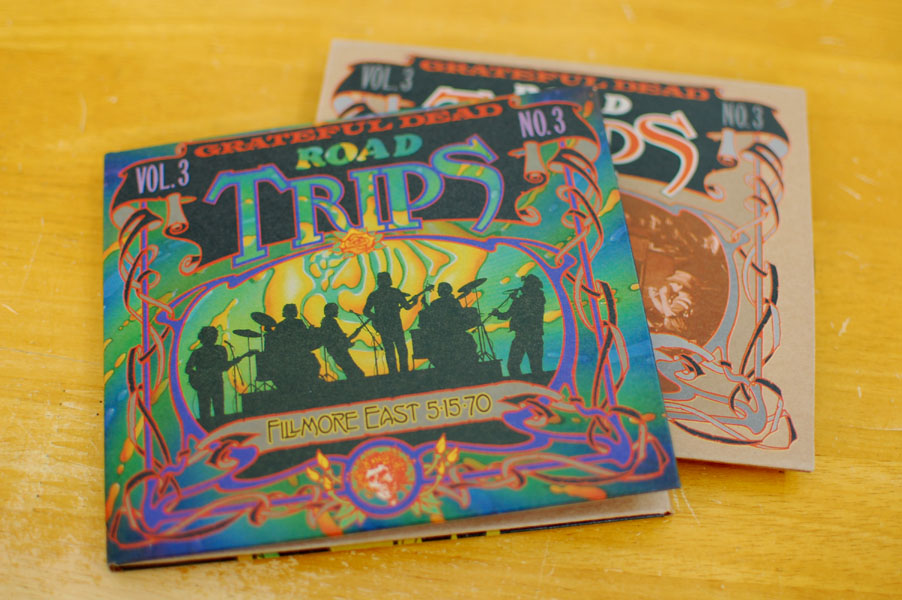
* Grateful Dead: Road Trips, Vol.3, No.3: Fillmore East 5-15-70 (GD/Rhino 3+1CD)
* Grateful Dead: Madison Square Garden, New York, NY 9-08-91 (SBD 3CDR)
* Grateful Dead: Madison Square Garden, New York, NY 9-09-91 (SBD 3CDR)
* Grateful Dead: Madison Square Garden, New York, NY 9-10-91 (SBD 3CDR)
* New Riders of the Purple Sage: Fillmore East, New York, NY 5-15-70 (SBD 2CDR)
* The Band: Rock of Ages (Capitol/MFSL SACD)
* Van Morrison: Wavelength (Polydor CD)
* Can: Soon Over Babaluma (Spoon SACD)
* Talking Heads: 77 (Sire/Warner Bros. DVD-A)
* Robert Pollard: We All Got Out of the Army (GBV, Inc. LP)
* Robert Pollard: Moses on a Snail (GBV, Inc. LP)
* Radiohead: Amnesiac (Capitol CD)
* Radiohead: “Pyramid Song” (Capitol CDEP)
* Radiohead: “Knives Out” (Capitol CDEP)
* Animal Collective: Campfire Songs (Paw-Tracks CD)
* Animal Collective: Here Comes the Indian (Paw-Tracks CD)
* Animal Collective: Sung Tongs (Fat Cat CD)

Commentary:

The new Road Trips is the first three-discer in the series (actually, four discs including the limited “bonus disc” -- more on that later). It contains most of the Grateful Dead’s epic performance at the Fillmore East on May 15, 1970, a classic show that has circulated widely in trading circles for forever. One has to ask: is it worth it? In my estimation: for a measly twenty-five bucks, yes. The sound quality is much improved, being sourced from the original vault masters and while purists may squawk about the editing decisions and the use of dynamic range compression, it is a smooth, coherent presentation of this music.

And what music! Jerry Garcia and Robert Hunter were writing whole batches of wonderful new songs that drew on their shared interest in old-time string band styles; Grateful Dead concerts were starting to sound more overtly country than outré psychedelic. By the spring of 1970, they were opening their concerts with intimate acoustic sets wherein these new songs were introduced (“Uncle John’s Band”; “Black Peter”; “Friend of the Devil”); obscure covers were given impromptu airings (“Long Black Limousine”; “The Ballad of Casey Jones”; “Silver Threads and Golden Needles”); and ending with a white gospel standard (“Cold Jordan” or “A Voice from On High”). Their touring companions, New Riders of the Purple Sage, would then play a set featuring Garcia on tangy pedal steel (!) and the Grateful Dead would conclude the evening with two more electric sets peppered with more of these tantalizing Garcia/Hunter tunes which sound like they were already a hundred years old (“Cumberland Blues”; “Dire Wolf”).

The pair were an uncannily copasetic songwriting team and the subsequent outpouring of songs came to define Garcia’s musical persona. But here Garcia is still trying to find his singing voice, affecting at times a faux-southern accent or at other times reverting to the acidized howl of the primal period. It would take another year or so for Garcia to grow into these songs. Even so, this set is a delight from beginning to end. The casual banter between the band and audience is charming and Pigpen is in fine form throughout, but especially on the concluding thirty-minute rave-up, “Turn On Your Lovelight,” hectoring the audience to “take your hands out of your pockets and do something!” while the band rages away modally behind him. Good stuff. Despite the good-timey vibe, if you listen closely you can hear the ghosts of Kent State hovering over the proceedings in the startlingly volatile outbursts of “off the pigs” and other counter-cultural rhetoric emanating from the stage from time to time. It was the ugly end of a utopian era -- and the beginning of a modern, professionalized Grateful Dead. In later years they would say almost nothing to the audience for fear of undue influence on their rabidly devoted (and possibly chemically altered) fans.

The annoyingly ultra-limited edition “bonus disc” is, of course, essential, containing six more songs from the May 15 concert, including gorgeous renditions of then-new Garcia/Hunter songs, “Candyman” and “Attics of My Life” as well as an electrifying forty-plus minutes from the previous night’s show in St. Louis. These things go out of print quickly, so if you’re interested in having the whole enchilada, you better act now. Even if the bonus discs are all gone, Road Trips Vol.3, No.3 is definitely top shelf Grateful Dead. Only available at dead.net.

It's Summertime!


Butterfly 2010-06-26a, originally uploaded by Rodger Coleman.

It's hot as heck, crazy thunderstorms arise out of nowhere, and the bugs are in abundance. That's not all bad; among the insects are magical fireflies at twilight and these iridescent indigo butterflies. This one didn't like me waving the camera at him, but this shot came out OK. Such amazing creatures, flying flowers, as evanescent as summertime.

June 20, 2010

Sun Ra Sunday

Sun Ra & His Arkestra: Slug’s Saloon, New York, NY 6-07-72 (AUD 2CDR)

When Sun Ra & his Arkestra returned to the east coast in May of 1972, they were welcomed back to Slug’s Saloon, the legendary Lower East Side nightclub where the Arkestra regularly held court from 1966 until their departure to California in 1970. But things were not the same: On February 19, trumpet star Lee Morgan was shot to death at the club by his enraged girlfriend further scaring audiences away from what was already well known as a rough neighborhood. By the summer, the club was on its last legs and would shut its doors for good shortly thereafter (see Szwed pp.218-220). So the Arkestra’s residencies at Slug’s during the summer of 1972 were both festive homecoming and sad farewell to an unusually supportive New York City venue. Fortunately for us, most of a complete set from their appearance on June 7 was recorded from the audience and circulates amongst devoted collectors. The mono tape recording sounds pretty decent for the period although it suffers from all the usual sorts of problems: generational loss, assorted glitches and drop-outs, general muddiness and, sometimes, outright distortion. If you’re willing to tolerate such anomalies, then it is well worth seeking out this spectacular performance.

While the core musicians remained faithful to Sun Ra’s vision, The Arkestra’s extended membership was, as usual, in flux. Once again left without a bassist, Alzo Wright steps in with some barely audible cello while Akh Tal Ebah replaces mainstay Kwami Hadi on trumpet, giving him an opportunity to step out from the shadow of Hadi’s showy virtuosity. For all that, the band sounds well-rehearsed and they tackle a bunch of new Ra compositions and re-arrangements with gusto. After an opening improvisation for arco cello and oboe followed by a long percussion work out, another unknown number in the “Discipline” series arises, this one fulminating with regal pomp. Moments later, another unknown title gets its first (and perhaps only) hearing: an agitated ostinato in 7/4 held together by Danny Ray Thompson’s relentless riffing on baritone sax. “They’ll Come Back” gets a dramatic vocal performance from June Tyson and ends with a brief but exquisite moment of “Strange Strings”-style orientalism. Ebah’s smeared tonality contrasts nicely with the churning skronk on “Calling Planet Earth” and, after a short statement of “Theme of the Stargazers,” “Discipline 11” is given a gospel-ish reading via spirited drumming from Lex Humphries with Ra’s aggressive organ solo pushing the band to ecstatic heights of electro-free-jazz intensity. Wow. This is a superb version of this rarely heard composition.

Another under-performed piece, “Somewhere Else,” gets an interesting (if somewhat tentative) reading here, with John Gilmore staking out the harmonic areas a cappella before the Arkestra enters with the oddly swinging, interlocking riffage. Ra takes one of his patented barbequed organ solos before Ebah attempts his own high-register acrobatic act, showing he was Hadi’s equal in terms of brilliant ideas, if not in their flawless execution. Personally, I love Ebah’s warm, mellow tone and find his blurry articulation endearingly expressive. A quick run through “Enlightenment” is followed by a typically grooving “Love in Outer Space” with Sonny rapturously vamping away on the organ throughout. Yet another unknown “Discipline” number follows, this one in the swinging big-band mold with multiple riffs colliding over swelling chords. Sadly, the tape is marred by numerous drop-outs, obscuring the composition’s subtle intricacies. As the drums devolve into more tribal sorts of rhythms, Gilmore takes a truly incendiary solo on tenor sax that gradually but insistently pushes the band towards its ultimate destination: “The Shadow World!” As the sound quality of the tape begins to improve, Sun Ra lays down the enervating chord sequence at a blindingly fast tempo. Astonishingly, the Arkestra erupts with a note-perfect rendition of this fantastically complicated composition. This inspires a tense, “mad-scientist-style” organ solo, Sun Ra spraying cluster-bombs of notes about the room with wild abandon, much to the crowd’s obvious delight. Not to be outdone, Gilmore returns with another blistering solo before the band returns with a tight reprise. Outstanding! Shifting gears, Sonny plays a pretty organ interlude over a set of melancholically descending chords which serves as an introduction to another unknown “Discipline” number. This one sets a pair of repeating, minimalist horn figures to balance atop the polyrhythmic rhythm section while Ebah blows a long-breathed, minor-key melody on top. Interesting. Danny Davis (or is it Marshall Allen?) takes flight on alto sax before a relatively brief drum solo which introduces a rare performance of “Angels and Demons at Play” in its recent bare-bones rearrangement. Unfortunately, the band still sounds unsure of itself and, after failing to coalesce, Sonny cues up “Watusi” which eschews the head for another tumultuous tenor solo from Gilmore before the extended percussion jam -- although Ebah can be heard wailing away in the background throughout. The tape cuts off shortly thereafter.

The Arkestra appeared once more at Slug’s a month later and again surreptitiously recorded from the audience (we'll take a listen to that one next time). Both of these gigs have been compiled into a six-disc box set by the Transparency label, purportedly with improved sound and approximately thirty minutes of additional material, but I have not heard it and do not know anyone who has. Can anyone out there in Internetland comment on this? These performances are so good I would gladly pay for an improved mastering of these recordings. Until then, I’m happy to have these widely-circulated “bootlegs,” despite their obvious flaws.

June 19, 2010

Playlist Week of 6-19-10

* Vivaldi: Double Violin Concertos (VBO/Marcon/Carmignola/Mullova) (Archiv Prod. CD)
* Geminiani: Cello Sonatas, Op.5 (ter Linden/Mortensen) (Brilliant Classics CD)
* Handel: Solo Sonatas, Op.1 (AAM/Egarr) (d.1) (Harmonia Mundi 2CD)
* Handel: Trio Sonatas, Op.2 & Op.5 (AAM/Egarr) (Hamonia Mundi 2CD)
* J.S. Bach: Das Wohltemperierte Clavier, Vol.2 (Egarr) (Harmonia Mundi 2CD)
* Schoenberg: String Quartets (Arditti) (d.2) (Montaigne/Naïve 2CD)
* Sun Ra: Slug’s Saloon, New York, NY 6-07-72 (AUD 2CDR)
* Sun Ra: Strange Celestial Road (Rounder CD)
* Grant Green: Idle Moments (Blue Note CD)
* Grant Green: The Complete Quartets with Sonny Clark (Blue Note 2CD)
* Herbie Hancock: Thrust (Columbia CD)
* Herbie Hancock: Arena Santa Giuliana, Perugia, Italy 7-16-08 (FM 2CDR)
* Evan Parker Electro-Acoustic Ensemble: The Moment’s Energy (ECM CD)
* Shine: Heaven and Hell (Innerrhythmic CD)
* Kip Hanrahan: Days and Nights of Blue Luck Inverted (American Clavé/Pangaea CD)
* Kip Hanrahan: Exotica (American Clavé CD)
* Olu Dara: In the World: From Natchez to New York (Atlantic CD)
* Bob Dylan: Bringing It All Back Home (mono) (Columbia/Sundazed LP)
* Bob Dylan: Highway 61 Revisited (mono) (Columbia/Sundazed LP)
* Bob Dylan: Infidels (Columbia SACD)
* Grateful Dead: Winterland June 1977: The Complete Recordings (6-8-77) (GD/Rhino 9+1CD)
* Grateful Dead: The Horizon, Rosemont, IL 3-10-93 (SBD 3CDR)
* Grateful Dead: The Horizon, Rosemont, IL 3-11-93 (SBD 3CDR)
* King Crimson: The Great Deceiver (Live 1973-1974) (d.1) (DGM 4CD)
* U2: The Unforgettable Fire (Deluxe Edition) (d.1) (Island/Universal 2CD)
* Robert Pollard: Moses on a Snail (GBV, Inc. LP/CD)
* Animal Collective: Spirit They’re Gone…/Danse Manatee (Fat Cat - UK 2CD)
* Animal Collective: Strawberry Jam (Domino CD)
* Animal Collective: Water Curses (Domino CDEP)
* Animal Collective: Merriweather Post Pavilion (Domino CD)
* Animal Collective: Fall Be Kind (Domino CDEP)

Commentary:

Robert Pollard’s umpteenth solo album is (despite its cheesy cover) an undeniable late-career triumph. As you know, I’m a huge fan and love to obsessively collect the endless stream of records the guy puts out. But regular folks are likely put off by the sheer volume of releases and unlikely to even stick a toe in the ever-expanding discography (especially with a cover like that). So it’s too bad that Moses on a Snail will likely not be heard by the huge numbers of people out there who would undoubtedly enjoy Pollard’s mature song-craft. At age 52, Pollard still believes in the redemptive power of rock music and, with longtime collaborator Todd Tobias, has just released his most immediately enjoyable album since 2008’s Off to Business. (That was, by the way, several albums ago.)

Sure, Pollard can’t hit the high notes the way he used to with Guided By Voices, but his voice remains an instrument of vast and subtle range, from a cockney-esque drawl to blue-eyed crooning; from strutting rock godhead to frail, vulnerable folkie to every other musical persona imaginable. Yet Pollard always sounds like his own inimitable self, singer and song united in a convincingly charismatic whole. And here Pollard delivers one of his most focused and impassioned vocal performances in ages. The songwriting is also consistently compelling with the typically elliptical lyrics conveying an unusually somber tone. Meanwhile, Tobias’s deft multi-instrumentalism and layered production style provides slickly polished yet respectfully weighty musical settings perfectly tailored to each song, contributing to the album’s beginning-to-end coherence. From the stately, strummy opener (“The Weekly Crow”) to the conclusion of the epic, hard-rocking title track, Tobias consistently demonstrates a profound sensitivity to Pollard’s uniquely quirky musical vision as well as a mastery of the art of record-making. Tobias has, over time, become Pollard’s most perfect amanuensis.

Not due in stores until next Tuesday, my copy arrived in the mail yesterday and (in an unusual move for me) I’ve been listening to it over and over ever since. It’s just that good! Thankfully the LP comes with a free copy of the CD or I would be relentlessly wearing away the grooves of the limited edition vinyl. Moses on a Snail is an instant classic (never mind the cover).

+++

Re: Animal Collective. It took a while, but I get it now. That means I have to hear the rest of it. Fun!

Pileated Woodpecker (mother feeding juvenile)

This isn't the sharpest photograph ever, but today I was lucky to catch a mother Pileated woodpecker feeding some of our suet to her young. Such amazing birds! It makes me happy to see them thriving in our back yard.

June 13, 2010

Sun Ra Sunday

THE SHADOW OF THE FIRE

The vibrations of the sounds seem the same
But the meaning of the sounds
Take separate directions
At the crossroads
of the Cosmic point of the arrow…
Beyond this Age
Through the darkness of the light years
And the light years of the darkness
And the pure darkness of the pure light.
The light is as the darkness
Because the light is the image
And the shadow of the fire.

-- Sun Ra

June 12, 2010

Playlist Week of 6-12-10

* Buxtehude: Sonatas, Op.1 (Holloway/Mortensen/ter Linden) (Naxos CD)
* J.S. Bach: Das Wohltemperierte Clavier, Vol.1 (Egarr) (Harmonia Mundi 2CD)
* Vivaldi: Violin Concertos, RV331, etc. (VBO/Marcon/Carmignola) (Archiv Prod. CD)
* Duke Ellington: The Great Paris Concert (Atlantic 2LP)
* Sun Ra: Astro Black (ABC/Impulse! LP>CDR)
* Bobby Hutcherson: Happenings (Blue Note CD)
* Evan Parker Electro-Acoustic Ensemble: Stadtgarten, Köln 5-13-10 (AUD 2CDR)
* Evan Parker Electro-Acoustic Ensemble: WDR, Bismarck-Saal, Köln 5-14-10 (AUD CDR)
* Herbie Hancock: Sextant (Columbia CD)
* Herbie Hancock & Headhunters: Sendsaal, Bremen, W. Germany 11-6-74 (FM CDR)
* Pat Metheny Group: The Road to You (Geffen CD)
* Sly & The Family Stone: A Whole New Thing (Epic/Sundazed LP)
* Bob Dylan: The Times They Are A-Changin’ (mono) (Columbia/Sundazed LP)
* Bob Dylan: Another Side of Bob Dylan (mono) (Columbia/Sundazed LP)
* Bob Dylan: The Freewheelin’ Bob Dylan (mono) (Columbia/Sundazed LP)
* Jeff Beck: Truth (mono) (Epic/Sundazed LP)
* Jeff Beck: Beck-Ola (Epic/Sundazed LP)
* The Who: Who’s Next? (Decca LP)
* The Who: Who Are You? (Polydor/Classic LP)
* Grateful Dead: Winterland June 1977: The Complete Recordings (6/7/77) (GD/Rhino 9+1CD)
* Jerry Garcia Band: After Midnight: Kean College 2/28/80 (Rhino 3CD)
* Yes: The Yes Album (Atlantic/MSFL CD)
* Yes: Fragile (Atlantic/MFSL CD)
* Genesis: Selling England By the Pound (Charisma LP)
* Can: Unlimited Edition (Spoon SACD)
* Saturday Night Fever (original soundtrack) (RSO/Polydor 2LP)
* Big Star: Radio City (Ardent/Classic LP)
* Boston: Boston (Epic LP)
* The Feelies: The Good Earth (Coyote LP)
* Los Lobos: Kiko (Slash/Warner Bros. CD)
* Guided By Voices: Do the Collapse (TVT CD)
* Robert Pollard: Motel of Fools (Fading Captain EP)
* Robert Pollard: Robert Pollard Is Off to Business (GBV, Inc. CD)
* Robert Pollard: “Weatherman and Skin Goddess” (GBV, Inc. CDEP)
* Circus Devils: Ringworm Interiors (Fading Captain Series LP)
* Radiohead: I Might Be Wrong: Live Recordings (Capitol CD)
* Animal Collective: Merriweather Post Pavilion (Domino CD)
* Animal Collective: Fall Be Kind (Domino CDEP)

Reading:

* Roger Scruton, The Aesthetics of Music (Oxford University Press, 1997)

After several previous failed attempts, I finally got through Roger Scruton’s monumentally ambitious The Aesthetics of Music. I can’t really say it was worth the effort. While Scruton makes some interesting observations and comes to some plausible conclusions as to why human beings respond to (certain kinds of) music in the way they (sometimes) do, he undermines an otherwise noble enterprise with a not-so-hidden ulterior motive: the needless rescue of “tonality” and so-called “classical” music from the presumed barbarism of a decadent modern culture. Uh-oh.

He gives the game away from outset by defining what we hear as music is the “transformation of sounds into tones” (p.17). This appears at first a useful definition; but by choosing the word “tone” upon which to build his aesthetics, he then embarks on a philosophical jeremiad against “atonality” (with sneering jibes at “post-modernism,” “pop music” and “Heavy Metal” thrown in for good measure). It seems to me that any comprehensive aesthetic of music would have to account for the widest possible range of musical experiences to be at all insightful. For even though I may not personally like a particular genre or style of music, there remain fundamental standards of “good” and “bad” within such genres or styles and the reason this is so should be the true subject of a musical aesthetics.

Elsewhere, Scruton is more useful. He confronts the ineffable immateriality of music by admitting that “the intentional object of musical perception [] can be identified only through metaphors” (p.108) which allude to the essentially “pure abstract quality” of music (p.122). This is suggestive of the reasons why music is so nutritive to the human spirit -- and so very difficult to write about. “Music inspires and consoles us partly because it is unencumbered by the debris that drifts through the world of life” (Id). Scruton thoroughly demonstrates that music is like “language” only in a strictly metaphorical sense since it lacks any representational ability. Music is always only about itself. Not even Scruton's beloved functional harmony can produce a generative syntax understandable as language. Accordingly, tonal harmony is not a strictly prescriptive grammar but a set of crudely-wrought tools, a certain traditional way of putting music together. But Scruton goes further and insists that this is the only way truly meaningful music can be put together and here his aesthetics veers off into sad polemic and unadulterated snobbery.

He graciously honors the importance of Schoenberg and the Second Viennese School and offers a grudging respect for certain quasi-tonal works such as Berg’s Violin Concerto; but he summarily concludes that the “serialism” of Boulez is utterly unintelligible except by “incorporating what we hear into tonal or quasi-tonal categories” (p.294) and “eliciting the ghost of a tonal order” (p.296) while we listen. He goes on to assert: “The possibility remains that tonal music is the only music that will ever really mean anything to us, and that, if atonal music sometimes gains a hearing, it is because we can elicit within it a latent tonal order” (p.308). Hogwash! This is contrary to my own experience and is further evidence of Scruton’s ideological agenda. Any attempt to mentally impose “a tonal order” upon atonal music is an exercise in frustration and will result in the kind of learned revulsion Scruton feels for Boulez, Stockhausen, Babbitt and the like. This is, of course, the desired result. Scruton refuses to accept that anyone can find musical meaning in these composers’ works and triumphantly declares: “[a]tonal music proved unable either to find an audience or to create one” (p.507). The audience for such music might be small, but it persists.

He has nice things to say about jazz but only to the extent that it serves to bolster tonality’s primacy, while conveniently ignoring its African roots and the “atonal” developments of Cecil Taylor and his ilk. And by the time he starts comparing the “ugliness” of Nirvana to the clever harmonies of The Beatles and the “shapeless cries” of REM to the rounded cadences of Cole Porter, well, it just gets silly:

[M]usic is a character-forming force, and the decline of musical taste a decline in morals. The anomie of Nirvana and REM is the anomie of its listeners. To withhold all judgment, as though taste in music were on a par with a taste in ice-cream, is precisely not to understand the power of music (p.502).
Even if we are to grant Scruton’s contention that “taste in music matters and that the search for objective musical values is one part of our search for the right way to live” (p.391), it does not follow that joining in his crusade to rescue classical music from the bogeymen of (post)modernism is “the right way to live.” He concludes the book with an exhortation to embark on “the great task…of recovering tonality as the imagined space of music, and of restoring the spiritual community with which that space was filled…a rediscovery of the tonal language, which will also redeem the time” (pp.507-508). As far as I can tell, tonality needs no such saving. What is needed is an aesthetic of music that can account for the infinity of its instances. Indeed John Cage demonstrated that even unintentional sounds can be heard as music without being “transformed into tones” as Scruton would, for ideological reasons, insist. This profound cognitive ability is what enables us to ascribe meaning to music of all kinds but Scruton’s tome ultimately fails to elucidate what this meaning might be or why we should care. What a waste.

June 6, 2010

Sun Ra Sunday

Sun Ra: Astro Black (ABC/Impulse! LP)

According to the jacket of Astro Black, Sun Ra’s first new recording for ABC/Impulse! was made at “El Saturn Studio” in Chicago on May 7, 1972, but that date is questionable since the Arkestra was just leaving California in May -- and the studio name is “strictly mythic” (Campbell & Trent p.186) Whatever the date or actual location, it was clearly made in a professional recording studio as the sound quality is exceptionally good. Sun Ra was obviously determined to take advantage of the mass exposure a major label could bring, producing one his finest albums. Notably, Ronnie Boykins makes a welcome return on bass after a long absence and he is prominently featured here, driving the band to great heights. The Arkestra is augmented with both Akh Tal Ebah and Kwami Hadi on trumpets, Charles Stephens on trombone, Alzo Wright on violin and viola, along with several conga players, who give much of this record its avant-exotica feel. But Boykins’s clearly inspires Sonny and his fluent explorations on organ and synthesizer throughout the album demonstrate a consummate mastery of electronic instruments. Astro Black is, in my opinion, one of Sun Ra’s crowning recorded achievements.

A radical re-arrangement of the title piece opens the album with June Tyson’s lugubrious singing supported by Sun Ra’s swooshing synthesizers, a pointillist horn chart, and Boykins’s stuttering bass groove. After the vocals subside, a thoughtful improvisation follows featuring a woozy synth duetting with Boykins on the bow, the horns eventually entering with some energetic episodes of free jazz blowing. After a few minutes of controlled chaos, Tyson reprises the lyrics and Sonny ends the piece with more spacey synthesizer noises while Boykins continues to saw away in the uppermost registers of his instrument. Nice. A brief rendition of “Discipline 99” again demonstrates Boykins’s ability to provide a rock-solid rhythmic and harmonic foundation on this obliquely swinging composition. Ra provides some glistening, tremulous vibraphone and the ensemble sounds tight and well-rehearsed with individual soloing kept to a minimum, thereby turning in a note-perfect reading. Boykins again leads the way on “Hidden Spheres,” spinning endlessly inventive variations on the hypnotic three-note ostinato over the percussionists’ simmering, semi-exotic groove. On top of all this, John Gilmore contributes a pithy but harmonically adventurous statement on tenor saxophone before Hadi’s wide-ranging trumpet solo and Eloe Omoe’s honking bass clarinet which concludes the piece.

All of side two is taken up with a nearly twenty-minute conducted improvisation entitled, “The Cosmo Fire,” which ranks up there with the other great long-form pieces in the discography such as “Other Planes of There,” “The Magic City” and “Atlantis.” While only loosely structured, Ra is totally in control, directing the band from behind his bank of “mad scientist” keyboards, signaling space chords and drawing out various sub-ensembles that come together and mutate while soloists enter and exit at his command. This extended piece is not as overtly episodic as the aforementioned previous experiments and instead builds up a cumulative momentum with Marshall Allen’s delightfully quacking and squealing oboe an almost constant presence within the restlessly shifting instrumental textures. The oboe is not an instrument you hear much in jazz except for Marshall Allen and here he distantly evokes the ancient Middle Eastern nay amidst all the cosmic afro-futurism and “out jazz” blowing. Allen is an underappreciated virtuoso on this difficult, rarely heard instrument. And again, Ronnie Boykins’s inimitable bass anchors the proceedings with an effortless élan which allows the rest of the band to freely take flight. Really, Boykins’s playing on this album is quite remarkable -- even for him -- and his unifying effect on the band is obvious and thrilling. Too bad he could not commit himself full time to Sun Ra.

It’s also too bad that, within three years, the purportedly “lucrative” deal with ABC/Impulse! went sour and the label unceremoniously dropped Sun Ra from the roster and promptly deleted all the albums (which included a number of reissued Saturn titles). To add insult to injury, Astro Black has never been re-issued on CD or otherwise, despite the label’s continued exploitation of other perhaps less-worthy “New Thing” titles in its catalog. It boggles the mind that this classic album is still out of print. Accordingly, original copies in good condition are extremely hard to find and fetch astronomical sums from collectors. That is really a shame as it truly is one of the finest records in Sun Ra’s discography.

June 5, 2010

Playlist Week of 6-05-10 (Happy Anniversary!)

* Benjamin Alard (solo harpsichord): Radio Classica, Barcelona 5-11-09 (FM CDR)
* Concerto Madrigalesco (Guglielmi): Mozartsaal, Konzerthaus, Wien 1-21-10 (FM CDR)
* Baroque Fever: St. John’s, Smith Square, London 5-15-10 (FM CDR)
* Venice Baroque Orchestra (Marcon/Carmignola): Victoria Hall, Genève 2-28-08 (FM 2CDR)
* Messiaen: Réveil des oiseaux, etc. (Orch. Nat. de France/Nagano/Loriod) (Erato CD)
* Lachenmann: NUN/Notturno (WDR Sinfonieorchester Köln, et al.) (Kairos CD)
* Duke Ellington: The Pianist (Fantasy LP)
* Duke Ellington: The Intimate Ellington (Pablo LP)
* John Patton: Boogaloo (Blue Note CD)
* John Patton: Understanding (Blue Note CD)
* Jackie McLean: One Step Beyond (Blue Note CD)
* Jackie McLean: New and Old Gospel (Blue Note CD)
* Sun Ra: Astro Black (Impulse! LP>CDR)
* Henry Threadgill & Make a Move: Everybody’s Mouth’s a Book (Pi CD)
* Henry Threadgill’s Zooid: Up Popped Two Lips (Pi CD)
* David Torn: Cloud About Mercury (ECM CD)
* Pat Metheny Group: Imaginary Day (Warner Bros. DVD-A)
* Bill Frisell: Gone, Just Like a Train (Nonesuch CD)
* Marc Johnson: The Sound of Summer Running (Verve CD)
* Shin Terai: Unison (Ion CD)
* Hip Hanrahan: Vertical’s Currency (American Clavé LP)
* Bob Marley & The Wailers: The Complete Wailers 1967-1972 (Pt.III) (d.1) (JAD 2CD)
* Nuggets: Original Artyfacts from the First Psychedelic Era 1965-1968 (d.4) (Rhino 4CD)
* Frank Zappa: Waka/Jawaka (Bizarre/Reprise LP)
* Grateful Dead: Dick’s Picks Vol.8: Harpur College 5-2-70 (GDM 3CD)
* Grateful Dead: Steppin’ Out With the Grateful Dead: England ’72 (d.3) (GD/Arista 4CD)
* Grateful Dead: Dick’s Picks Vol.31 (August, 1974) (d.4) (GDM 4CD)
* Grateful Dead: Copps Coliseum, Hamilton, Ontario 3-21-90 (SBD 3CDR)
* Grateful Dead: Copps Coliseum, Hamilton, Ontario 3-22-90 (SBD 2CDR)
* David Crosby: If Only I Could Remember My Name (Atlantic DVD-A)
* Planet Earth Rock and Roll Orchestra: Wally Heider Studios 1970-1971 (fan/boot 2CDR)
* Big Star: #1 Record (Ardent/Classic LP)
* Wilco: (the album) (Nonesuch CD)
* Jim O’Rourke: Insignificance (Drag City LP)
* Robert Pollard & His Soft Rock Serenaders: Choreographed Man of War (FCS LP)
* Circus Devils: Mother Skinny (Happy Jack Rock Records CD)
* Cobra Strike: The 13th Scroll (Ion CD)
* Tortoise: It’s All Around You (Thrill Jockey LP)
* The Flaming Lips: At War With the Mystics 5.1 (stereo) (Warner Bros. DVD-A)
* The Flaming Lips: Embryonic (Warner Bros. DVD-A)

Commentary:

Sixteen years ago today, Elizabeth and I were married in a small garden ceremony at her grandmother’s house in Santa Ana, California. It was a happy, happy day as our families came together through marriage. And we had a fun honeymoon traveling up the coast to San Francisco (with a detour to not-so-scenic Sacramento to see the Grateful Dead at Cal Expo). After all these years, I remain deliriously in love with my wife and feel like the luckiest guy in the world to be married to this beautiful, amazing woman. We’ve had a wonderful life together and I look forward to many more years to come. To celebrate our anniversary, we’re going to go out to dinner at an exquisite little restaurant located right here in Kingston Springs called Mack & Kates, It should be delicious. Happy Anniversary, Liz!

May 30, 2010

Sun Ra Sunday

I’m taking a break for the holiday weekend -- and so should you. Instead of reading my rambling drivel, have a listen to the man himself in this brief interview from WTZA-TV 62 which was aired to promote the Arkestra’s appearance at The Getaway in Saugerties, New York on June 13, 1986. Note that the death of Bennie Goodman, “The King of Swing,” is announced right after Ra’s segment.

May 29, 2010

Playlist Week of 5-29-10

* Vivaldi: Late Violin Concertos, RV177, etc. (VBO/Marcon/Carmignola) (Sony Classical CD)
* Vivaldi: Late Violin Concertos, RV386, etc. (VBO/Marcon/Carmignola) (Sony Classical CD)
* Duke Ellington: Ellington Uptown (Columbia LP)
* Herbie Nichols: The Complete Blue Note Recordings (d.2) (Blue Note 3CD)
* Horace Silver Quintet: Song for My Father (Blue Note LP)
* Freddie Redd Quartet: Music from the Connection (Blue Note LP)
* Eric Dolphy: Out to Lunch (Blue Note/Music Matters 2-45RPM)
* Jackie McLean: Destination Out! (Blue Note LP)
* Bobby Hutcherson: Patterns (Blue Note LP)
* Bobby Hutcherson: Components (Blue Note LP)
* Sun Ra: Unknown venue, Berkeley, Ca circa.1972 (SBD CDR)
* Sun Ra: Astro Black (Impulse! LP>CDR)
* Ornette Coleman: Virgin Beauty (Columbia/Portrait LP)
* Anthony Braxton Small Ensemble: Wesleyan University 4-23-10 (AUD CDR)
* Anthony Braxton Large Ensemble: Wesleyan University 4-29-10 (AUD 2CDR)
* Mahavishnu Orchestra: Century Theatre, Buffalo, NY 1-27-73 (Pre-FM 2CDR)
* Kip Hanrahan: Desire Develops an Edge (American Clavé 2LP)
* Bob Marley & The Wailers: The Complete Wailers 1967-1972 Pt.II (d.3) (JAD 3CD)
* The Mothers of Invention: The Grand Wazoo (Bizarre/Reprise LP)
* Pink Floyd: The Dark Side of the Moon (Capitol/EMI SACD)
* Grateful Dead: Boston Garden, Boston, MA 9-24-93 (SBD 3CDR)
* Grateful Dead: Boston Garden, Boston, MA 9-25-93 (SBD 3CDR)
* Grateful Dead: Boston Garden, Boston, MA 9-29-93 (SBD 3CDR)
* Grateful Dead: Boston Garden, Boston, MA 9-30-93 (SBD 3CDR)
* Love: Forever Changes (Elektra/Rhino CD)
* The Feelies: Crazy Rhythms (Stiff LP)
* The Flaming Lips, et al.: The Dark Side of the Moon (Warner Bros. CD)
* Robert Pollard: We All Got Out of the Army (GBV, Inc. CD)
* Tortoise: Beacons of Ancestorship (Thrill Jockey LP)

Commentary:

The idea of The Flaming Lips remaking Pink Floyd’s iconic Dark Side of the Moon seems preposterous at first. But then again, when I saw the Lips for the very first time back in 1986 at Molly’s in Allston, Massachusetts, they earnestly plowed through The Who’s Tommy in the middle of their set. Further, various oddball covers litter their discography, including a note-perfect rendition of Queen’s “Bohemian Rhapsody” (which can be found on the At War With the Mystics 5.1 CD/DVD-A). So, the idea is not so far-fetched after all. And if you are at all familiar with this classic album and are a fan of The Flaming Lips, then their take on it will certainly be of interest. Assisted by Star Death and White Dwarfs, Henry Rollins (who handles the speaking parts), and Peaches (who provides a disturbingly uncanny impersonation of Clare Torry’s orgasmic wail on “The Great Gig in the Sky”), the approach is surprisingly sincere and un-ironic. Fortunately, they do not attempt an exact recreation the album and instead re-imagine it in a post-punk style while still evincing a genuine love for the original. But it seems to me a similar affection for The Dark Side of the Moon is necessary to really appreciate this, to get the joke as it were. While it has been a lot of fun for me to listen to, your mileage may vary considerably.